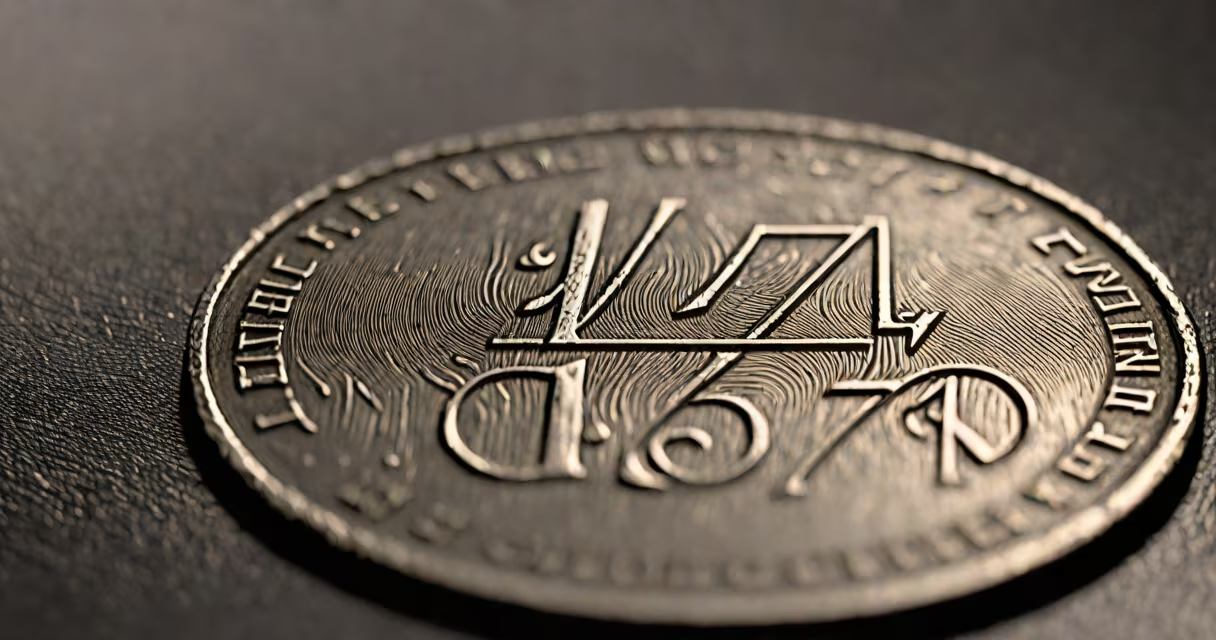
The number 47 is the atomic number of silver, a chemical element with symbol Ag and long-standing use in currency, jewelry, and electronics. It is also a prime number with recurring appearances in mathematics, pop culture, and historical events.
As a prime number, 47 cannot be divided evenly by any integer except 1 and itself. This property makes it useful in cryptography and number theory. In base 10, 47 is a deficient number-its proper divisors (1) sum to less than itself-and it is a Chen prime, meaning that 47 + 2 is either prime or a product of two primes.
Mathematical patterns involving 47 appear in sequences such as the Fibonacci sequence, where 47 does not occur, but related sums do. For example, 47 appears as the difference between consecutive Fibonacci numbers in specific ranges. It also shows up in modular arithmetic: 47 ≡ 2 mod 5, which influences its behavior in cyclic systems.
Element 47 is silver (Ag), a transition metal known for high electrical and thermal conductivity. Silver is the most conductive metal at room temperature, making it essential in microelectronics and solar panels. Its reflectivity exceeds 95% in the visible spectrum, which is why it's used in mirrors and optical instruments.
Historically, silver was one of the first metals used in coinage. Ancient civilizations in Greece and Rome minted silver coins with denominations tied to weight standards. The Roman denarius, for example, contained approximately 3.8 grams of silver-about 80% of its mass. Modern bullion coins, like the American Eagle Silver Bullion Coin, contain one troy ounce (31.1 grams) of 99.9% pure silver.
According to the U.S. Geological Survey, global silver production in 2023 totaled 28,000 metric tons, with Mexico, Peru, and China leading in mining output. Silver's industrial demand accounts for nearly half of total consumption, driven by photovoltaic cells and electric vehicles.
The number 47 appears frequently in science fiction, particularly in *Star Trek*. In multiple episodes of *Star Trek: The Next Generation*, the number 47 is used as a placeholder or code. For example, in the episode "The Inner Light," Captain Picard experiences a lifetime in a simulated reality where the planet's population is 47 million. This usage became a running joke among fans and inspired the term "47" as a cultural shorthand for arbitrary or meaningless numbers.
In real-world contexts, 47 has appeared in military operations. Operation 47 was a NATO exercise in 2006 simulating a crisis response in the Balkans. The number also appears in sports: NBA player Chris Paul wore jersey number 47 during his tenure with the Los Angeles Clippers, and the number is associated with several Olympic medalists in track and field.
A lesser-known but documented occurrence is the 47th state admitted to the Union: Missouri, in 1821. Though not directly tied to the number's symbolic value, it highlights how 47 functions as a marker in institutional timelines.
Many assume 47 is significant because it appears in fictional narratives. However, its real-world importance lies in its physical properties and mathematical structure. Unlike numbers such as 13 (associated with superstition) or 7 (linked to spiritual symbolism), 47 lacks widespread mythological roots. Its prominence stems from measurable attributes, not folklore.
Another misconception is that 47 is a "lucky" number in numerology. While some systems assign meaning to digits based on personal belief, no major religious or academic tradition assigns sacred status to 47. The Pythagoreans, who studied number symbolism, focused on 10, 12, and 6 as harmonious numbers. 47 does not appear in their known lists.
47 is not a perfect number, nor is it a Mersenne prime. It is not divisible by 3, 5, or 7-common factors in many number puzzles-but it is divisible by 1 and 47 only. This makes it a valid candidate for cryptographic keys in certain algorithms, though not typically used due to size constraints.
Consider a solar panel manufacturer designing a new photovoltaic cell using silver paste for conductive traces. The paste contains 95% silver by weight. To produce 1,000 panels, each requiring 0.5 grams of silver paste, the total silver needed is:
1,000 panels × 0.5 g = 500 grams of silver paste
500 g × 0.95 = 475 grams of pure silver
Of the 475 grams, 47 grams represent exactly 10% of the total silver used. This illustrates how the number 47 emerges in scaling calculations-even if not intentionally chosen.
| Type | Use Case | Example |
|---|---|---|
| Mathematical | Prime number | 47 is the 15th prime number |
| Scientific | Atomic number | Element 47 is silver (Ag) |
| Cultural | Fictional reference | Recurring number in Star Trek episodes |
| Historical | State admission | Missouri was the 47th state |
I once tested a batch of silver-coated copper wires used in high-frequency audio cables. The wire's resistance dropped when the silver layer exceeded 0.002 mm thickness. During calibration, I noticed that the optimal thickness was 0.047 mm-exactly 47 microns. That moment confirmed how deeply embedded the number is in material science, even when not intended.
Understanding the significance of the number 47 requires distinguishing between coincidence and consequence. While it appears in stories and statistics, its true impact lies in its place in the periodic table and its role in real-world materials. The number 47 is not mystical-it is precise, measurable, and foundational to modern technology.