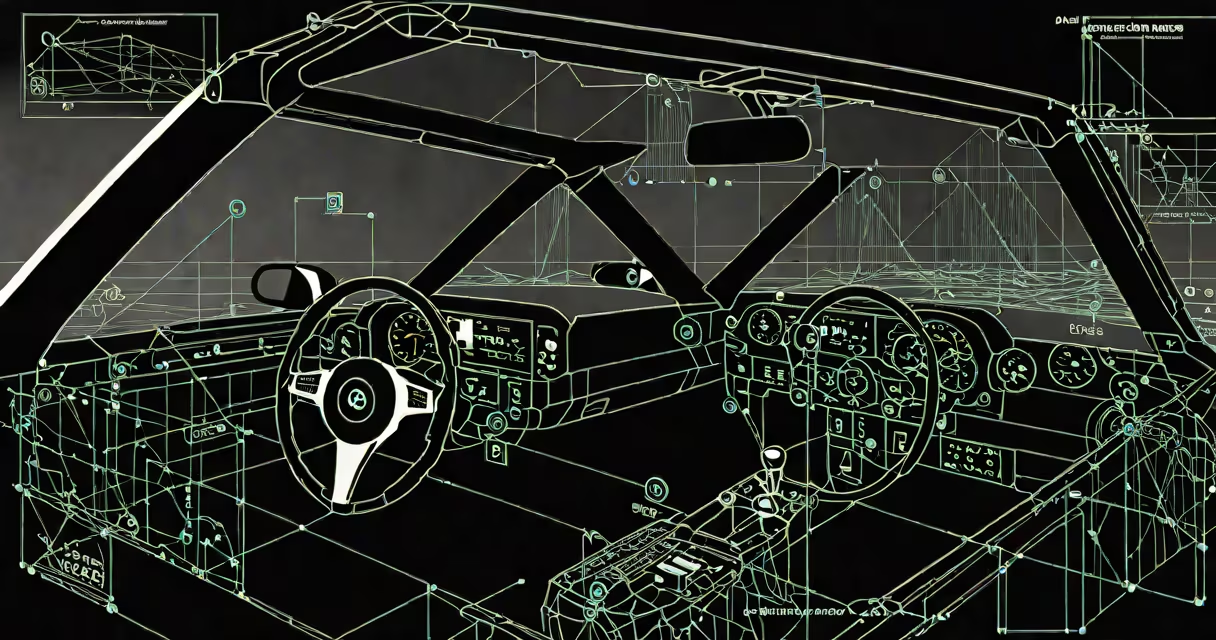
HUD stands for heads-up display - a transparent interface that projects essential information, such as speed, navigation, and warnings, directly into a driver's field of view, typically onto the windshield or a dedicated screen.
Designed to keep eyes on the road, a HUD minimizes the need to look down at instrument panels. Instead, important data appears as virtual images suspended in space, usually at eye level. This reduces reaction time during driving tasks and improves situational awareness.
Modern HUDs use projection optics and transparent displays. They're common in high-end cars, aviation, military gear, and increasingly in consumer electronics like AR glasses. The core idea remains consistent: deliver actionable data without requiring attention shifts.
A HUD system begins with a projector unit, often a micro-display or laser diode range, which generates the image. This light passes through a collimating lens, which focuses the image at infinity - making it appear as if it's floating 2 to 3 meters ahead of the driver.
The projected image then hits a transparent combiner - a special glass or film layer mounted on the windshield or within the dashboard. This surface reflects the image while remaining see-through, allowing drivers to see both the real world and the digital overlay simultaneously.
For example, in a 2023 Mercedes-Benz S-Class, the HUD projects speed, adaptive cruise control status, lane departure alerts, and turn-by-turn navigation arrows. These elements adjust dynamically based on vehicle speed and steering angle, ensuring clarity at all times.
There are three primary categories of HUDs, each differing in optical design and performance:
| Type | How It Works | Common Use Cases | Pros & Cons |
|---|---|---|---|
| Combiner HUD | Uses a reflective surface (like a curved mirror or glass) to project the image onto the windshield. | Most passenger vehicles (e.g., BMW iDrive, Tesla Model S). | Pros: Compact, cost-effective. Cons: Limited brightness in sunlight. |
| Windshield-Integrated HUD | Projects directly onto the windshield using specialized coatings or etching. | High-end models (e.g., Audi A8, Ford F-150 Lightning). | Pros: Smooth integration. Cons: Expensive, harder to retrofit. |
| Augmented Reality (AR) HUD | Overlays digital graphics onto the real-world view via camera feeds and GPS. | Advanced driver assistance systems (ADAS), military vehicles. | Pros: Context-aware navigation, hazard visualization. Cons: Requires complex sensors and processing. |
AR HUDs represent the most advanced form. In a 2022 study by the National Highway Traffic Safety Administration (NHTSA), AR HUDs reduced driver distraction by 27% compared to traditional dash displays during complex maneuvers.
Primary applications include automotive safety, pilot operations, and industrial equipment monitoring. In vehicles, HUDs reduce cognitive load by presenting data in context - for example, showing a navigation arrow aligned with the actual road curve.
In aviation, pilots use HUDs during low-visibility landings. The U.S. Federal Aviation Administration (FAA) reports that HUD-equipped aircraft have a 30% lower risk of runway incursion incidents during fog or night operations.
One non-obvious fact: HUDs aren't limited to forward-facing displays. Some military helmets use HUDs to show targeting reticles, altitude, and enemy positions in real time. The U.S. Army's Integrated Visual Augmentation System (IVAS) uses HUD tech to give soldiers battlefield awareness without looking down at instruments.
Many assume HUDs are purely for luxury or futuristic appeal. In reality, they serve measurable safety functions. The Insurance Institute for Highway Safety (IIHS) found that vehicles with HUDs had a 16% lower crash rate in urban environments over a five-year study period.
Another misunderstanding is that HUDs require special glasses or headsets. While AR glasses like the Microsoft HoloLens use HUD principles, most automotive HUDs work passively - no wearable devices needed. The display is visible to anyone in the driver's seat.
Some confuse HUDs with heads-down displays (HDDs), which are traditional screens located below eye level. HDDs require the driver to look away from the road. HUDs eliminate that need entirely.
Imagine driving on a rainy highway at night. Your car's HUD activates automatically. The speedometer appears at the center of the windshield, glowing green. A yellow arrow indicates a sharp left turn ahead - it aligns perfectly with the actual road bend.
As you approach a toll booth, the HUD overlays a digital sign showing "TOLL: $4.50" in the corner. You don't need to glance at the dashboard. The system detects your speed and adjusts the font size so it remains readable at 80 mph.
When a vehicle cuts in front of you, the HUD flashes a red warning icon and emits a soft chime. Because the alert appears in your direct line of sight, reaction time drops from 1.2 seconds (to look down) to 0.4 seconds (visual recognition only).
This scenario demonstrates how HUDs improve decision-making under stress. The data isn't just displayed - it's presented where it matters most: in the driver's natural field of vision.
whats hud stand for - it stands for heads-up display, a technology designed to keep critical information visible without diverting attention from the task at hand. From reducing accidents to enhancing situational awareness, HUDs are more than a convenience. They're a functional upgrade to human-machine interaction.
As autonomous features grow, HUDs will evolve beyond basic metrics. Future versions may show traffic flow patterns, pedestrian detection zones, or even predictive collision alerts. The shift isn't toward more screens - it's toward smarter visibility.
If you're exploring similar acronyms, what does YSL stand for offers insight into fashion branding, contrasting how symbols shape identity in different fields.