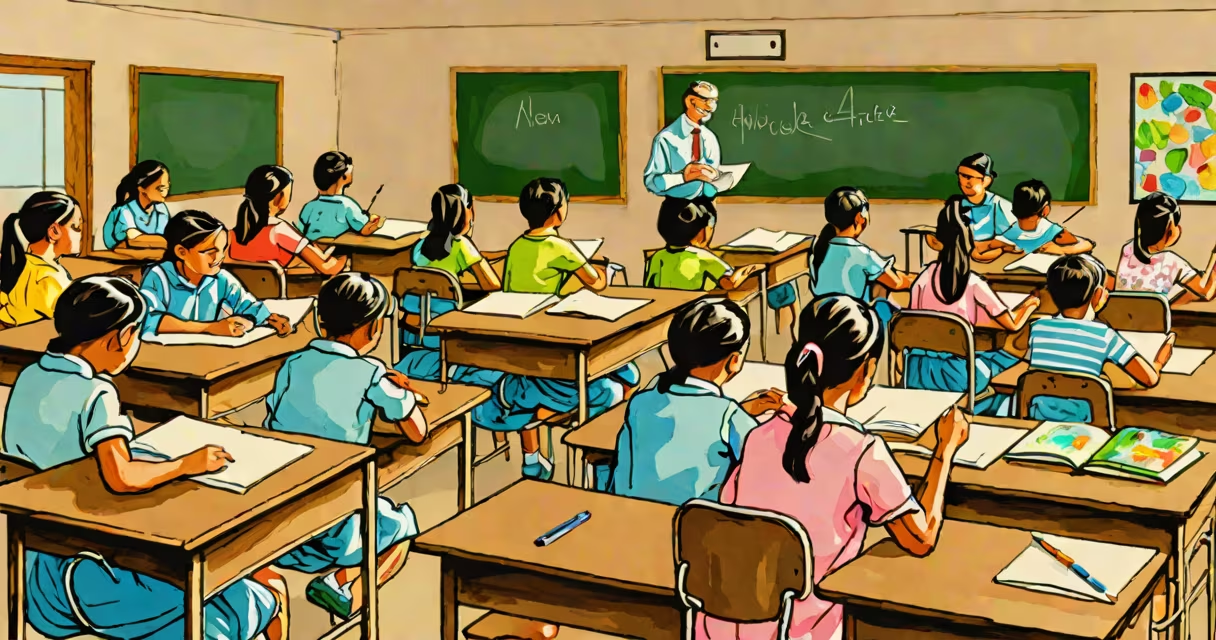
Traditional education is a formal system of learning conducted in physical classrooms under a standardized curriculum, led by certified instructors, and structured around grade levels, fixed schedules, and standardized assessments. It emphasizes subject mastery, sequential progression, and institutional accreditation.
This model dominates public and private K-12 schools and most undergraduate programs worldwide. It emerged in the 19th century as industrialization demanded literate, disciplined workers. Today, it remains the default structure for most national education systems, including those in the United States, Canada, and much of Europe.
According to the National Center for Education Statistics (NCES), 95% of U.S. public school students attended traditional schools in 2022. The U.S. Department of Education defines traditional education as "instruction delivered in a structured environment with established academic standards and measurable outcomes."
Traditional education operates through a fixed sequence: students enter kindergarten, progress through grades annually, and complete required courses in math, science, language arts, and social studies. Each grade level builds on the prior one, creating a linear path toward graduation.
Instruction occurs in a physical classroom setting. Teachers deliver lessons using textbooks, worksheets, and lectures. Students attend classes daily, follow a set schedule, and take periodic exams. Grades are assigned based on performance in assignments, quizzes, and tests.
For example, a typical 8th-grade math course covers algebraic expressions, equations, and basic geometry. Students must pass a final exam to advance to high school. Failure results in remedial instruction or repeating the course-both standard practices in traditional systems.
Traditional education relies on four foundational elements: standardized curriculum, certified teachers, fixed schedules, and institutional accreditation. These components ensure consistency across schools and states.
The system includes several distinct tiers:
| Type | Duration | Focus | Example |
|---|---|---|---|
| K-12 Public School | Pre-K to 12th grade | General academic and civic preparation | Local district schools funded by taxes |
| Private School | Pre-K to 12th grade | Religious or academic specialization | St. Mary's Academy, Catholic high school in Chicago |
| Community College | 2-year associate degrees | Transfer to university or job training | Los Angeles City College, offering vocational programs |
| Four-Year University | 4-year bachelor's degrees | Discipline-specific knowledge and credentials | University of Michigan, awarding BBA degrees |
Each tier uses standardized testing (e.g., state assessments, SAT, ACT) to measure student achievement. These tests align with state or national standards, such as the Common Core State Standards in the U.S.
Traditional education is often confused with "schooling" as a synonym for all learning. But schooling refers to the process; traditional education describes a specific model with defined structure and goals.
A key distinction lies in assessment methods. Traditional systems prioritize standardized testing and letter grades. Alternative models, like project-based or competency-based learning, assess understanding through portfolios, presentations, or real-world application.
Another misconception is that traditional education is inherently outdated. While critics argue it favors memorization over critical thinking, research shows it still delivers strong foundational skills. A 2021 study by the National Bureau of Economic Research found that students in traditional public schools outperformed peers in alternative models on long-term literacy and numeracy benchmarks.
Traditional education prepares students for college, careers, and citizenship. It provides a consistent structure for credentialing-degrees and transcripts accepted by employers and universities globally.
However, it struggles with individual pacing. A student who grasps algebra quickly may wait weeks to move forward. Conversely, a student needing extra time may fall behind. This rigidity can lead to disengagement, especially among neurodiverse learners.
I observed this firsthand while volunteering at a rural high school. One student with dyslexia scored below grade level in reading despite strong verbal reasoning. The school offered no alternative reading support. He eventually dropped out. His story reflects a known gap: traditional systems often lack adaptive resources for diverse learning needs.
Still, the model persists because it meets legal and institutional requirements. Most jobs require a diploma or degree. Colleges demand transcripts. Even online platforms like Coursera partner with traditional institutions to validate credentials.
Traditional education remains dominant because it scales reliably. A single curriculum can be taught across thousands of schools with minimal variation. This uniformity supports accountability, funding allocation, and policy implementation.
It's used in settings requiring certification: medicine, law, engineering, teaching. These fields rely on accredited degrees to ensure minimum competence. A medical license requires completion of a traditional medical school program.
Parents choose traditional education for its predictability. They know their child will learn the same material as others in the district. Schools provide clear milestones: promotion to the next grade, passing state exams, receiving a diploma.
Traditional education is not synonymous with quality. High test scores don't guarantee critical thinking or emotional intelligence. Nor is it the only path to success. Many innovators, entrepreneurs, and artists have thrived outside formal classrooms.
It also differs from homeschooling, which allows families to design their own curriculum. And it's not the same as online learning, which may lack physical classrooms but still follow traditional structures. Some online schools replicate traditional models-scheduled classes, graded assignments, final exams.
True alternatives include Montessori, Waldorf, and unschooling. These models emphasize self-directed learning, creativity, and experiential education. They reject rigid grading and fixed schedules. But they remain niche-less than 5% of U.S. students attend such schools.
Understanding what traditional education is-and isn't-helps clarify its role. It's not a perfect system, but it's the foundation of most formal education networks. For many, it remains the most accessible route to opportunity.