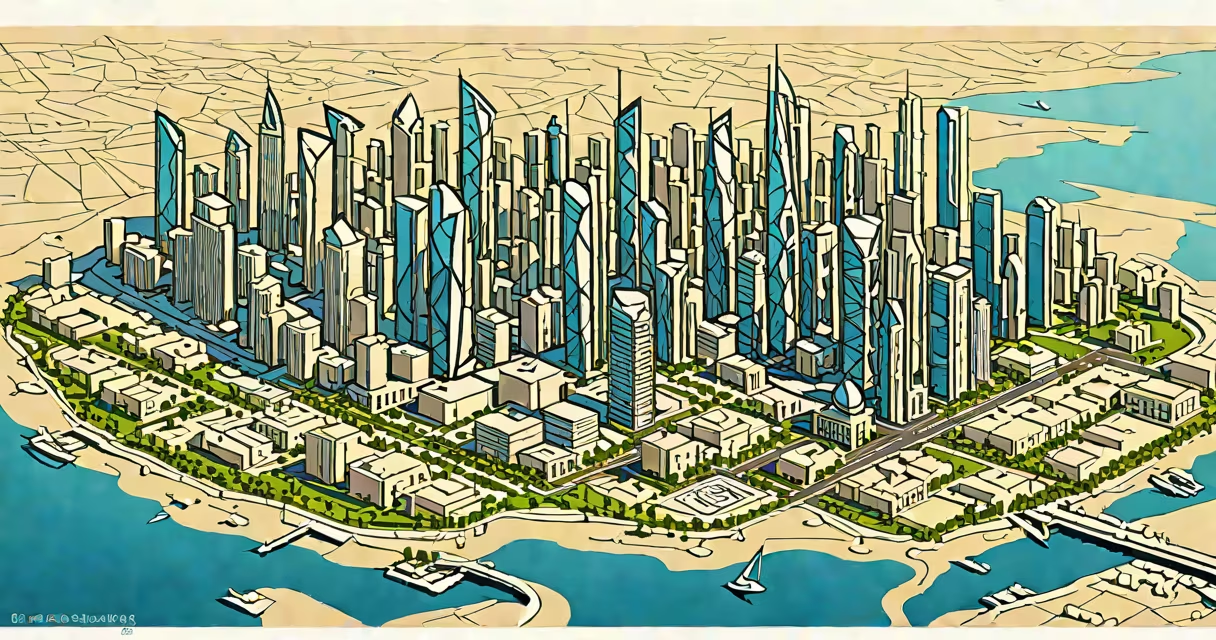
Doha is the capital and largest city of Qatar, a sovereign nation situated on the northeastern coast of the Arabian Peninsula in Western Asia. It lies along the Persian Gulf and serves as the political, economic, and cultural center of the country.
Qatar is a small but wealthy nation, covering approximately 11,586 square kilometers (4,473 square miles). It is bordered by Saudi Arabia to the south and is surrounded by the Persian Gulf on all other sides. Doha occupies a strategic position near major shipping lanes and is home to one of the world's busiest ports, the Port of Doha.
The city was founded in the late 18th century and grew rapidly after the discovery of oil in the 1930s and natural gas in the 1970s. Today, Doha hosts over 1 million residents and is known for its high-rise buildings, modern infrastructure, and cultural institutions such as the Museum of Islamic Art and the National Museum of Qatar.
Doha is the administrative heart of Qatar. All government ministries, the national parliament, and the royal family reside in the city. The Qatari government uses Doha as the base for national planning, foreign policy coordination, and international diplomacy.
For example, Doha hosted the 2022 FIFA World Cup, making it the first Arab nation to do so. The tournament required extensive urban development, including the construction of Lusail Stadium, designed to host the final match. This event underscored Doha's role as a global hub for sports and international events.
Despite its modernity, Doha preserves traditional elements. Souq Waqif, a historic market district, remains a central gathering place for locals and tourists. It features Arabic architecture, spice stalls, and camel caravans during cultural festivals.
Doha's urban layout reflects rapid modernization. The city is divided into districts such as West Bay, Doha Corniche, and Education City. West Bay, with its glass towers and financial institutions, is the commercial core. The Doha Corniche runs along the coastline and is popular for evening walks and public events.
Transportation in Doha includes a metro system launched in 2019, the first in the Gulf Cooperation Council region. The Doha Metro connects key areas like the airport, business centers, and residential zones. It operates on four lines and uses driverless trains, reducing travel time between locations.
Energy infrastructure supports the city's growth. Qatar has the world's third-largest natural gas reserves, contributing to Doha's energy independence. The city relies on desalination plants to supply fresh water, with over 90% of its water coming from seawater purification.
Some people mistake Doha for being in Saudi Arabia due to proximity and similar regional culture. However, Qatar is a distinct nation with its own government, currency (Qatari riyal), and legal system. It is not part of any larger federation or union.
Another misconception is that Doha is a desert city with minimal green space. In reality, Doha has invested heavily in landscaping. The city maintains over 1,000 hectares of parks and gardens, including the Al Bidda Park and the Doha Zoo, which is part of a larger conservation initiative.
A lesser-known fact: Doha is the only capital city in the Gulf region that does not have a major river or natural freshwater source. Its water supply depends entirely on desalination and groundwater extraction, making sustainable water management a critical priority.
Comparing Doha with other Gulf capitals highlights unique characteristics:
| Feature | Doha, Qatar | Abu Dhabi, UAE | Riyadh, Saudi Arabia |
|---|---|---|---|
| Population (2023 est.) | 1.1 million | 1.5 million | 7.4 million |
| Annual GDP per capita | $65,000 | $58,000 | $29,000 |
| Primary language | Arabic (official) | Arabic (official) | Arabic (official) |
| Major export | Natural gas (LNG) | Petroleum and gas | Petroleum |
While all three cities are major regional hubs, Doha stands out for its focus on education and sustainability. The city hosts branches of U.S.-based universities, including Georgetown University in Qatar and Texas A&M University at Qatar. These institutions contribute to Doha's reputation as a center for higher learning in the Middle East.
I visited Doha in early 2023 during the winter season. The city felt both futuristic and deeply rooted in tradition. Walking through the Doha Corniche at sunset, I saw families enjoying outdoor dining while the skyline glowed under artificial lighting. Later, I toured the Katara Cultural Village, where a performance of traditional Arabic music played in a courtyard surrounded by stone arches.
One detail stood out: despite the city's modern design, many public spaces still feature traditional Islamic geometric patterns in paving and railings. This blend of old and new is intentional. The Qatari government promotes architectural harmony through strict urban planning codes.
Doha is unequivocally in Qatar. The country is an independent state recognized by the United Nations since 1971. It is a constitutional monarchy ruled by the Al Thani family. Qatar is a member of the Arab League, the Organization of Islamic Cooperation, and the Gulf Cooperation Council.