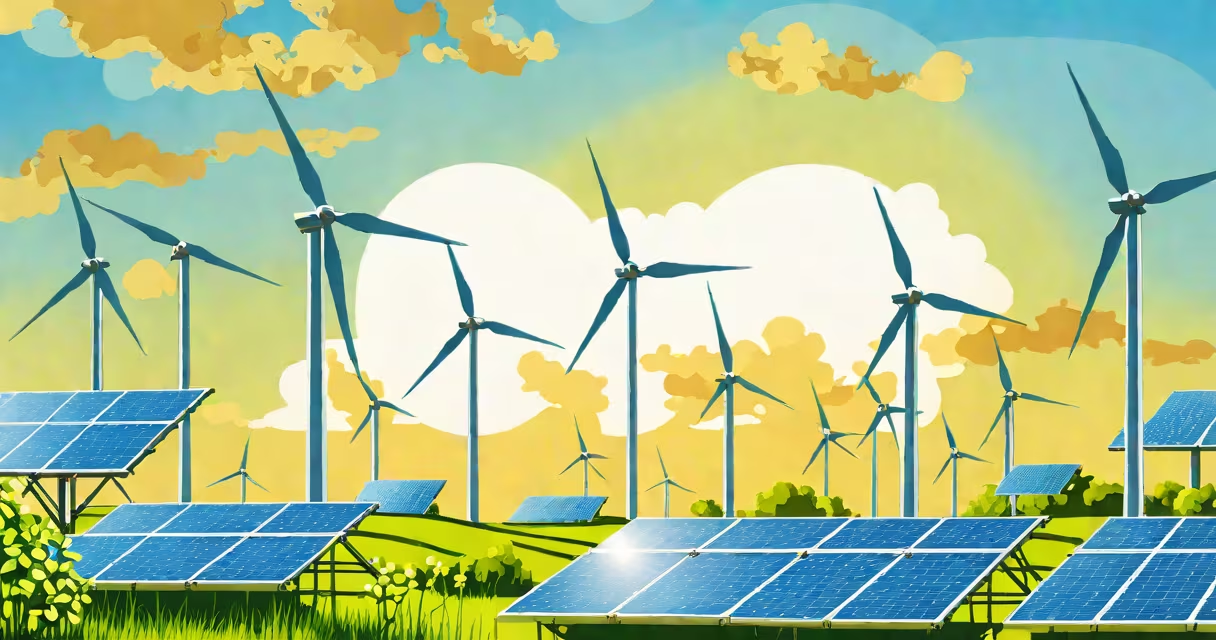
An energy source is renewable if it naturally replenishes at a rate equal to or faster than human consumption, produces minimal greenhouse gas emissions during operation, and maintains ecological balance over time. Renewable sources include sunlight, wind, flowing water, and geothermal heat.
Renewability hinges on two principles: continuous availability and environmental neutrality. Solar energy arrives daily via the sun's fusion reactions, which will continue for billions of years. Wind forms from uneven solar heating of Earth's surface and atmospheric pressure differences. Water cycles through evaporation, precipitation, and runoff, driven by solar energy. These processes operate independently of human extraction timelines.
The International Energy Agency (IEA) defines renewable energy as "energy derived from natural sources that are replenished on a human timescale." This excludes fossil fuels, which take millions of years to form. The U.S. Department of Energy emphasizes that renewables must not deplete finite reserves or cause irreversible environmental harm.
Renewable systems convert natural flows into usable electricity or heat. Solar photovoltaic cells absorb photons from sunlight and release electrons, generating direct current. Wind turbines use aerodynamic blades to spin generators when air moves past them. Hydropower channels flowing rivers through turbines, turning kinetic energy into rotational motion. Geothermal plants tap underground steam or hot water to drive turbines.
These systems rely on ongoing natural processes. A solar farm doesn't consume fuel-it harvests light. A wind farm doesn't burn anything-it captures motion. Unlike coal plants, which require constant mining and emit CO₂, renewable facilities produce power without consuming irreplaceable materials.
Grid integration remains a challenge. Solar and wind outputs vary with weather and time of day. Modern systems pair them with battery storage or grid-scale demand response. For example, California's grid uses lithium-ion batteries to store excess solar energy for nighttime use, reducing reliance on natural gas peaker plants.
Renewable energy sources share four defining traits: rapid regeneration, low operational emissions, scalability, and geographic diversity. They regenerate within days, months, or years-not millennia. Their operation emits little to no carbon dioxide, methane, or particulates. They scale from rooftop solar to utility-scale wind farms. And they're available across regions-solar in deserts, wind in coastal plains, geothermal in tectonic zones.
Non-renewables fail on all four counts. Coal takes 300 million years to form. Oil extraction damages ecosystems. Natural gas combustion releases 50% less CO₂ than coal but still contributes to climate change. Burning fossil fuels adds carbon to the atmosphere faster than natural sinks can remove it.
| Energy Type | Replenishment Rate | Operational Emissions | Global Availability |
|---|---|---|---|
| Solar | Continuous (sunlight) | Zero during generation | Widespread (anywhere with daylight) |
| Wind | Constant (atmospheric circulation) | Zero during generation | High in coastal and open areas |
| Hydropower | Annual (water cycle) | Low (some methane from reservoirs) | Depends on river systems |
| Coal | Millions of years | High (CO₂, SO₂, NOx) | Global but limited by deposits |
| Natural Gas | Millions of years | Moderate (CO₂, methane leaks) | Global but unevenly distributed |
Some confuse biomass with purely renewable energy. While plant matter regrows, burning wood or crop residue releases stored carbon. If harvesting exceeds regrowth rates, net emissions rise. The IPCC notes that unsustainable biomass use can increase atmospheric CO₂ levels by up to 15% compared to fossil fuels.
Another misconception: all green energy is renewable. Hydrogen produced via electrolysis using renewable electricity is clean-but if the electricity comes from coal, the hydrogen is not renewable. The source of the input matters. Green hydrogen requires renewable-powered electricity to qualify.
A third error: assuming renewability equals sustainability. A solar farm in a desert may deplete groundwater if irrigation is needed for panel cleaning. Over-extraction can harm local ecosystems. The National Renewable Energy Laboratory (NREL) warns that lifecycle analysis must assess water use, land impact, and material sourcing-not just energy output.
Consider Denmark's wind-powered district heating system in Aarhus. In 2022, 46% of the city's electricity came from wind, and 95% of its heating was supplied by combined heat and power plants fueled by wind-generated electricity. The system reduced CO₂ emissions by 120,000 tons annually compared to gas-based heating.
Each wind turbine generates 2.5 megawatts under optimal conditions. With average wind speeds of 7 m/s, a single turbine produces enough electricity for 1,500 homes per year. Maintenance costs average $0.02/kWh-lower than coal's $0.03/kWh and natural gas's $0.04/kWh, according to Lazard's 2023 Levelized Cost of Energy Analysis.
When evaluating whether a source qualifies as renewable, ask: Does it renew faster than we use it? Does it emit harmful pollutants during operation? Is it scalable without harming ecosystems? If yes to all, it meets the standard.
Understanding what makes an energy source renewable prevents mislabeling and supports informed policy. Renewability isn't just about nature-it's about balance, timing, and long-term stewardship.