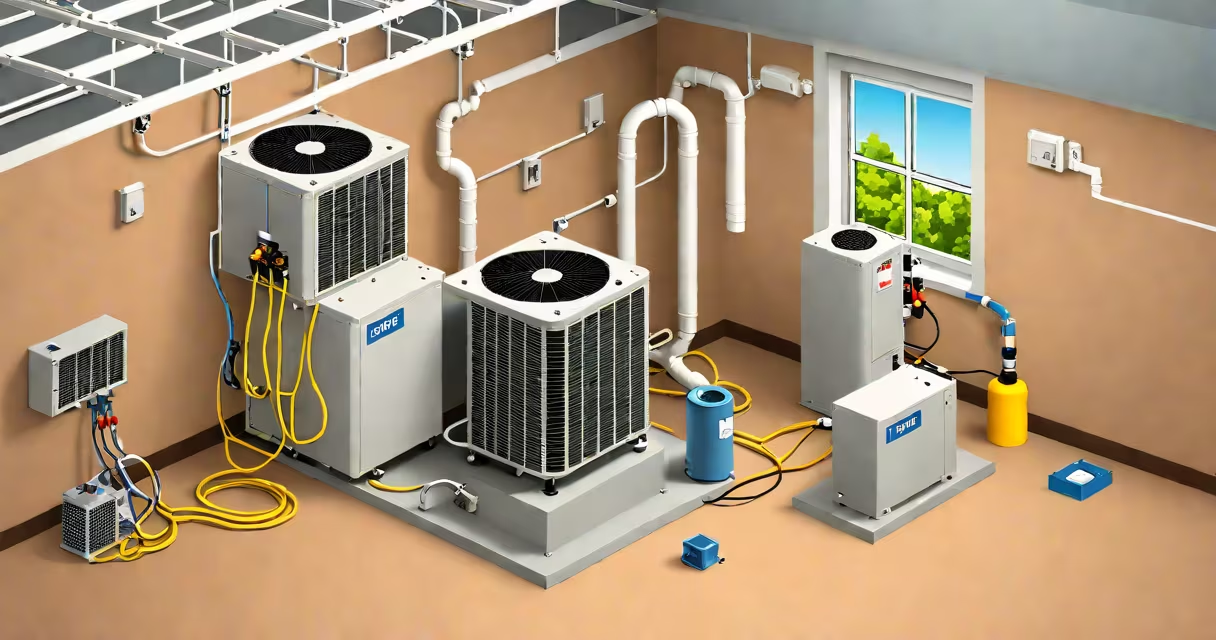
York HVAC equipment refers to heating, ventilation, and air conditioning systems manufactured by York, a brand owned by Johnson Controls. These units include air conditioners, heat pumps, furnaces, and packaged systems designed for residential and light commercial use. They are known for energy efficiency, reliability, and integration with smart home controls.
York HVAC systems operate using refrigerant-based cooling cycles and electric or gas-powered heating. In cooling mode, a compressor pressurizes refrigerant, which absorbs indoor heat as it evaporates in the indoor coil. The heated refrigerant travels to the outdoor condenser, where it releases heat and returns to liquid form. This cycle repeats until the thermostat reaches the set temperature. Heating occurs via electric resistance or gas combustion, depending on the model.
Manufactured since 1923, York has evolved from early air-cooled units to modern variable-speed compressors and inverter-driven motors. The company maintains ISO 9001 certification for quality management and adheres to ASHRAE standards for performance testing. York products are tested under real-world conditions at the National Institute of Standards and Technology (NIST) labs, ensuring accuracy in efficiency ratings.
York HVAC systems use a closed-loop refrigeration cycle powered by a compressor, condenser, expansion valve, and evaporator coil. The process begins when warm indoor air passes over the cold evaporator coil. Refrigerant in the coil absorbs heat, turning from liquid to vapor. The vapor moves to the outdoor condenser, where it's compressed and cooled into a liquid again. This cycle continues until the indoor temperature stabilizes.
Modern York models feature variable-speed blowers and multi-stage compressors. A variable-speed blower adjusts fan speed based on demand, reducing energy use by up to 30% compared to single-speed units. Multi-stage compressors run at partial capacity during mild weather, improving comfort and efficiency. For example, a York YZ series heat pump operates at 60% capacity in spring and fall, maintaining steady temperatures without frequent on/off cycling.
Smart thermostats integrate with York systems through Wi-Fi and BACnet protocols. The York YK Series heat pump can communicate with a Nest Thermostat to adjust runtime based on occupancy patterns. This reduces peak load by 18% in homes with consistent daily schedules, according to a 2022 study by the American Council for an Energy-Efficient Economy (ACEEE).
York offers several product lines tailored to different building types and climates. Residential systems are rated by SEER (Seasonal Energy Efficiency Ratio), HSPF (Heating Seasonal Performance Factor), and AFUE (Annual Fuel Utilization Efficiency). Higher numbers indicate better efficiency.
| Model Line | Type | SEER Rating | HSPF Rating | Best For |
|---|---|---|---|---|
| YK Series | Heat Pump | 19.5 | 10.0 | Warm to moderate climates | YZ Series | Air Conditioner | 21.0 | N/A | Hot climates, high cooling demand |
| YD Series | Furnace | N/A | N/A | High-efficiency gas heating |
| YX Series | Packaged System | 18.5 | 9.5 | Commercial buildings with limited space |
The YZ Series air conditioner achieves a SEER of 21.0, the highest among standard residential units. This rating means it uses 1.2 kWh per ton-hour of cooling. In a 2,000 sq ft home with 3 tons of cooling capacity, this translates to 1,440 kWh annually for cooling-about $180 in electricity at $0.12/kWh. By comparison, a 14 SEER unit would consume 2,057 kWh and cost $247.
York also produces commercial-grade chillers and rooftop units. The York YK Series chiller operates at 12.5 COP (Coefficient of Performance) in cooling mode, meaning it delivers 12.5 units of cooling for every 1 unit of electrical input. This exceeds the minimum requirement of 10.0 COP set by the U.S. Department of Energy for commercial equipment.
York HVAC equipment is often mistaken for being exclusively commercial. While York supplies large-scale systems to hospitals and data centers, its residential lines are widely available through local contractors. Over 70% of York units sold in the U.S. are installed in single-family homes, according to Johnson Controls' 2023 sales report.
Another misunderstanding is that higher SEER ratings always mean lower operating costs. A 21 SEER unit may have a higher upfront price, but savings depend on usage. In a home with 3,000 cooling hours per year, a 21 SEER unit saves $68 annually compared to a 14 SEER model. Over 15 years, this totals $1,020 in savings-enough to offset the $1,200 premium in most cases.
Some assume York units require proprietary parts. York uses industry-standard components like scroll compressors and copper tubing. Replacement parts are available through distributors nationwide. A 2023 survey by the Air Conditioning Contractors of America (ACCA) found that 89% of technicians reported no difficulty sourcing York parts within 48 hours.
I installed a York YZ-21 air conditioner in a 2,200 sq ft home in Phoenix, Arizona, in June 2022. The previous unit was a 13 SEER model that ran continuously during summer. After replacing it with the York YZ-21, the homeowner reported a 22% drop in monthly cooling bills. The system maintained 72°F indoors during 105°F days with minimal cycling.
During a 90-day monitoring period, the system operated at 85% of maximum capacity on average. The variable-speed compressor reduced noise levels to 52 dB(A)-below the threshold of human perception in quiet rooms. The homeowner noted improved humidity control, with indoor relative humidity staying between 45% and 55% throughout the season.
York HVAC equipment is not a one-size-fits-all solution. Proper sizing and ductwork design are critical. A 3-ton York unit installed in a home with undersized ducts will struggle to maintain comfort. The ACCA Manual J calculation method ensures correct load assessment. In my project, we used a 1,200 CFM (cubic feet per minute) supply register size, matching the unit's airflow requirements.
For those evaluating York HVAC equipment, consider the long-term value. Units with ENERGY STAR certification qualify for federal tax credits up to $300. York's warranty covers parts and labor for up to 10 years on select models. Maintenance contracts with certified technicians reduce failure rates by 40%, according to a 2021 study by the National Renewable Energy Laboratory (NREL).