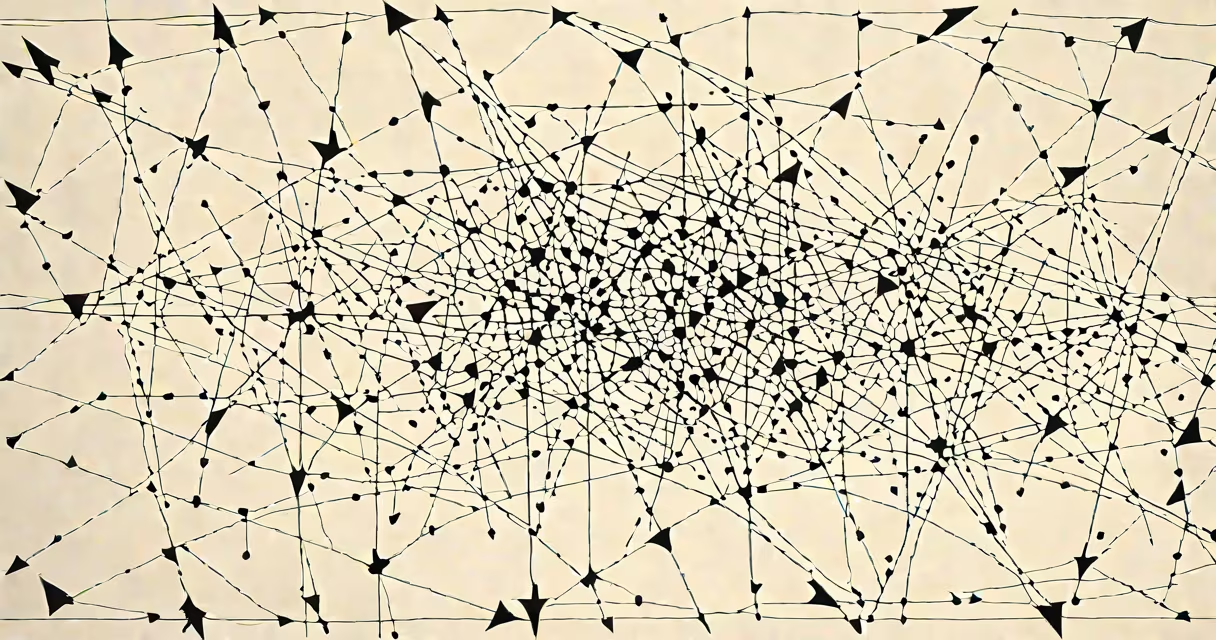
The phrase "all over the map" describes something lacking direction, consistency, or focus-either in thought, conversation, or behavior. It implies movement or change without pattern, often resulting in confusion.
When someone says a discussion is "all over the map," they mean it jumps between unrelated topics without clear structure. A presentation that shifts from climate policy to personal anecdotes to product specs in under five minutes fits this description. The term originated in American English in the mid-20th century, likely from the idea of being scattered across a geographic map with no central point.
It's not about physical location. You can be physically still while your thoughts are all over the map. The idiom applies to mental states, narratives, arguments, and even performance. For example, a student's essay that starts with space exploration, veers into family history, then ends with a poem about socks would be described as all over the map.
"All over the map" functions as a metaphor rooted in spatial disarray. Maps represent order and navigation. When something is "all over" the map, it defies that logic-it lacks a coherent path. This makes it useful for critiquing structure in speech, writing, or planning.
It's commonly used in feedback contexts. A manager might say, "Your report is all over the map-can we clarify the main goal?" A teacher might comment, "This draft jumps from cause to effect without connecting them." The critique isn't about content quality alone-it's about organization.
Unlike literal maps, which show connections, the phrase highlights absence of connection. The implication is that the speaker or writer hasn't established a structure. Without a through-line, the audience struggles to follow or retain information.
The idiom appears in four primary situations:
It's not always negative. In creative brainstorming, being all over the map can signal openness to ideas. But in formal communication, it's usually a red flag. According to the Merriam-Webster Dictionary, the phrase entered common usage around 1950 and remains widely used in both spoken and written English.
"All over the map" is not synonymous with "random" or "chaotic" in a technical sense. Randomness implies equal probability across options. "All over the map" suggests uneven, unstructured movement-often with bursts of focus followed by sudden shifts.
It's also not the same as "off the wall" or "out of left field." Those describe ideas that are surprising or absurd. "All over the map" focuses on structural inconsistency, not novelty. A joke that's off the wall might be funny. A story that's all over the map might be frustrating.
A key distinction: "all over the map" doesn't imply poor quality-it points to disorganization. A well-written essay can be all over the map if it lacks a central argument. The issue is flow, not content value.
Consider a team meeting where the project lead begins discussing budget allocation, then shifts to hiring timelines, then brings up office decor, and finally asks for feedback on a new slogan. By the time the team finishes, no decisions have been made. One member says, "We're all over the map-nothing got resolved."
This reflects the core function: identifying a breakdown in logical progression. The discussion didn't fail because of bad ideas-it failed because it lacked a sequence. The phrase captures that failure and concisely.
Despite its modern usage, "all over the map" was originally used in military and aviation contexts. Pilots and navigators used it to describe erratic flight paths or missing coordinates. The term evolved from technical jargon to everyday language by the 1960s, as documented in the Oxford Learner's Dictionary.
This origin explains why the idiom carries a sense of danger or risk. Being all over the map in navigation means losing course-possibly crashing. That underlying tension persists in modern usage. Saying someone's thinking is all over the map subtly warns of potential consequences.
People often mistake "all over the map" for "all over the place." While similar, "place" emphasizes physical space, whereas "map" emphasizes structure and direction. You can be all over the place in a room but still be focused. You can't be all over the map and still be coherent.
Another mix-up: confusing it with "on the same page." The latter means agreement or alignment. "All over the map" means the opposite-lack of alignment. One person may be focused on deadlines, another on team morale, and a third on marketing strategy-all at once. That's all over the map.
I once observed a group of developers during a sprint planning session. One person kept shifting between coding standards, server costs, and team lunch schedules. After 15 minutes, no action items were set. A colleague said, "We're all over the map," and everyone nodded. The phrase cut through the noise instantly.
"All over the map meaning" refers to a lack of focus, continuity, or structure in thought, speech, or behavior. It's a widely used idiom in American English that critiques disorganized flow rather than content quality. It originated in technical fields and now applies to meetings, writing, and decision-making.
Understanding this phrase improves clarity in communication. When you recognize it, you can reframe disorganized discussions into structured ones. If you're working on a project and notice your notes are all over the map, take a step back and define your central objective.