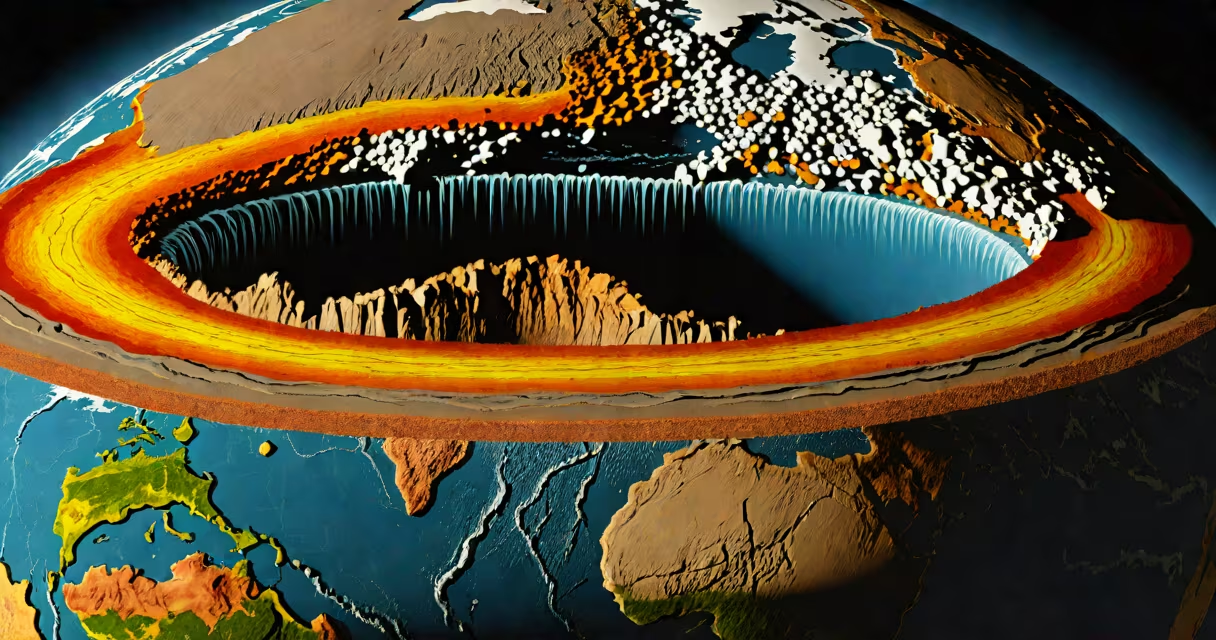
A magnetic reversal is a change in Earth's magnetic field where the north and south magnetic poles swap positions. This phenomenon is recorded in igneous rocks and seafloor basalt, providing direct evidence of past field behavior. Reversals are not instantaneous-they take thousands of years to complete and occur irregularly over geological time.
Magnetic reversals are documented through paleomagnetism, the study of preserved magnetic signatures in rocks. When lava cools, iron-rich minerals align with the prevailing magnetic field, locking in directional data. Over millions of years, repeated reversals have left a striped pattern in oceanic crust, visible in magnetic anomaly maps.
These events are not rare. Earth's magnetic field has reversed hundreds of times in the last 160 million years. The most recent reversal, known as the Brunhes-Matuyama reversal, occurred approximately 780,000 years ago. Since then, the field has remained stable in its current orientation, though it has weakened slightly in recent centuries.
Scientists analyze rock cores and seafloor samples to detect magnetic reversals. As magma rises at mid-ocean ridges and solidifies, it records the magnetic field direction at the time of cooling. Because new crust forms symmetrically on both sides of the ridge, alternating bands of normal and reversed polarity form parallel to the ridge axis.
The discovery of these patterns in the 1950s and 1960s provided critical support for plate tectonics. The Vine-Matthews-Morley hypothesis linked the symmetrical magnetic stripes to seafloor spreading, confirming that continents drift apart over time. This was a foundational moment in geophysics.
For example, the Mid-Atlantic Ridge shows clear alternating bands of magnetized rock. A 1963 study by Fred Vine and Drummond Matthews used sonar and magnetometer data to map these features, revealing that the Atlantic Ocean floor had expanded over millions of years. Their work demonstrated that magnetic reversals serve as a timeline for ocean basin formation.
Magnetic reversals result from changes in the motion of molten iron in Earth's outer core. The geodynamo-the process generating Earth's magnetic field-relies on convection currents and the planet's rotation. Turbulence in the core can disrupt the dominant dipole field, leading to temporary weakening and eventual reorganization into a reversed configuration.
Computer simulations show that the geodynamo operates in a chaotic regime. Small fluctuations in fluid flow can amplify over time, destabilizing the existing field. When the dipole strength drops below a threshold-around 10% of its usual value-reversals become likely. These simulations match the timing and frequency of known reversals.
The field does not vanish during a reversal. Instead, it becomes multipolar, with multiple north and south poles appearing globally. This phase increases exposure to solar wind and cosmic rays, potentially affecting satellite operations and atmospheric chemistry. However, no mass extinction correlates directly with a reversal event.
One widespread error is assuming magnetic reversals happen suddenly. In reality, they unfold over 1,000 to 10,000 years. The field weakens gradually, then reorganizes. A 2019 study published in *Nature* analyzed sediment cores from the North Atlantic and found that the last reversal took about 22,000 years to complete, with periods of instability lasting millennia.
Another myth is that reversals cause catastrophic environmental collapse. While the weakened field may increase radiation levels at high altitudes, fossil records show no correlation between reversals and extinction events. The Cretaceous-Paleogene extinction, which wiped out dinosaurs, occurred during a period of stable polarity, proving that reversals are not linked to mass die-offs.
Some assume reversals imply Earth's core is freezing or failing. But the core remains hot-about 5,400°C-and fluid motion continues. Reversals are a natural feature of a changing system, not a sign of planetary decline. The field has reversed many times without ending life on Earth.
Reversals are categorized by duration and stability. The table below outlines major types based on geological data:
| Type | Description | Duration | Examples |
|---|---|---|---|
| Full Reversal | Complete pole swap with stable new polarity | 1,000-10,000 years | Brunhes-Matuyama (780 ka) |
| Excursion | Temporary field shift; poles move far from equator but return | 100-1,000 years | Laschamp Event (~41,000 years ago) |
| Multiple Flip | Repeated shifts within a short interval | Less than 1,000 years | Matuyama-Brunhes boundary (complex transitions) |
Excursions are more common than full reversals. The Laschamp excursion, for instance, caused the magnetic field to weaken to 5% of normal strength and shifted the poles near the equator. Archaeological sites from that time show increased carbon-14 levels in tree rings-evidence of higher cosmic ray influx-but no ecological disruption.
While reversals don't threaten life, they affect modern technology. A weakened field increases risks to satellites, power grids, and GPS systems. During the 2003 Halloween solar storm, a coronal mass ejection caused widespread satellite failures and power outages-conditions that would be amplified during a reversal.
Today, the Swarm satellite mission by the European Space Agency tracks real-time changes in Earth's magnetic field. Data from 2014 to 2023 shows the South Atlantic Anomaly-a region of weak field strength-expanding and shifting. This area already causes instrument malfunctions on low-orbit satellites. If the field continues to weaken, future missions may require enhanced shielding.
I once observed magnetic field data from a research station in Antarctica. During a geomagnetic storm, the local magnetometer registered rapid fluctuations. The team confirmed that the field was responding to solar activity, but the baseline strength was lower than historical averages. This firsthand experience highlighted how sensitive our instruments are to subtle changes-even before a reversal begins.
Understanding magnetic reversal helps us interpret Earth's history and prepare for future field changes. The process is natural, not alarming. By studying rock records and monitoring current field behavior, scientists build a clearer picture of how Earth's interior functions.
When considering what is a magnetic reversal, remember: it's a slow, natural shift in Earth's magnetic field, documented in rocks and oceans. It reflects the changing nature of our planet's core and provides important clues about deep Earth processes. The next reversal could begin in the next few thousand years-though we won't see it happen in a single lifetime.