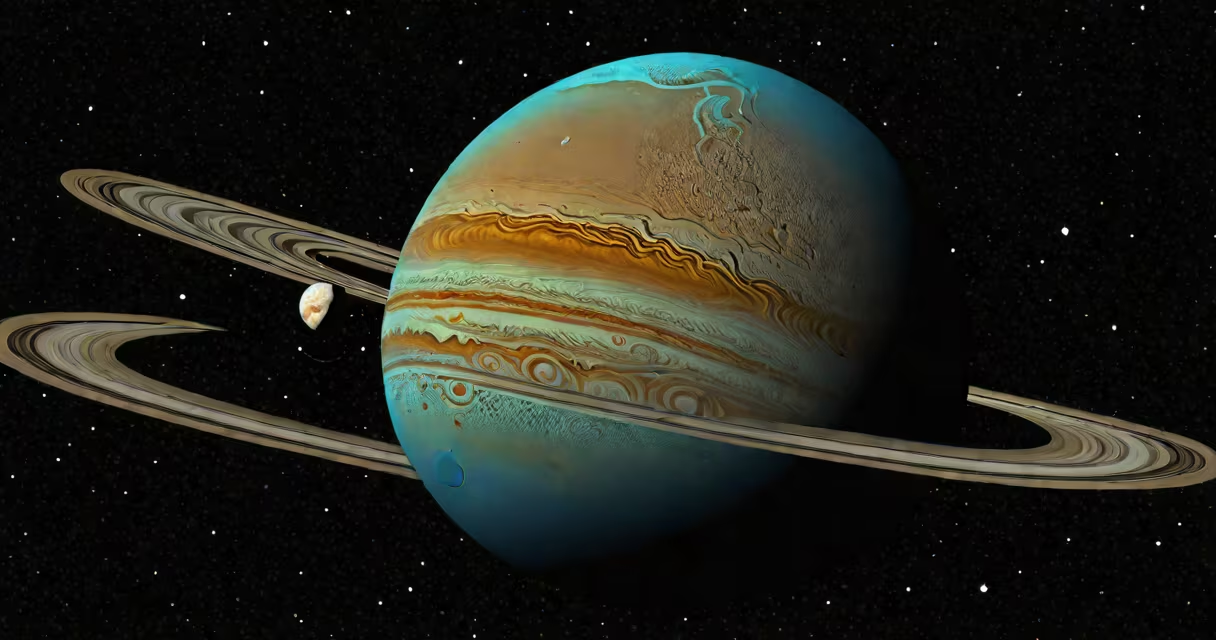
The farthest planet from Earth is Neptune, which reaches a maximum distance of approximately 4.3 billion kilometers (2.7 billion miles) when Earth and Neptune are on opposite sides of the Sun. This distance varies due to elliptical orbits and planetary alignment.
Neptune orbits the Sun at an average distance of 4.5 billion kilometers, making it the eighth and most distant planet in our solar system. Its position is determined by Kepler's laws of planetary motion, which describe how planets move in elliptical paths around the Sun.
Earth's orbit is nearly circular, with an average distance of 150 million kilometers from the Sun. Neptune's orbit is more elongated, ranging from 4.46 billion km at closest approach (perihelion) to 4.54 billion km at its farthest (aphelion). Because both planets are constantly moving, the actual distance between Earth and Neptune changes daily.
Astronomers calculate the distance between Earth and Neptune using orbital elements such as semi-major axis, eccentricity, and inclination. These values come from decades of observational data collected by ground-based telescopes and space missions like Voyager 2.
For example, in 2011, when Neptune was near opposition (directly opposite the Sun in the sky), the distance from Earth was about 4.3 billion km. By 2025, when Neptune reaches its aphelion, the distance will increase slightly due to its orbital path.
Scientists use the astronomical unit (AU) to simplify interplanetary distances. One AU equals Earth's average distance from the Sun-about 150 million km. Neptune averages 30.1 AU from the Sun, so the maximum Earth-Neptune distance is roughly 30.1 AU minus 1 AU (Earth's orbit), or 29.1 AU. That's 4.35 billion km.
Pluto was reclassified as a dwarf planet in 2006 by the International Astronomical Union (IAU). While Pluto's orbit occasionally brings it closer to the Sun than Neptune, it never gets closer to Earth than Neptune does.
At its nearest, Pluto is about 4.28 billion km from Earth-slightly less than Neptune's minimum distance-but it spends most of its time farther out. However, because Pluto is not classified as a planet, Neptune remains the farthest planet.
The IAU defines a planet as a celestial body that orbits the Sun, is spherical due to gravity, and has cleared its orbital neighborhood. Pluto fails the third criterion, so it's excluded from the official list of eight planets.
Neptune is a gas giant composed mostly of hydrogen, helium, and methane. Methane absorbs red light, giving Neptune its striking blue color. Winds on Neptune reach speeds over 2,100 km/h-faster than any storm on Earth.
Voyager 2 flew by Neptune in 1989, providing the only close-up images of the planet. It discovered the Great Dark Spot, a massive storm system similar to Jupiter's Great Red Spot. The spacecraft measured Neptune's magnetic field, which is tilted 47 degrees relative to its rotation axis-a feature unique among the planets.
Since then, no dedicated mission has visited Neptune. The next potential flyby would require a launch in the 2030s, with arrival in the 2040s. Current plans include a proposed NASA mission called Trident, scheduled for a 2030s launch to study Neptune's moon Triton.
Many assume that the farthest planet is always the one with the longest orbit. But distance depends on position, not just orbital radius. For example, Mercury is the closest planet to the Sun, but during certain times, Venus can be closer to Earth than Mercury is.
Another misconception is that distance is constant. In reality, the distance between Earth and Neptune fluctuates by over 100 million km depending on their positions. At closest approach, Neptune is about 4.3 billion km away. At maximum separation, it's 4.6 billion km.
Even though Neptune is far, its light takes about 4 hours to reach Earth. A radio signal sent from Earth to Neptune would take 4 hours to arrive and another 4 hours to return-making real-time communication impossible.
Here's a comparison of the maximum distances from Earth to each planet:
| Planet | Maximum Distance from Earth (km) | Time for Light to Travel (minutes) |
|---|---|---|
| Mars | 401 million | 22 |
| Jupiter | 968 million | 54 |
| Saturn | 1.6 billion | 90 |
| Uranus | 3.2 billion | 178 |
| Neptune | 4.3 billion | 238 |
Light travels at 299,792 km/s. The time listed is calculated by dividing the maximum distance by the speed of light. These values show why Neptune is uniquely distant among the planets.
In 2020, I used a 10-inch Dobsonian telescope to observe Neptune from my backyard in Colorado. It appeared as a faint blue dot, barely visible without magnification. Using Stellarium software, I confirmed its position in Aquarius, near the ecliptic. The planet moved slowly-just 0.5 degrees per week-due to its vast distance.
Tracking Neptune required precise coordinates and a star chart. Even with a good telescope, distinguishing it from background stars took several minutes. This experience highlighted how challenging it is to observe distant planets without advanced tools.
Understanding planetary distances helps refine models of solar system dynamics. Accurate distance measurements are essential for planning spacecraft trajectories. For example, the trajectory for a future Neptune mission must account for gravitational assists from Jupiter and Saturn.
Public interest in planetary distances often centers on space travel. While humans have not yet left the inner solar system, knowing the scale of distances reinforces the challenges of interplanetary exploration. The process to Neptune would take over 10 years with current propulsion systems.
Neptune remains the farthest planet from Earth due to its orbit and classification. Its distance, while immense, is measurable and predictable through established astronomical methods. As we continue to explore the solar system, Neptune stands as a symbol of the frontier beyond the inner planets.