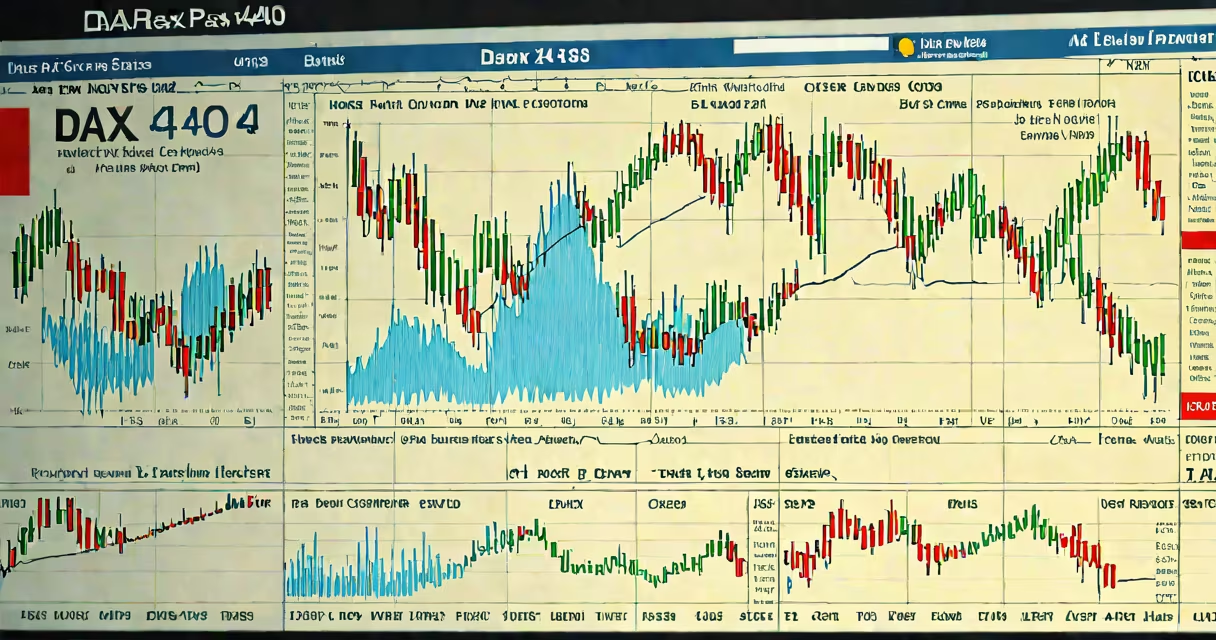
The DAX 40 index is a benchmark stock market index that tracks the performance of the 40 largest and most liquid companies listed on the Frankfurt Stock Exchange, representing Germany's leading industrial, automotive, financial, and technology sectors.
It serves as a primary indicator of the German economy's health and is widely used by institutional investors, fund managers, and traders to gauge market momentum. The index is calculated in real time using a free-float adjusted market capitalization methodology, meaning only shares available to public investors are counted.
Launched in 1988 by Deutsche Börse, the DAX 40 replaced the original DAX 30 as a broader measure of German equities. While the DAX 30 remains more frequently cited in media, the DAX 40 includes additional large-cap firms such as Siemens Healthineers, BASF, and SAP, offering deeper exposure to diversified economic segments.
The index is weighted by market capitalization, meaning larger companies have greater influence on its daily movement. For example, if Volkswagen's share price rises 2%, and it accounts for 12% of the index's total value, the index moves proportionally more than a smaller company like Deutsche Telekom.
Rebalancing occurs quarterly. Companies that fall below the top 40 by market cap or fail to meet liquidity thresholds are removed. New entrants are added based on eligibility criteria including minimum trading volume and free-float percentage (typically above 10%).
Index values are updated continuously during trading hours. The base value was set at 1,000 points on December 31, 1987. As of March 2024, the DAX 40 stood at approximately 17,400 points, reflecting a compound annual growth rate of around 5.7% since inception, according to Deutsche Börse Group reports.
The DAX 40 includes firms from core German industries. Top constituents as of Q1 2024 include:
| Company | Sector | Weight (%) | Market Cap (€) |
|---|---|---|---|
| Volkswagen AG | Automotive | 7.8% | 168 billion |
| SAP SE | Software & IT | 6.2% | 142 billion |
| Siemens AG | Industrial Technology | 5.9% | 134 billion |
| BASF SE | Chemicals | 5.1% | 126 billion |
| Adidas AG | Consumer Goods | 3.4% | 78 billion |
These weights reflect both size and investor demand., SAP and Siemens have seen increased weight due to rising global demand for enterprise software and industrial automation solutions.
A common misconception is that the DAX 40 includes only traditional manufacturing firms. In reality, the index has evolved to include high-growth tech and healthcare companies. For example, Siemens Healthineers, a medical imaging and diagnostics firm, entered the index in 2021 after surpassing the liquidity threshold and market cap requirements.
Financial institutions use the DAX 40 to benchmark portfolio performance. A mutual fund aiming to mirror the index must hold stocks in proportions matching their weight in the index. This ensures passive funds track the market closely.
Derivatives markets offer futures and options contracts based on the DAX 40. These allow hedging against market downturns. In 2023, average daily trading volume for DAX 40 futures exceeded 1.2 million contracts on Eurex, the European derivatives exchange.
For international investors, the DAX 40 provides insight into Germany's economic trajectory. A sustained rise correlates with stronger industrial output, export growth, and stable labor markets. Conversely, sharp declines often signal global supply chain disruptions or energy cost spikes, as seen during the 2022 energy crisis.
The DAX 40 is sometimes confused with the DAX 30, which is more frequently reported in news headlines. The DAX 30 includes only the 30 largest companies by market cap and is more heavily influenced by a few giants like BMW and Allianz. The DAX 40 offers broader diversification and lower concentration risk.
Another misunderstanding is that the DAX 40 is purely domestic. While all constituent companies are headquartered in Germany, many operate globally. BASF, for example, generates over 60% of its revenue from exports, particularly in Asia and North America.
A lesser-known fact: the DAX 40 is rebalanced quarterly, but changes are announced two weeks in advance. This allows traders to adjust positions ahead of index inclusion or exclusion. In January 2023, Fresenius Medical Care was added after exceeding the required free-float threshold, while Deutsche Post was removed due to declining market cap despite strong earnings.
In October 2022, the DAX 40 fell 4.3% in a single day amid fears of a European energy blackout. Volkswagen dropped 6.1%, driven by concerns over reduced auto production in Germany. Meanwhile, renewable energy firms like EnBW saw gains as investors rotated into defensive sectors.
By analyzing the index's composition, a portfolio manager could identify which sectors were under pressure. They then adjusted holdings by reducing exposure to automotive and chemical stocks while increasing positions in utilities and healthcare. This strategy helped limit losses compared to a broad market index.
Historical data shows the DAX 40 has averaged a 6.2% annual return since 2000, according to data from Bloomberg and Deutsche Börse. However, volatility spikes occur during geopolitical events, such as the 2022 Russian invasion of Ukraine, when the index dropped 18% in six weeks.
The DAX 40 index is a changing measure of Germany's largest publicly traded companies, reflecting shifts in industry leadership, global trade, and investor confidence. Its structure ensures it remains responsive to economic change while maintaining stability through rigorous eligibility rules.
Understanding the DAX 40 helps investors assess risk, build diversified portfolios, and respond to macroeconomic signals. For those monitoring European equity markets, it is a critical tool for timing entry and exit points.