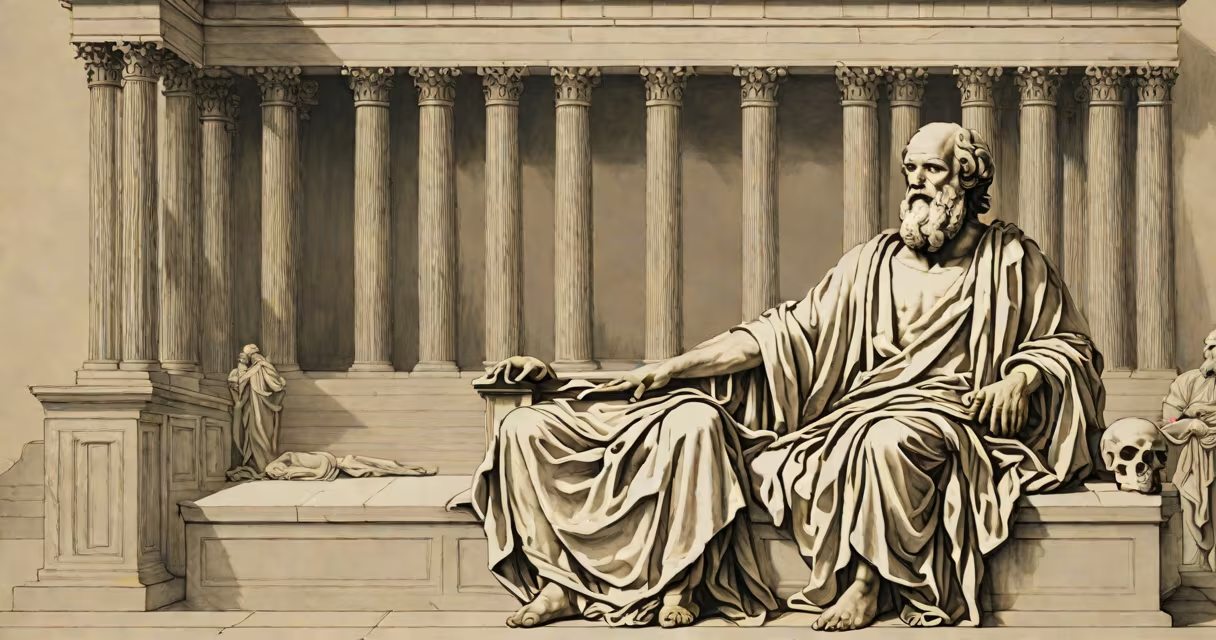
Socrates died in 399 BCE after being sentenced to drink hemlock by an Athenian jury. He refused to flee or compromise his principles, accepting death as a consequence of his lifelong pursuit of truth and moral integrity.
The trial was held in Athens during a period of political instability following the Peloponnesian War. Socrates was accused of impiety and corrupting the youth. His defense, recorded by his student Plato in the Apology, centered on his role as a philosopher who questioned assumptions and challenged societal norms. He claimed his mission came from a divine sign-an inner voice that guided him to examine virtue and justice.
After conviction, Socrates was imprisoned for thirty days while awaiting execution. During this time, he engaged in dialogue with friends and disciples, including Plato, who later wrote detailed accounts of his final hours. The death was not sudden-it was a slow process involving ingestion of poison hemlock, which caused paralysis and eventual respiratory failure. Socrates remained composed throughout, reportedly saying, "I owe a cock to Asclepius. Please pay it." This reference to the god of healing may have been a final gesture of gratitude or irony, acknowledging that death was a cure for the soul's illness.
Hemlock was a known poison in ancient Greece. Its effects were well-documented in medical texts. The plant contains alkaloids such as coniine, which disrupt neuromuscular function. Symptoms include muscle weakness, blurred vision, nausea, and eventually respiratory arrest. The dose administered to Socrates was calibrated to cause death within hours, not minutes.
Plato's Phaedo describes the scene in detail. Socrates drank the hemlock from a cup, then walked around until his legs grew numb. He lay down and spoke calmly with his companions until his body cooled. His final words were not a plea for mercy but a reflection on the immortality of the soul. He believed that philosophy was preparation for death-the soul, unburdened by the body, could achieve true knowledge.
Historical records confirm that Socrates did not resist. He accepted the verdict despite having the chance to escape. His friend Crito offered to bribe the guards. Socrates refused, arguing that breaking the law-even in response to injustice-would undermine the social contract. To flee would make him a hypocrite, proving that he valued life over principle.
Plato's Apology and Phaedo are the primary sources for the death of Socrates. These dialogues are not strict historical reports but philosophical narratives shaped by Plato's interpretation. However, scholars agree that the core events align with known facts. The Apology presents Socrates' defense speech, while Phaedo dramatizes his final hours.
Modern historians like Robin Waterfield, author of Plato: A Very Short Introduction, note that the trial was influenced by political fear. Athens had recently lost the war to Sparta and executed several generals. Accusations of corruption and disloyalty were common. Socrates' association with prominent figures like Alcibiades-a controversial general-may have fueled suspicion.
Another account comes from Xenophon, a contemporary and fellow soldier. His version in Memorabilia differs slightly-he portrays Socrates as more pragmatic and less defiant. But both versions agree on the outcome: Socrates died in prison, refusing to renounce his beliefs.
Many assume Socrates was executed for speaking out against democracy. This is incorrect. He was not charged with sedition or treason. The formal charges were asebeia (impiety) and diabolos ton neanion (corrupting the young). The accusation of impiety stemmed from his refusal to worship the state gods and his claim of a divine inner voice.
Another myth is that Socrates was tortured or suffered prolonged agony. There is no evidence of torture. Hemlock causes a gradual loss of motor control, not pain. Ancient physicians like Galen described the process as peaceful. Socrates' calm demeanor supports this view.
A lesser-known fact: the state did not execute him personally. The executioner was a public official, a slave named Midias, who carried out the sentence under legal authority. The act was not personal-it was procedural. Socrates' death was not a punishment inflicted by enemies but a lawful consequence of a trial.
Socrates' death became a foundational story in Western philosophy. It established the idea that truth and virtue outweigh survival. His choice to die rather than lie or flee set a precedent for ethical resistance. Thinkers from Augustine to Martin Luther King Jr. cited him as a model of principled action.
His final words-"We owe a cock to Asclepius"-are often misunderstood. Some interpret this as a joke or a sign of resignation. But in context, it reflects a belief in the soul's purification through death. Asclepius was associated with healing, and offering a cock was a traditional sacrifice after recovery from illness. Socrates may have seen death as a restoration of health to the soul.
Philosophers like Simone Weil and Hannah Arendt analyzed the event as a form of political martyrdom. Arendt argued in The Human Condition that Socrates' death marked the beginning of philosophy as a public act-one that confronts power with reason. His execution was not an end but a catalyst for inquiry.
| Figure | Time Period | Method | Reason for Death | Outcome |
|---|---|---|---|---|
| Socrates | 399 BCE | Hemlock | Impiety, corrupting youth | Symbol of intellectual integrity |
| Jesus Christ | 30-33 CE | Crucifixion | Challenging religious authority | Foundational figure in Christianity |
| Seneca | 65 CE | Self-inflicted stab | Accused of conspiracy | Death seen as dignified exit |
| Giordano Bruno | 1600 CE | Fire | Heretical views on cosmos | Martyr of scientific thought |
Unlike others, Socrates did not seek martyrdom. He did not preach revolution. He simply refused to stop questioning. His death was not a protest-it was a statement of consistency.
I once stood in the ruins of the Athenian Agora, near the site where the trial took place. The stone benches are worn smooth by centuries of foot traffic. Standing there, I imagined the crowd that gathered-students, elders, soldiers. Socrates didn't shout. He spoke quietly, with precision. That stillness, that refusal to perform, is what made the moment unforgettable.
The death of Socrates remains a touchstone for ethics, courage, and the cost of truth. It is not merely a historical event-it is a living example of how one person's choices can define a tradition. His final act was not defiance, but alignment: living in accordance with what he believed to be right, even when the world demanded otherwise.