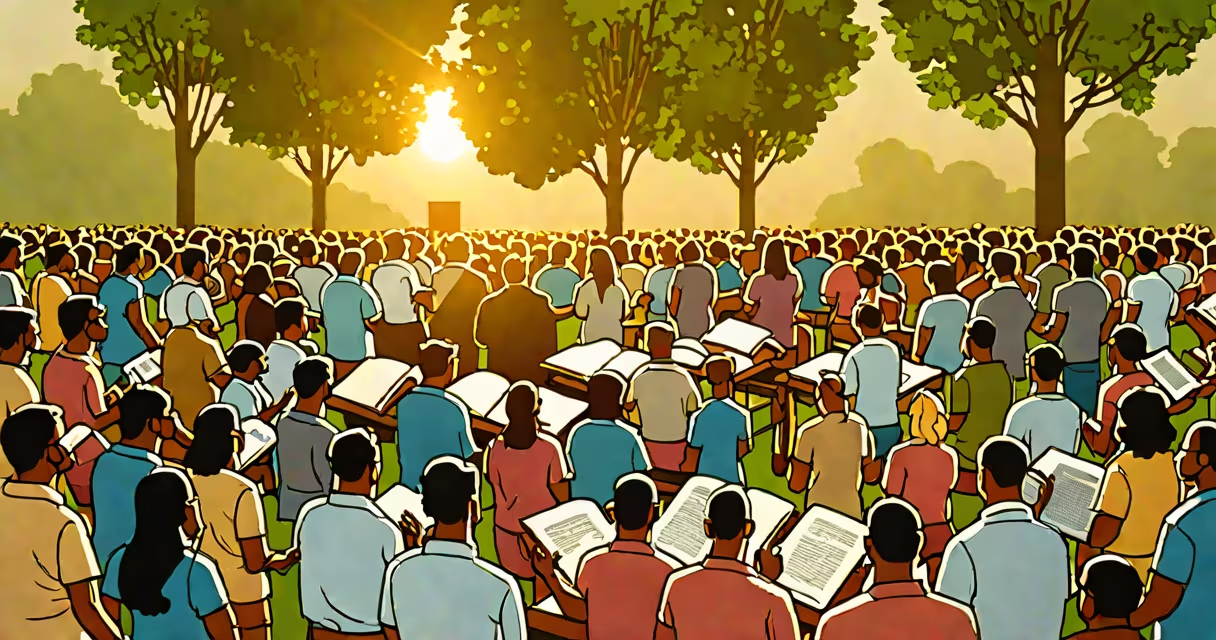
Evangelical religion refers to a branch of Protestant Christianity centered on personal conversion, the authority of the Bible, and active evangelism-sharing the message of Jesus Christ. It emerged from Reformation roots and gained global influence in the 20th century through grassroots movements and media.
The term "evangelical" derives from the Greek word *euangelion*, meaning "good news," specifically the Gospel. This focus on spreading the Gospel defines the movement's identity. Evangelicals prioritize a direct, major encounter with Jesus Christ, often described as being "born again." This spiritual rebirth is seen as essential for salvation and marks the beginning of a committed Christian life.
According to the Pew Research Center, approximately 26% of U.S. adults identify as evangelical, making it one of the largest religious groups in the country. Globally, the movement includes over 600 million adherents, with significant growth in Latin America, sub-Saharan Africa, and parts of Asia. These numbers reflect both the appeal of personal faith and the effectiveness of local church networks in expanding reach.
Evangelical religion operates through a combination of personal belief, communal practice, and mission-driven action. At its foundation is the belief that salvation comes through faith in Jesus Christ alone, not through good works or rituals. This doctrine, known as *sola fide* (faith alone), traces back to Martin Luther's Reformation teachings.
Scripture is viewed as the ultimate authority in matters of faith and practice. Evangelicals typically interpret the Bible literally or historically, believing it to be free from error in its original manuscripts. The National Association of Evangelicals (NAE), representing over 40,000 churches in the U.S., affirms that "the Bible is the inspired, inerrant Word of God."
Evangelicals emphasize evangelism-the act of sharing the Gospel-with urgency. This can include door-to-door outreach, youth missions, and digital platforms. The 1974 International Congress on World Evangelization in Manila established a benchmark for modern missionary efforts, leading to the formation of organizations like the Billy Graham Evangelistic Association and the Lausanne Movement.
Evangelical theology rests on five pillars commonly cited by leaders and scholars:
Churches within the movement vary in worship style-from traditional hymns to contemporary praise music-but all uphold these core tenets. Many evangelical congregations operate with a volunteer-led structure, relying on lay leadership rather than formal clergy hierarchy.
A notable feature is the rise of megachurches. As of 2023, the United States had over 1,000 churches with 2,000 or more attendees. Hillsong Church, based in Sydney but with global campuses, exemplifies how evangelicalism blends worship, community, and outreach into a scalable model. Its online presence reaches millions weekly.
While evangelicalism originated in Europe during the Reformation, its most changing growth has occurred outside the West. In Nigeria, evangelical churches have expanded rapidly since the 1980s, with estimates suggesting over 50 million Christians in the country-many affiliated with evangelical or Pentecostal movements.
In Brazil, the Assemblies of God, an evangelical denomination, claims over 12 million members. Their success stems from localized preaching, healing services, and community programs. A 2021 study by the University of São Paulo found that evangelical churches were twice as likely as Catholic parishes to offer social services like food distribution and job training.
Evangelicalism also plays a significant role in political and cultural life. In the U.S., evangelical voters influenced presidential elections in 2004, 2016, and 2020. The movement's stance on issues like abortion, marriage, and religious freedom reflects its moral structure rooted in biblical interpretation.
| Region | Estimated Evangelical Population | Key Growth Driver |
|---|---|---|
| Sub-Saharan Africa | 150 million+ | Local church planting and youth engagement |
| Latin America | 100 million+ | Pentecostal fusion and media outreach |
| North America | 70 million | Megachurch expansion and digital ministry |
| Asia-Pacific | 40 million+ | Underground church networks and refugee communities |
Evangelical religion is frequently mistaken for fundamentalism, but the two differ. While both emphasize biblical literalism, fundamentalists tend to withdraw from culture, whereas evangelicals engage actively in society and politics. The Southern Baptist Convention, though conservative, supports public education and civic participation-practices rare among strict fundamentalist groups.
Another misconception is that all evangelicals oppose science. This is false. Many evangelical scientists work in fields like genetics, climate research, and medicine. The BioLogos Foundation, founded by geneticist Francis Collins, promotes harmony between Christian faith and scientific discovery. Collins, who led the Human Genome Project, wrote in his book *The Language of God* that "science and faith are not enemies-they are partners in understanding creation."
A less obvious point: evangelicalism is not monolithic. There are distinct streams-charismatic, holiness, and Anabaptist-influenced branches-all claiming evangelical identity. For example, the Mennonite Church, while peace-oriented and non-militant, identifies as evangelical due to its emphasis on discipleship and Bible-based living.
In 2019, a team from the International Mission Board (IMB) launched a church plant in rural Kenya. They began by training local leaders using a curriculum based on the book of Acts. Over 18 months, they held weekly meetings in homes, taught basic Bible literacy, and organized community clean-ups to build trust.
By the end of the project, 14 new house churches existed, with 210 baptized members. Attendance rose from 15 to over 300 in six months. The initiative succeeded because it prioritized relationship-building over rapid growth. As one leader noted, "We didn't come to fix a problem-we came to walk alongside people learning to follow Jesus."
This example illustrates how evangelical practices balance spiritual conviction with practical service. It also shows that evangelism isn't always about large events-it can begin with a single conversation.
I attended a weekend retreat hosted by a regional evangelical network in 2022. The event included small group discussions, worship sessions, and a panel on mental health from a Christian counselor. What stood out was the absence of performance. People spoke openly about struggles-grief, anxiety, family conflict-without fear of judgment. The atmosphere wasn't about perfection but authenticity. That moment clarified how evangelicalism functions not as a rigid system, but as a relational response to spiritual need.
"Evangelical religion meaning" is not synonymous with "Christianity." While all evangelicals are Christians, not all Christians are evangelicals. Catholics, Orthodox believers, and liberal Protestants may affirm core doctrines like the resurrection but differ on conversion experiences, biblical interpretation, and mission strategies.
The term is sometimes misused to describe any religious enthusiasm. But evangelicalism is a specific theological and historical movement with defined markers. It is not merely passion-it is a structured expression of faith grounded in scripture, conversion, and mission.
For those exploring the season of penance and reflection, lent meaning religion offers a contrasting spiritual rhythm focused on repentance and renewal. Meanwhile, the concept of "g up meaning" in cultural contexts often refers to informal progress or growth-distinct from the theological weight of evangelical commitment.
Understanding evangelical religion meaning requires recognizing its blend of personal transformation, scriptural fidelity, and global outreach. It is neither a monolith nor a passing trend. It is a living tradition shaping religious life across continents and generations.