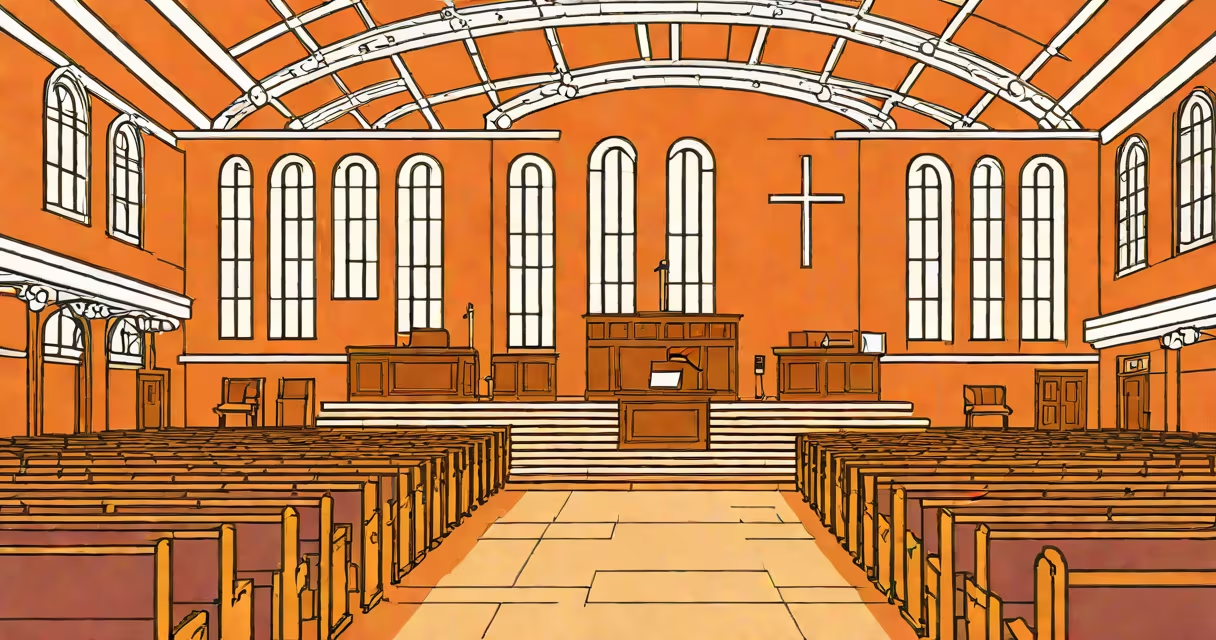
The term "evangelist church" refers to a Protestant Christian congregation rooted in the practice of evangelism-the public proclamation of the Gospel message to promote personal conversion and spiritual renewal. These churches emphasize preaching, altar calls, and personal testimonies as core elements of worship and outreach.
Evangelist churches emerged prominently in the 18th and 19th centuries during revivals like the Second Great Awakening in the United States. They are distinct from liturgical traditions such as Roman Catholicism or Eastern Orthodoxy, which center on sacraments and ritual. Instead, evangelist churches prioritize individual faith experiences, Bible-based sermons, and mission-driven community engagement.
While the word "evangelist" appears in the New Proof (Ephesians 4:11), referring to a spiritual role, the modern usage of "evangelist church" describes a denomination or independent congregation organized around evangelistic purpose. Notable examples include the Assemblies of God, Church of the Nazarene, and various independent megachurches founded by figures like Billy Graham and Benny Hinn.
Evangelist churches operate through structured preaching cycles, often following a topical or verse-by-verse Bible study format. Services typically last 60 to 90 minutes and feature a central sermon delivered by a pastor or visiting evangelist. The message focuses on sin, repentance, salvation through Jesus Christ, and the call to discipleship.
Altar calls are a sign of many evangelist services. After the sermon, attendees are invited to come forward to accept Jesus personally. This act is seen as a public declaration of faith, often accompanied by prayer, music, and follow-up counseling. Research from the Pew Research Center shows that 72% of Protestants in the U.S. attend churches where altar calls occur regularly, underscoring their cultural significance.
Small groups or discipleship circles are common post-service activities. These gatherings provide accountability, Bible study, and peer support. A 2021 study by the Barna Group found that 68% of attendees in evangelical churches participate in small groups, compared to 34% in mainline Protestant denominations.
Evangelist churches vary widely in structure. Some are independent congregations; others belong to larger networks. The table below outlines major types based on governance, size, and theological emphasis.
| Type | Governance | Typical Size | Key Features |
|---|---|---|---|
| Pentecostal | Regional or national leadership | 100-2,000 members | Emphasis on Holy Spirit gifts, speaking in tongues, healing |
| Non-denominational | Local board or pastoral oversight | 50-5,000+ | Flexible theology, contemporary worship, high media presence |
| Charismatic | Global network (e.g., International Charismatic Movement) | 1,000-10,000+ | Focus on spiritual gifts, large-scale events, global outreach |
Despite differences, all share a commitment to evangelism as a primary mission. The National Association of Evangelicals reports that 94% of member churches conduct regular outreach programs, including food drives, youth camps, and international missions trips.
Evangelist churches are most prevalent in North America, Sub-Saharan Africa, and parts of Latin America. In Nigeria, for example, the Redeemed Christian Church of God (RCCG) has over 10 million members across 100 countries, making it one of the largest evangelical movements globally.
These churches often serve as centers of social cohesion in urban and rural communities. In post-industrial towns in the American Midwest, they fill gaps left by declining civic institutions. A 2020 report from the Urban Institute found that 62% of low-income residents in Rust Belt cities reported attending an evangelical church for emotional support or practical aid.
They also play a significant role in political and cultural discourse. In the U.S., evangelical voters have influenced presidential elections since the 1980s. According to the Pew Research Center, 70% of evangelical Protestants voted for Donald Trump in 2016, citing shared values on abortion and religious freedom.
"Evangelist church" is frequently mistaken for "Pentecostal church," though the latter is a subset. All Pentecostal churches are evangelical in orientation, but not all evangelist churches emphasize glossolalia (speaking in tongues) or charismatic experiences. The distinction matters: a non-Pentecostal evangelical church may reject supernatural manifestations as doctrinally unproven.
A second misconception is equating evangelist churches with prosperity gospel movements. While some megachurches promote wealth as divine reward, this teaching is controversial even within evangelical circles. The National Association of Evangelicals explicitly disavows the prosperity gospel, stating in a 2019 statement that "material blessings are not guaranteed by faith."
Consider a typical Sunday at Grace Fellowship Church, a non-denominational evangelical congregation in Austin, Texas, with 2,100 weekly attendees. The service begins at 10:00 a.m. with a 20-minute worship set featuring contemporary Christian songs. The band includes a keyboardist, drummer, lead guitarist, and vocalists.
At 10:30 a.m., Pastor David delivers a 45-minute sermon titled "The Cost of Following Jesus." He uses Luke 14:26-33 as his text, explaining that discipleship requires prioritizing God above family, possessions, and comfort. He shares a story of a young man who left a corporate job to serve in a refugee camp in Jordan.
After the sermon, the worship team leads a song called "Oceans (Where Feet May Fail)." At 11:30 a.m., the invitation is given: "If you've never made a decision for Christ, come forward now." Over 80 people walk to the front. Volunteers greet them, offer prayer, and hand out discipleship packets.
Following the service, small groups meet in classrooms. One group discusses Romans 12:1-2, focusing on "living sacrifices" and daily surrender. Another hosts a parenting workshop. The entire event runs on volunteer labor and donations-no paid staff beyond the pastor.
I attended a similar service at a church in Nashville during a winter retreat. The atmosphere was warm but intense. People clapped, raised hands, and wept openly during the music. After the altar call, a woman approached me, her eyes red, saying, "I've been searching for years. Today, I finally felt peace." That moment confirmed what research suggests: evangelist churches fulfill deep psychological and communal needs beyond doctrine.
The evangelist church meaning centers on mission-driven faith, not institutional form. It is not a denomination but a function-a church whose primary identity is spreading the Gospel. This focus shapes everything from architecture (open spaces for movement) to programming (outreach events, youth camps).
Understanding this clarifies why some churches labeled "evangelical" resist being categorized under traditional denominational systems. Their goal is not preservation but expansion-reaching those who have never heard the message of Jesus.
For those exploring spiritual roots, the difference between sacramental and evangelical traditions matters. If you're seeking a faith grounded in ritual and mystery, Catholic or Orthodox traditions may suit you better. But if you value personal encounter, changing preaching, and active mission work, the evangelist church meaning reflects a living, breathing expression of Christian faith.