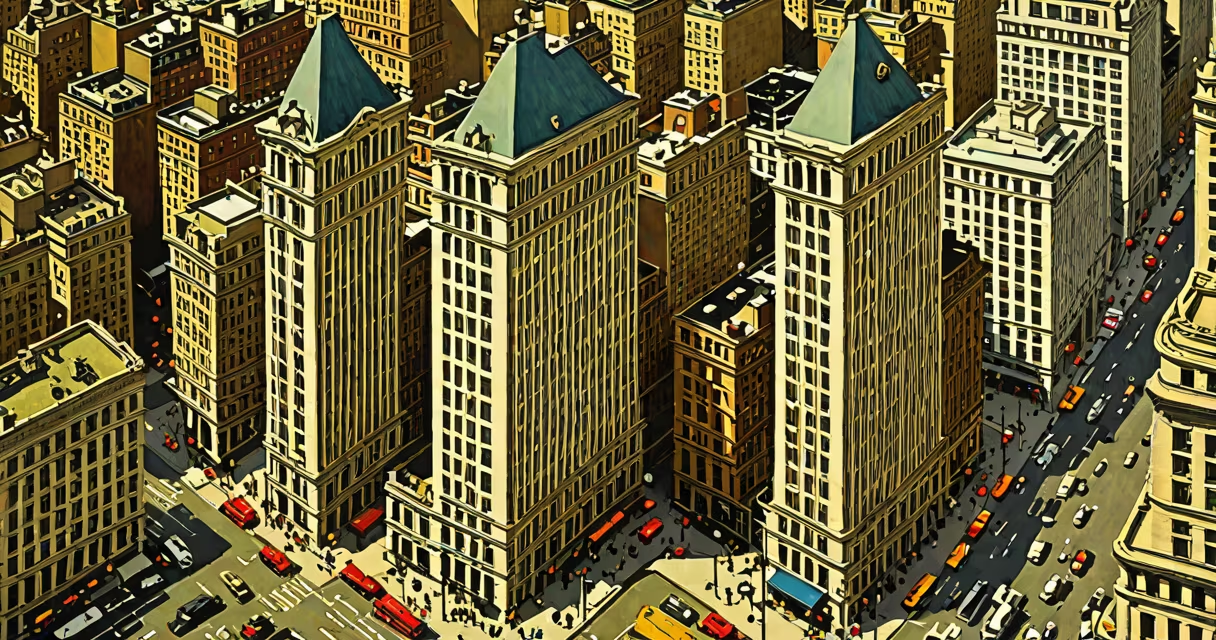
The Flatiron Building in New York City is a 22-story Art Deco skyscraper located at the intersection of Fifth Avenue and Broadway in Manhattan, notable for its wedge-shaped design and status as a National Historic Landmark since 1966.
Completed in 1902, the Flatiron Building was among the first steel-framed high-rises in New York. Its triangular footprint results from the convergence of Broadway at a 29-degree angle with Fifth Avenue, creating a narrow, pointed structure that resembles a household iron-hence its name. The building stands 285 feet tall and was the tallest in Manhattan for six years after its completion.
Designed by architect Daniel Burnham and his firm D.H. Burnham & Co., the structure features limestone cladding, vertical setbacks, and a stepped cornice typical of early 20th-century commercial architecture. The original interior was designed for office use, housing law firms, insurance companies, and early tech startups. Today, it remains a symbol of New York's architectural ambition and urban planning evolution.
The Flatiron Building's unique shape emerged from a practical constraint: the city grid's irregular geometry. Broadway cuts diagonally across Manhattan's rectangular street pattern, forming a triangle between 23rd Street, Fifth Avenue, and Broadway. The site's narrow width-just 65 feet at its base-forced a design that maximized usable floor space while minimizing structural load on the foundation.
Engineers used a steel skeleton frame, a then-revolutionary technique that allowed taller buildings without relying solely on masonry walls. This frame distributed weight vertically through columns and beams, enabling the building to rise above its narrow footprint. The façade's limestone panels were prefabricated off-site and installed in precise alignment to maintain aesthetic continuity.
Despite its height, the building's wind resistance was a concern. Engineers added diagonal bracing and wind-dampening elements in the upper floors. Wind speeds at the rooftop can exceed 40 mph during storms-strong enough to make signs sway and windows rattle. The building's orientation amplifies wind funneling effects, especially at the corner where Fifth Avenue meets Broadway.
The Flatiron Building's exterior is clad in Indiana limestone, quarried from Bedford, Indiana. The stone was chosen for its durability, uniform texture, and ability to withstand New York's harsh winters. Over time, weathering has caused subtle discoloration, particularly on the southern face exposed to prevailing winds.
Interior features include a central elevator core, wide corridors, and large windows oriented toward the sun. The ground-floor retail spaces have undergone multiple renovations, including a 2017 overhaul that restored original brass fixtures and replaced glass storefronts with historically accurate designs. The building's mechanical systems were upgraded in 2009 to meet modern energy codes, reducing heating and cooling costs by 30% compared to pre-renovation levels.
| Feature | Detail |
|---|---|
| Height | 285 ft (87 m) |
| Floors | 22 |
| Completion Date | 1902 |
| Architect | Daniel Burnham & Co. |
| Landmark Status | National Historic Landmark (1966) |
The Flatiron Building currently hosts a mix of tenants, including tech startups, law offices, and creative agencies. Its prime location near Union Square and the Empire State Building makes it highly sought after. Average rental rates in 2023 reached $85 per square foot annually, higher than the citywide average of $55.
Culturally, the building is a frequent backdrop in film and television. It appears in *Spider-Man* (2002), *The Amazing Spider-Man* (2012), and the TV series *Law & Order*. The building's silhouette is often photographed at golden hour, when sunlight hits the east-facing side, casting long shadows across the plaza.
A lesser-known fact: the building's original name was the Fuller Building, after its developer, George B. Fuller. The nickname "Flatiron" emerged informally in the press and became official by the 1920s. The name stuck despite the building's actual height being nearly four times its base width.
Many assume the Flatiron Building is the tallest in Manhattan. It is not. The Chrysler Building (1,046 ft) and One World Trade Center (1,776 ft) both surpass it. However, it remains one of the most recognizable due to its shape and location.
Another misconception is that the building was designed specifically to fit the triangle. In reality, the site was already defined by city zoning laws. Architects adapted the design to the existing geometry rather than shaping the city to accommodate the building.
Some visitors believe the building leans. It does not. The tilt is an optical illusion caused by perspective and the steep angle of Broadway. Survey data from the NYC Department of Buildings confirms the structure's plumb tolerance is within 0.1 degrees.
In 2022, a software development team moved into Set 1402, occupying 4,200 square feet on the 14th floor. They reported a 15% increase in employee satisfaction after relocating, citing better natural light and views of the Empire State Building. The office layout included standing desks, soundproof meeting pods, and a rooftop terrace used for team events.
Energy usage dropped 22% after installing smart thermostats and motion-sensor lighting. The building's central HVAC system, updated in 2018, maintains indoor temperatures between 68°F and 72°F year-round. During winter months, the building's steam pipes heat adjacent structures, contributing to district-wide efficiency.
While the Flatiron Building is a standalone icon, it exists within a network of historic districts. The area is part of the Flatiron District, designated as a New York City Landmark District in 1989. Nearby, the old Bryant Park Hotel (now a luxury residence) and the former site of the New York Tribune building contribute to the neighborhood's layered history.
The Flatiron Building New York remains a living monument-not just to early skyscraper engineering, but to the enduring power of form shaped by place.