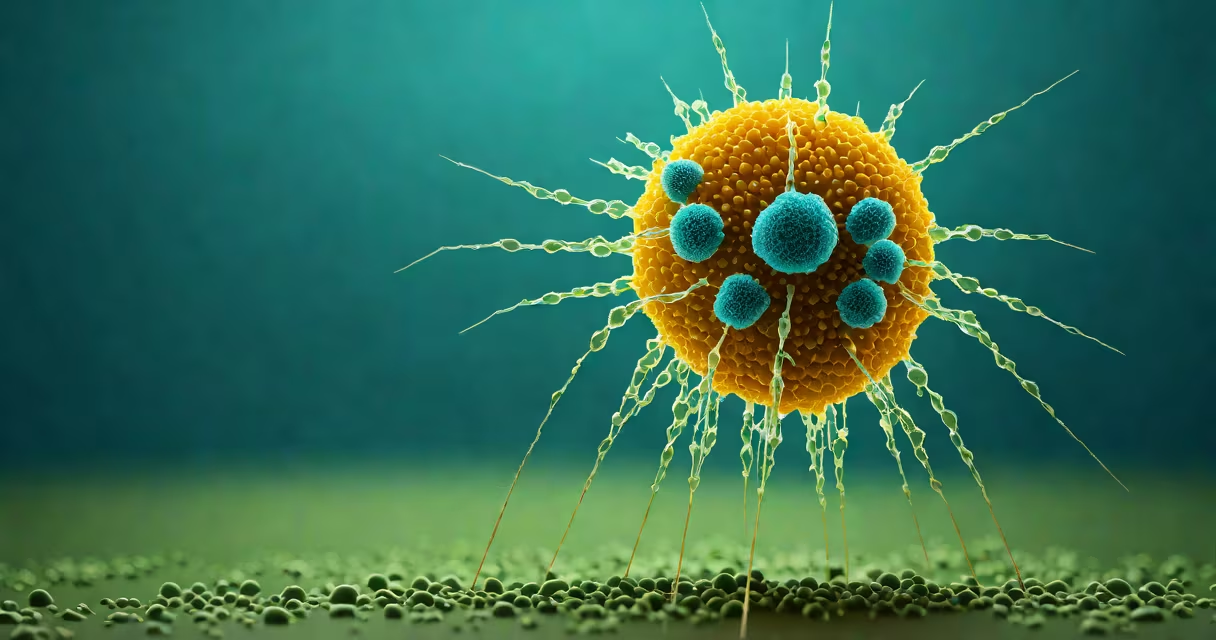
A bacteriophage virus, or simply phage, is a virus that specifically infects and replicates within bacteria. It uses bacterial cellular machinery to produce new viral particles, often destroying the host cell in the process. Phages are among the most abundant biological entities on Earth, with estimates suggesting they outnumber bacteria tenfold in marine environments.
Phages consist of a protein capsid enclosing genetic material-either DNA or RNA-and a tail structure that facilitates attachment to specific receptors on bacterial surfaces. Once bound, the phage injects its genome into the host cell, hijacking the cell's replication and protein synthesis systems to generate thousands of new phage particles. After assembly, the host cell lyses (bursts), releasing progeny viruses to infect neighboring bacteria.
Research from the National Institutes of Health confirms that phages play a critical role in regulating bacterial populations in ecosystems such as soil, oceans, and the human gut microbiome. Their specificity makes them valuable tools in both environmental science and clinical applications, particularly in developing alternatives to antibiotics.
Phage infection begins with recognition and binding. The tail fibers of a phage detect specific surface proteins or polysaccharides on a bacterial cell. This interaction is highly selective-each phage strain typically targets only certain bacterial species or strains. For example, T4 phage binds exclusively to *Escherichia coli* via its tail fibers, which recognize lipopolysaccharide molecules on the outer membrane.
After binding, the phage contracts its tail sheath, driving a hollow tail tube through the bacterial envelope. The viral genome-double-stranded DNA in the case of T4-is then injected into the cytoplasm. Once inside, the phage genome takes control of the host's transcription and translation systems. Host genes are shut down, and phage-encoded enzymes begin synthesizing viral components: capsids, tails, and genomes.
The entire replication cycle-from attachment to lysis-can take as little as 20 minutes in optimal conditions. During this time, a single infected cell may release between 100 and 300 new phage particles. Lysis occurs when phage-encoded holins form pores in the inner membrane and endolysins degrade the peptidoglycan layer, causing osmotic rupture.
Bacteriophages are broadly categorized by their life cycle: lytic and lysogenic. The lytic cycle results in immediate host cell destruction, while the lysogenic cycle involves integration of the phage genome into the bacterial chromosome, allowing long-term dormancy.
| Type | Replication Method | Host Outcome | Example |
|---|---|---|---|
| Lytic | Immediate replication and cell lysis | Cell death | T4 phage (infects *E. coli*) |
| Lysogenic | Genome integrates into host DNA; remains dormant until triggered | Latent infection; potential for host transformation | λ phage (lambda) in *E. coli* |
Some lysogenic phages carry genes that confer advantages to their host. For instance, the cholera toxin gene (*ctxA*) in *Vibrio cholerae* is encoded by a prophage integrated into the bacterial genome. This demonstrates how phages contribute to bacterial evolution and pathogenicity.
Another distinction lies in morphology. The most studied phages belong to the *Caudovirales* order, characterized by a head-tail structure. However, some phages lack tails entirely-such as the filamentous phages that grow by extrusion rather than lysis. These include M13, used in biotechnology for phage display techniques.
Phages are used in research, medicine, and industrial processes due to their precision and abundance. In laboratories, they serve as model organisms for studying gene regulation and viral genetics. The discovery of restriction enzymes-tools essential to recombinant DNA technology-came from observing how phages were degraded by bacterial defense systems.
Medically, phages are being explored as therapeutic agents in the face of rising antibiotic resistance. A 2023 study published in *Nature Microbiology* documented successful treatment of a multidrug-resistant *Pseudomonas aeruginosa* infection in a patient using a personalized phage cocktail. The therapy reduced bacterial load by 99% over seven days without adverse effects.
Industrial applications include food safety. In the United States, the FDA has approved the use of phage-based products like ListShield™ to reduce *Listeria monocytogenes* contamination on ready-to-eat meats. These formulations are applied during processing and have shown efficacy in reducing pathogen levels by over 90% in controlled trials.
One widespread error is assuming phages can infect human cells. They cannot. Their structural specificity limits them to bacterial hosts only. Human cells lack the receptors phages require for attachment. This makes phage therapy inherently safe for patients, unlike broad-spectrum antibiotics that disrupt beneficial microbiota.
Another misconception is that phages are "viruses" in the same sense as influenza or HIV. While all are viruses, phages differ in host range, genome type, and evolutionary history. Unlike animal viruses, which often use lipid envelopes and fuse with membranes, phages rely on direct injection and mechanical penetration. This difference affects how they are studied and applied.
During my work in a microbiology lab, I observed a lawn of *E. coli* cultures develop clear zones-called plaques-after being exposed to a phage suspension. Each plaque represented a single phage particle that had replicated and killed surrounding bacteria. This visual confirmation of infection is still a standard method for quantifying phage concentration in research settings.
Phages are not a new concept. They were first identified in 1915 by Frederick Twort and independently by Félix d'Hérelle in 1917. D'Hérelle coined the term "bacteriophage," meaning "bacteria eater." Despite early enthusiasm, phage therapy was largely abandoned in Western medicine after the rise of antibiotics. Now, renewed interest driven by antimicrobial resistance has led to clinical trials in Europe and North America.
Understanding what is a bacteriophage virus reveals a useful natural mechanism for controlling bacterial growth. Its precision, abundance, and ecological significance make it a important subject in biology and medicine. As antibiotic resistance continues to challenge global health, phage-based strategies offer a targeted alternative.