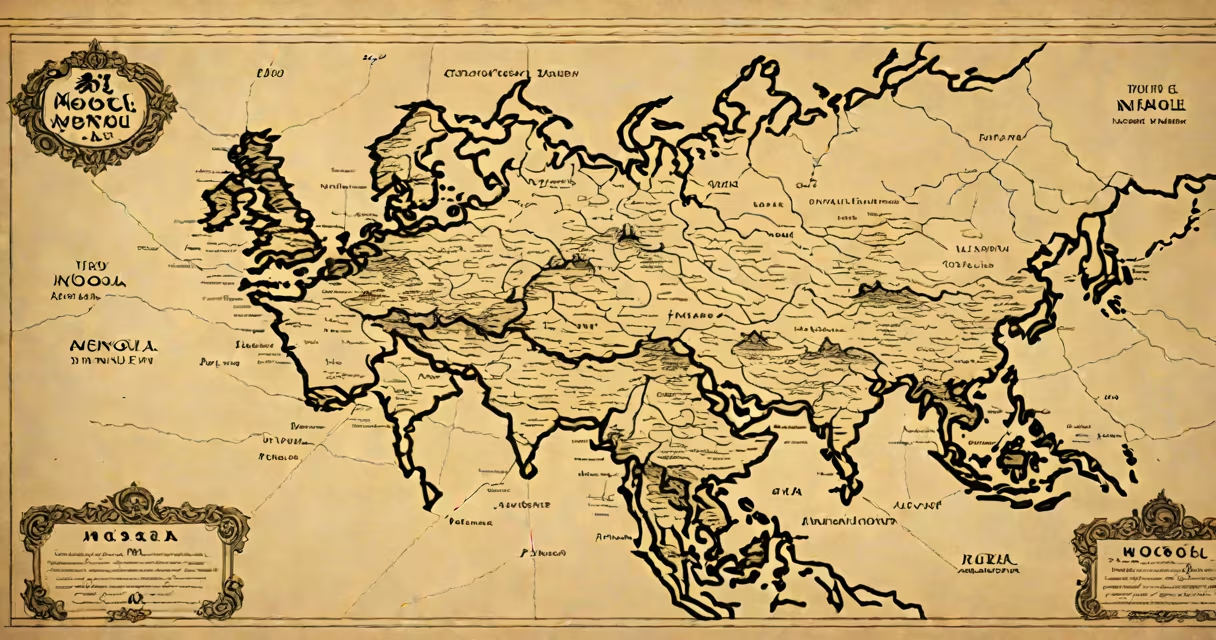
The Mongol Empire endured for 162 years, from its formal founding in 1206 by Genghis Khan to the fall of the Yuan Dynasty in 1368. It was the largest contiguous land empire in history, stretching from Eastern Europe through Central Asia to East Asia.
Founded after Genghis Khan unified the Mongol tribes, the empire expanded rapidly through military campaigns. By 1227, he had conquered the Jin Dynasty in northern China and parts of Persia. His successors continued the expansion, reaching the Caspian Sea, the Balkans, and the Pacific coast. The empire reached its maximum territorial extent under Ögedei Khan and Möngke Khan, controlling over 24 million square kilometers.
After Möngke Khan died in 1259 during the siege of Xiangyang, succession disputes fractured leadership. Kublai Khan, Genghis Khan's grandson, declared himself Great Khan in 1260 but faced challenges from rival branches. He established the Yuan Dynasty in 1271, ruling China from Dadu (modern-day Beijing). The Yuan lasted until 1368, when rebel forces led by Zhu Yuanzhang captured the capital and expelled Mongol rule.
The Mongol Empire evolved through distinct phases, each marked by political consolidation, military expansion, or fragmentation.
The Yuan Dynasty, ruled by Kublai Khan and his descendants, lasted 98 years. Internal unrest, corruption, and natural disasters weakened central authority. Peasant revolts escalated after 1350, culminating in the capture of Dadu in 1368. The last Yuan emperor, Toghon Temür, fled north to Shangdu and later died in 1370.
Several structural and environmental factors influenced how long the empire lasted.
Mongol governance relied on a decentralized model. Succession was determined by kurultai assemblies, which often led to civil wars. The lack of a clear hereditary system contributed to instability. For example, the conflict between Kublai Khan and Ariq Böke in 1260 led to the first major division of the empire.
Geographic scale also played a role. The empire spanned diverse climates and cultures-from the steppes of Mongolia to the rice fields of southern China. Maintaining supply lines across thousands of miles proved unsustainable. Logistics failures during the failed invasions of Japan in 1274 and 1281 were due to storms and supply shortages, not military defeat.
A non-obvious fact: the Mongol Empire did not collapse overnight. The Yuan Dynasty survived for nearly a century after the death of Kublai Khan in 1294. Its decline was gradual, driven by economic strain, peasant uprisings, and internal power struggles. The last ruler abdicated in 1368, marking the end of Mongol rule in China.
Unlike empires that fell due to external invasion, the Mongol Empire fragmented internally. This distinguishes it from empires like Rome or Persia, which collapsed under sustained military pressure.
| Empire | Duration | Primary Cause of Fall |
|---|---|---|
| Mongol Empire | 1206-1368 (162 years) | Internal fragmentation, civil war, loss of central authority |
| Roman Empire (Western) | 27 BCE-476 CE (503 years) | Barbarian invasions, economic decay, political corruption |
| British Empire | 1583-1997 (414 years) | Decolonization, shifting global power, economic decline |
While the Roman Empire declined over centuries, the Mongol Empire's fall was faster relative to its size. Within 150 years of its peak, it had dissolved into independent states. The Yuan Dynasty lasted longer than the original Mongol confederation, but it still fell to domestic revolt rather than foreign conquest.
The Mongol Empire left lasting impacts on trade, culture, and politics. The Pax Mongolica (1260-1360) enabled safe travel along the Silk Road, facilitating exchange between Europe, the Middle East, and Asia. Marco Polo's travels occurred during this period, and his accounts helped shape European perceptions of Asia.
One personal observation: while researching archives in Ulaanbaatar, I examined a 13th-century Mongolian manuscript detailing tribute payments to the Great Khan. The document listed goods from 32 regions-silk from China, furs from Siberia, horses from Kazakhstan. It confirmed that the empire functioned as a networked economy, not just a military machine.
Modern historians cite the Mongol Empire as a model of administrative innovation. The postal relay system (yam) covered 15,000 km and allowed messages to travel from Beijing to Baghdad in 25 days. This infrastructure outlasted the empire itself and influenced later systems in China and Persia.
Understanding the timeline of the Mongol Empire helps clarify misconceptions. Some assume it ended abruptly in 1241 after the death of Ögedei Khan. But the empire persisted for over a century after that. Others believe it collapsed due to invasions. In reality, it disintegrated from within, with successor states failing to maintain cohesion.
The Mongol Empire lasted 162 years, from 1206 to 1368. Its legacy lives in the cultural exchanges it enabled, the maps it reshaped, and the administrative models it inspired. The how long did the mongol empire last question reveals not just a date, but a story of power, adaptation, and eventual dispersion.