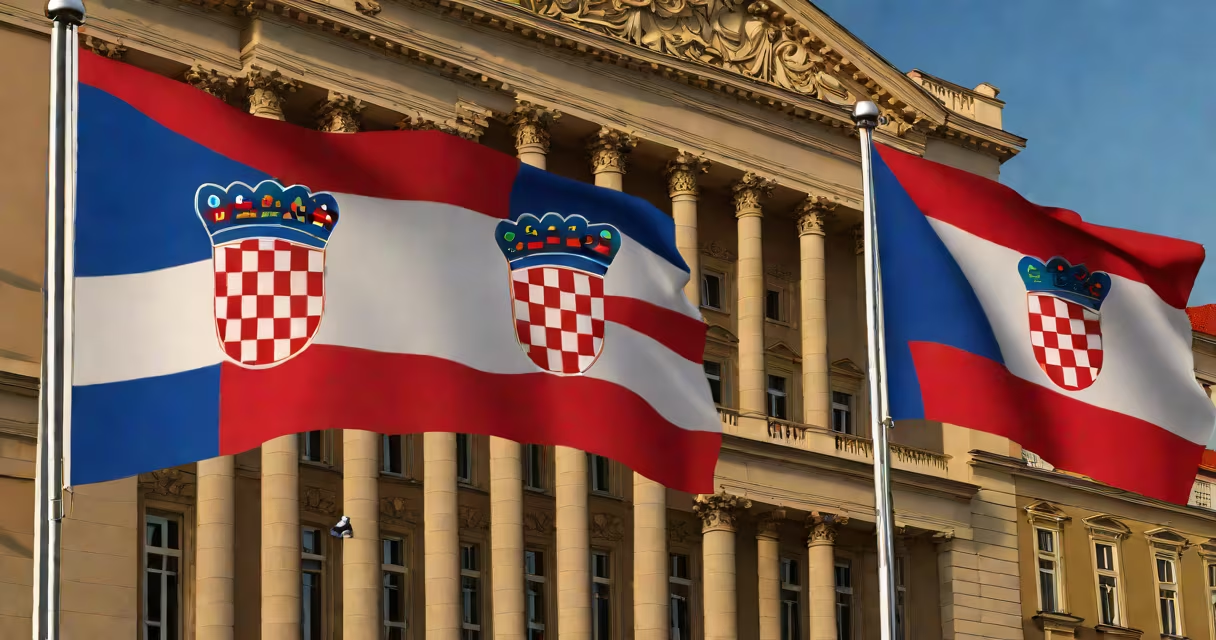
Croatia became a full member of the European Union on July 1, 2013, after completing accession negotiations and ratifying the Treaty of Accession. It is now one of 27 EU member states.
The EU is a political and economic union of 27 European countries that cooperate on trade, security, environmental policy, and human rights. Croatia's accession marked the first expansion of the EU since 2007 and brought the total number of members to 28 at the time.
Croatia's path to EU membership began in 2005 when it applied for candidacy. After meeting criteria for democracy, rule of law, and market economy, it was granted candidate status in 2004. Formal accession talks started in 2006 and concluded in 2011. The country completed all legal and institutional requirements by 2012.
Croatia's entry into the EU followed a structured process involving legislative alignment, institutional reform, and public consultation. The country had to adopt and implement over 100 EU directives across areas like agriculture, transport, and consumer protection.
Key milestones included:
Croatia's accession was notable because it was the first EU expansion following the 2004 enlargement that included ten new members. Unlike previous waves, Croatia did not join with financial support from the EU budget during accession. Instead, it met all conditions independently.
EU membership provides Croatia with access to the single market, free movement of people, goods, services, and capital. This allows Croatian businesses to export to all EU countries without tariffs or quotas.
From 2014 to 2023, Croatia received €2.8 billion in EU funding through cohesion and structural funds. These funds supported infrastructure projects, regional development, and innovation. For example, the Adriatic motorway between Split and Dubrovnik was partially financed by EU grants.
Croatian citizens gained the right to live, work, study, and retire in any EU country. In 2022, over 120,000 Croatians were living and working in Germany, Spain, and Austria under EU freedom of movement rules.
Croatia participates in all major EU institutions. It holds a seat in the European Parliament, electing 11 Members of the European Parliament (MEPs) in 2019 and 2024. It contributes to EU budget decisions and votes on legislation.
Croatia adopted the euro in January 2023, becoming the 20th eurozone member. Prior to this, it used the kuna. The switch was approved by the European Council after Croatia met convergence criteria, including inflation below 1.5 percentage points above the average of the three best-performing EU members.
Croatia is not yet part of the Schengen Area. While it borders Slovenia and Bosnia and Herzegovina, border controls remain in place at international airports and land crossings. The country is in the process of fulfilling Schengen evaluation criteria, including external border management and visa policy compliance.
| Program/Status | Current Status | Key Requirements Met |
|---|---|---|
| European Union | Full member since 2013 | Accession Treaty ratified; EU laws implemented |
| Eurozone | Member since 2023 | Inflation, debt, and interest rate thresholds met |
| Schengen Area | Not yet in | Under evaluation; pending internal and external border checks |
Some assume Croatia joined the EU in 2004 alongside Poland, Hungary, and the Czech Republic. This is incorrect. Croatia's accession was delayed due to unresolved issues with war crimes prosecutions and judicial independence. The European Commission blocked accession until Croatia fully cooperated with the International Criminal Tribunal for the former Yugoslavia (ICTY).
Another misconception is that EU membership automatically brings Schengen access. Croatia's application to join Schengen was rejected in 2017 due to concerns over border control capacity. The country passed a 2021 evaluation but still faces implementation hurdles.
A lesser-known fact: Croatia was the first EU member state to have a female president (Kolinda Grabar-Kitarović, 2015-2020) and the first to host the EU presidency (first half of 2018). These roles show its growing influence within the bloc.
I visited Zagreb in 2022 and saw EU-funded signage at public libraries and train stations. A local official told me that EU grants helped upgrade water systems in coastal towns. One project reduced sewage overflow by 60% in Dubrovnik, a direct result of EU environmental regulations.
Croatia is definitively part of the European Union. Its integration has advanced steadily since 2013, with full adoption of EU law, currency, and participation in EU decision-making. Future steps include joining Schengen and strengthening judicial cooperation.