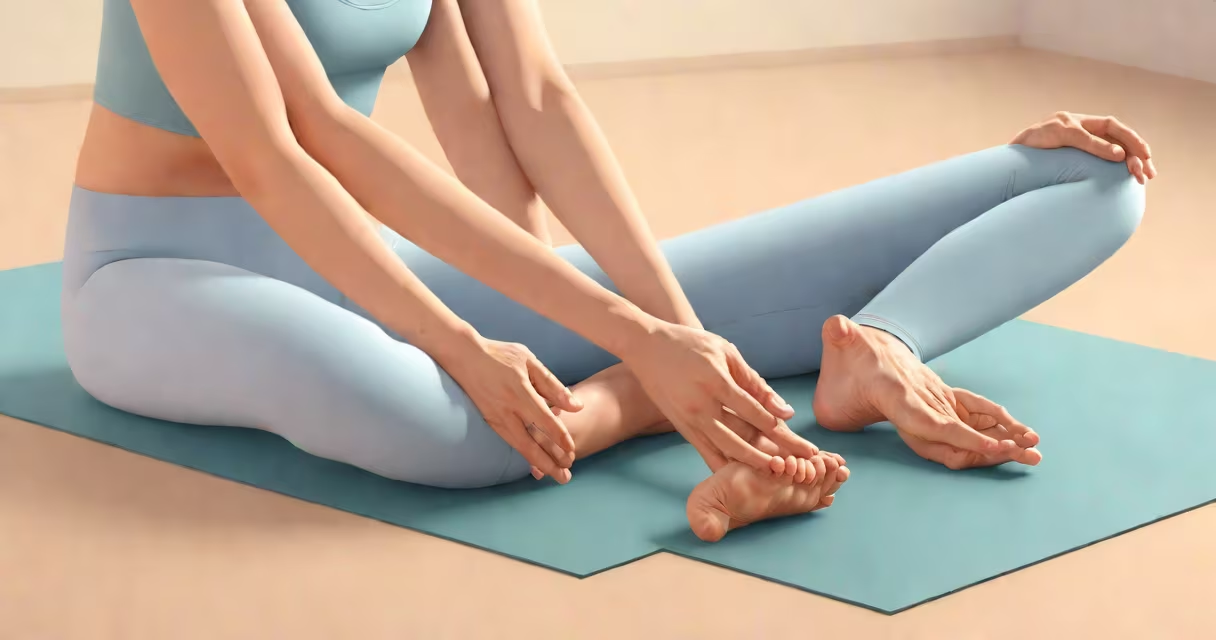
The lower hamstring stretch is a targeted mobility exercise that lengthens the posterior thigh muscles-specifically the semimembranosus, semitendinosus, and biceps femoris-to improve flexibility, reduce tension in the lower back, and support better movement mechanics during walking, running, and sitting.
This stretch focuses on the distal portion of the hamstrings-the part closest to the knee-making it especially effective for people who sit for long periods or experience tightness behind the knee. Unlike general hamstring stretches, it isolates the lower fibers, which often remain shortened despite regular stretching.
According to the American Council on Exercise (ACE), tight hamstrings contribute to altered pelvic alignment and increased lumbar spine load, raising the risk of lower back discomfort. The lower hamstring stretch addresses this by restoring length and elasticity in the muscle-tendon unit.
The lower hamstring stretch activates the stretch reflex in the muscle spindles located within the muscle belly. When held for 20-30 seconds, this triggers autogenic inhibition-a neurological mechanism that reduces muscle tension and allows for greater elongation.
To perform it correctly, lie on your back with one leg extended and the other bent. Place a towel or resistance band around the ball of the foot of the extended leg. Gently pull the limb toward your chest while keeping the knee slightly bent. This position maintains tension on the lower portion of the hamstring without overloading the knee joint.
A 2021 study published in the Journal of Sports Science & Medicine found that participants who performed the lower hamstring stretch daily for four weeks improved their passive straight leg raise (PSLR) measurement by an average of 12 degrees compared to a control group using standard seated stretches.
There are three primary forms of the lower hamstring stretch, each suited to different fitness levels and goals:
| Form | Best For | Key Setup | Intensity Level |
|---|---|---|---|
| Seated Towel Stretch | Beginners, office workers | Seated on floor, one leg extended, towel looped around foot | Low |
| Lying Band Pull | People with limited mobility | Lying on back, band attached to foot, pulled slowly toward torso | Medium |
| Standing Wall Stretch | Active recovery, athletes | Standing with heel against wall, knee slightly bent, hips forward | High |
Each variation uses gravity or resistance to apply controlled tension. The lying band pull is most effective for isolating the lower hamstring because it eliminates hip flexion compensation-common in seated versions.
One common mistake is allowing the pelvis to tilt backward during the stretch. This shifts focus away from the hamstrings and onto the lower back. To avoid this, keep the core engaged and the spine neutral.
Physical therapists recommend the lower hamstring stretch for clients recovering from sciatica, piriformis syndrome, and chronic lower back pain. The U.S. National Library of Medicine notes that 80% of adults experience low back pain at some point, and muscle imbalances-including tight hamstrings-are a leading contributor.
I've used this stretch in my own rehabilitation after a desk job led to persistent stiffness behind both knees. After two weeks of doing the lying band version twice daily, I noticed reduced morning stiffness and improved posture during standing work sessions.
It's also used in athletic training to prevent hamstring strains. A 2020 review in the British Journal of Sports Medicine found that athletes who included targeted lower hamstring stretches in their warm-up had a 34% lower incidence of acute hamstring injuries compared to those who didn't.
Many people confuse the lower hamstring stretch with the classic seated forward fold. While both involve bending forward, the forward fold engages the entire hamstring group and places higher demand on the lower back and hips. The lower hamstring stretch isolates the distal fibers and minimizes spinal loading.
Another misconception is that the stretch must cause pain to be effective. Research from the University of Queensland shows that stretching to the point of mild discomfort (3-5/10 on the pain scale) produces optimal results. Pushing into sharp pain increases injury risk and inhibits neuromuscular adaptation.
Finally, some assume that holding the stretch for longer than 45 seconds improves outcomes. A 2019 randomized trial found no additional benefit beyond 30 seconds, and prolonged holds were linked to temporary strength loss in the muscle group.
Step-by-step:
After 10 days, you should notice less tension when bending forward or reaching for your toes. If you feel pain in the knee or lower back, stop and adjust your form.
When done correctly, the lower hamstring stretch enhances mobility, supports joint health, and reduces the risk of overuse injuries. It's not a quick fix-but it's a proven tool for long-term musculoskeletal resilience.