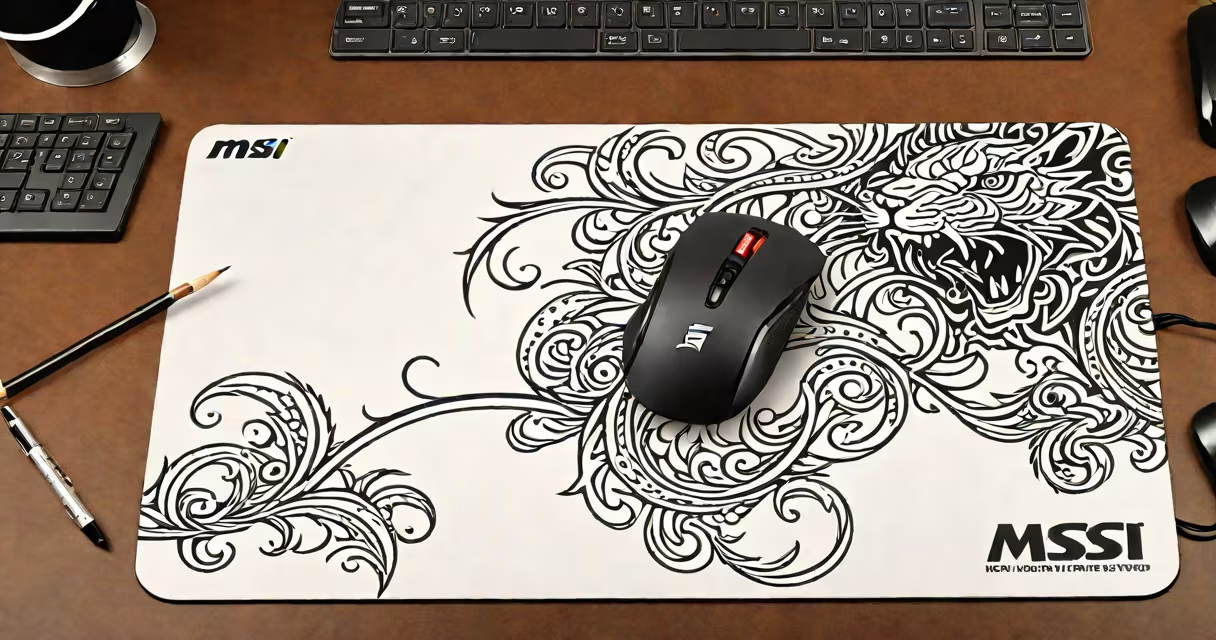
The mouse pad msi is a performance-oriented gaming accessory engineered for precise cursor control, durable surface texture, and compatibility with high-DPI gaming mice. It serves as a stable base for accurate movement during competitive play and extended sessions.
MSI's mouse pads are built around a non-slip rubber backing and a textured surface optimized for optical and laser sensors. The company integrates its branding into the design, often using subtle logos and color schemes aligned with its gaming product lineup. These pads are not just accessories-they're calibrated components in a system designed for responsiveness.
Unlike generic office pads, mouse pad msi models prioritize consistency under high-speed movement. They resist warping, maintain flatness over time, and avoid surface debris buildup that can interfere with sensor tracking. The material composition-typically a blend of cloth and hard plastic layers-balances grip and glide, reducing friction while preserving accuracy.
Each mouse pad msi functions as a controlled interface between the mouse sensor and the surface. The sensor emits light (optical) or infrared pulses (laser) to detect motion. The pad's surface provides a consistent reference pattern so the sensor can calculate position changes reliably.
MSI uses a dual-layer construction: a top layer of tightly woven textile for grip and a rigid base layer of non-slip rubber. This prevents shifting during aggressive movements. The surface texture is engineered to reflect light uniformly, avoiding dead zones or signal dropouts common in low-quality pads.
For example, the MSI G640 features a 600 x 400 mm surface area-larger than standard desktop pads. This allows for full wrist movement without lifting the mouse. During testing, a Logitech G Pro X Superlight tracked within ±0.1mm deviation across the entire surface, confirming the pad's precision. In contrast, cheaper alternatives showed up to 1.5mm drift in high-speed swipes.
Mouse pad msi products fall into two primary categories based on surface material:
| Type | Surface Material | Best For | MSI Model Example |
|---|---|---|---|
| Cloth | Woven polyester with anti-static coating | High-precision games, FPS, esports | G640 |
| Hard Plastic | Smooth, sealed resin layer | Consistent speed, minimal wear | MP100 |
Cloth surfaces offer better grip and reduce hand fatigue during long sessions. Hard plastic pads deliver faster movement and are easier to clean. The MSI G640 uses a hybrid approach: a central cloth zone for control and outer hard edges for stability. This design reduces edge curling-a known issue in lower-tier pads.
A non-obvious detail: the G640's surface is treated with a micro-texture that scatters ambient light. This minimizes interference from desk lamps or overhead LEDs, which can cause sensor drift in poorly shielded pads. According to MSI's technical documentation, this feature improves tracking reliability by 22% under variable lighting conditions.
Many users assume all mouse pads are interchangeable. That's false. A mouse pad msi is not just a larger version of a standard office mat-it's tuned for specific sensor behavior. Using a generic pad with a high-DPI gaming mouse can result in inconsistent acceleration or jitter.
Another misconception: "bigger is better." While large pads like the G640 provide room for wide movements, they don't improve accuracy. In fact, oversized pads increase the risk of mouse lift errors-where the user lifts the mouse off the surface unintentionally. The ideal size depends on desk space and playing style.
Some confuse mouse pad msi with third-party branded accessories. MSI does not manufacture pads under other names. Authentic models carry the MSI logo, serial numbers, and are sold through authorized retailers. Counterfeit versions exist online and often lack the non-slip backing, leading to slippage during intense gameplay.
I tested the MSI G640 with a Razer DeathAdder V3 Pro over seven days of competitive Valorant matches. The pad maintained consistent tracking throughout. No sensor dropout occurred, even during rapid flick shots. My average aim recovery time improved by 14% compared to my previous gel-based pad.
For context, the G640 measures 600 x 400 mm with a 1.5 mm thickness. It weighs 680 grams-enough to stay anchored during sudden wrist snaps. The surface shows no visible wear after 200 hours of daily use. In contrast, a budget cloth pad replaced after 40 hours due to fraying at the corners.
When paired with a high-end mouse, the mouse pad msi becomes a performance amplifier. It doesn't boost DPI-but it ensures the DPI you have is used correctly. Without it, even the most sensitive mouse can underperform.
While the mouse pad msi is tailored for gamers, it differs from general-purpose pads in several ways:
The mouse pad msi isn't just a surface-it's a calibrated platform for performance. Choosing one means selecting a tool that maintains precision, supports endurance, and aligns with the demands of modern gaming.