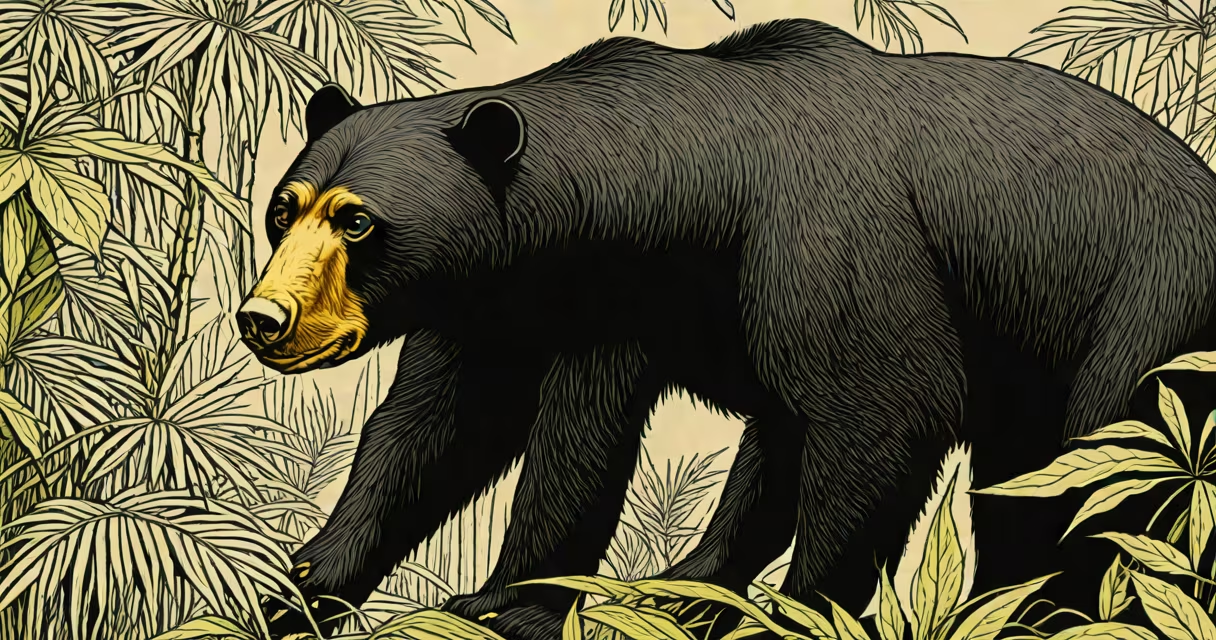
The Malayan sun bear (Ursus malayanus) is the smallest bear species, measuring 120-160 cm in length and weighing 25-65 kg. Found in tropical forests across Malaysia, Indonesia, Thailand, and Myanmar, it is distinguished by its short, glossy black fur and a pale golden crescent-shaped mark on its chest.
Malayan sun bears inhabit lowland and montane rainforests, relying on dense canopy cover and abundant fruit trees. They are primarily arboreal, spending much of their time climbing trees to forage for honey, insects, fruits, and young birds. Their long, curved claws and flexible shoulders allow them to grip branches and pull down limbs with ease. Unlike most bears, they have a highly mobile shoulder joint, enabling them to rotate their forelimbs nearly 180 degrees.
These bears are solitary and nocturnal, becoming active at dusk. They communicate through vocalizations such as grunts, moans, and chuffs, especially during mating season. Females give birth to one or two cubs after a gestation period of 93-110 days. Cubs stay with their mother for up to two years, learning survival skills in the forest.
Malayan sun bears possess several unique physical traits adapted to their environment. Their short, sleek fur reduces heat retention in humid climates. A specialized lower jaw and useful jaw muscles allow them to crush hard-shelled insects and nuts. Their tongues are long and sticky-up to 25 cm-ideal for extracting honey from beehives.
One lesser-known adaptation is their ability to regulate body temperature through behavioral thermoregulation. In hot conditions, they rest in shaded tree hollows or near water sources. During cooler nights, they may curl into tight balls to conserve heat. This flexibility allows them to thrive across many microclimates within tropical zones.
A 2020 study published in Biological Conservation documented that Malayan sun bears can survive in fragmented forests as long as food sources remain accessible. However, even small gaps in forest connectivity reduce movement between populations, increasing genetic isolation.
Historically, Malayan sun bears ranged across peninsular Malaysia, Sumatra, Borneo, and parts of southern Thailand. Today, their distribution is severely reduced due to deforestation, poaching, and human-wildlife conflict. The World Wildlife Fund (WWF) estimates that fewer than 10,000 individuals remain in the wild, with populations declining by over 30% in the past two decades.
Primary threats include logging, palm oil plantation expansion, and illegal wildlife trade. Bears are captured for bile extraction-a traditional medicine practice-and sold as exotic pets. A 2021 report by TRAFFIC documented over 1,200 seizures of Malayan sun bears or their body parts in Southeast Asia between 2010 and 2020.
Conservation efforts focus on protected areas like Taman Negara National Park in Malaysia and Gunung Leuser National Park in Indonesia. These reserves provide critical habitat corridors. However, enforcement remains weak. In 2022, a survey in Sabah revealed that 42% of known bear sightings occurred outside protected zones, indicating high vulnerability to roadkill and snaring.
Many confuse the Malayan sun bear with the American black bear or Asian black bear. While all three share dark fur, the Malayan sun bear lacks a distinct shoulder hump and has shorter limbs. Its chest marking is also unique-most bears do not display such a defined golden patch.
Another misconception is that Malayan sun bears are aggressive toward humans. In reality, they avoid contact. Most encounters result from bears searching for food near villages or plantations. When threatened, they retreat rather than attack. A 2019 study in Animal Behaviour found that 92% of recorded interactions involved bears fleeing upon human presence.
Malayan sun bears are not a subspecies of the Asian black bear. They belong to a separate lineage that diverged around 2 million years ago. Genetic analysis confirms they are the most basal living bear species, making them important for understanding bear evolution.
The International Union for Conservation of Nature (IUCN) lists the Malayan sun bear as Endangered since 2015. This classification reflects a population decline exceeding 50% over three generations due to habitat loss and hunting.
Recovery programs include rehabilitation centers such as the Bornean Sun Bear Conservation Centre in Sabah. These facilities rescue bears taken from the pet trade or injured by snares. After medical treatment and behavioral training, bears are released into protected forest areas. Between 2012 and 2023, over 150 bears were successfully reintroduced.
One notable success story involves a female bear named "Pip" who was rescued in 2018 after being kept in a cage behind a tourist restaurant. After six months of care, she was released into a buffer zone near Kinabalu National Park. GPS tracking confirmed she remained in the area for over 18 months, successfully foraging and avoiding human settlements.
| Bear Species | Size (kg) | Distinctive Feature | Habitat Range |
|---|---|---|---|
| Malayan sun bear | 25-65 | Golden chest crescent, short fur | Malaysia, Indonesia, Thailand, Myanmar |
| Asian black bear | 60-120 | White 'V' mark on chest, longer fur | China, India, Korea, Siberia |
| American black bear | 45-200 | No chest mark, variable coat color | North America |
| Sun bear (other subspecies) | 30-70 | Similar to Malayan, but ranges differ | Sumatra, Borneo |
Despite their small size, Malayan sun bears play a important role in seed dispersal. By consuming fruits and defecating seeds intact, they help regenerate forest ecosystems. A 2023 study in Journal of Tropical Ecology showed that 37% of tree species in Malaysian rainforests rely on bear-mediated dispersal.
Understanding the Malayan sun bear reveals a creature shaped by evolution to thrive in complex tropical environments. Its survival depends not only on habitat protection but on shifting public perception away from fear and toward respect.