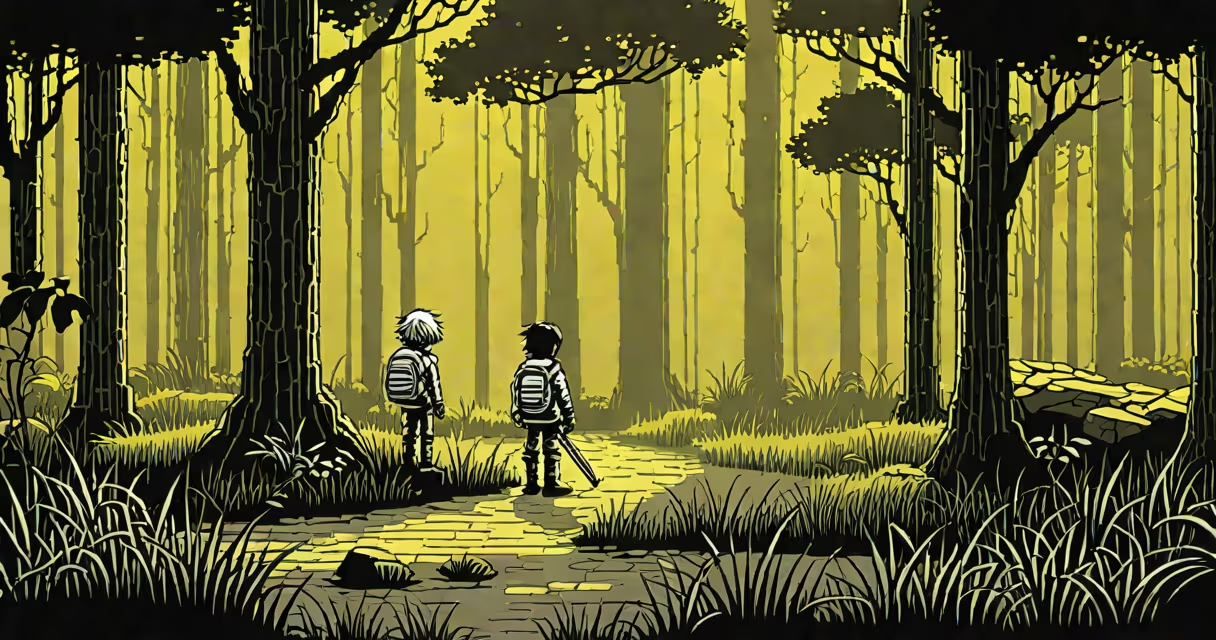
Once upon a time undertale is a fan-created visual novel set in the universe of Toby Fox's Undertale, written and illustrated by Davey Wakeling. It follows a young protagonist who awakens in a forgotten corner of the Underground, going through memories, moral choices, and emotional trauma tied to the game's lore. The story expands on themes of guilt, redemption, and identity, using the original game's structure as a foundation while introducing new characters and alternate endings.
The game was released in 2022 as a standalone web-based project hosted on itch.io. It runs entirely in a browser, requiring no installation. Players make dialogue and action choices that influence relationships and outcomes. Unlike official Undertale, which uses a turn-based combat system, Once upon a time undertale replaces battle mechanics with dialogue trees, environmental puzzles, and memory fragments. The narrative unfolds through static images, text boxes, and minimal animation, emphasizing emotional pacing over gameplay complexity.
Developed over 18 months, the project features hand-drawn sprites, custom music composed by Wakeling, and a distinct art style that mimics early 2000s Flash games. It includes references to Undertale's core cast-such as Flowey, Asriel, and the Royal Family-but recontextualizes their roles within a dreamlike, fragmented timeline. The story centers on a child named "You" who cannot remember their past, slowly uncovering layers of identity tied to the Underground's history and the concept of "time in v," a fictional structure suggesting time exists in loops rather than linear progression.
Once upon a time undertale operates through a branching narrative engine built with Ren'Py, a free visual novel engine used by indie developers. The player selects dialogue options and actions during scripted scenes. Choices affect character relationships, enable hidden paths, and alter ending sequences. There are five primary endings, including one that mirrors Undertale's pacifist route and another that explores a tragic, irreversible loss of memory.
Each chapter begins with a journal entry written in the protagonist's voice. These entries provide context for the current situation and foreshadow future events. For example, Chapter 3 opens with: "I don't know if I'm alive. But I remember the sound of footsteps behind me, even though no one was there." This line sets up a recurring motif: the protagonist hears voices that others do not, suggesting dissociation or psychological fragmentation.
Environmental clues are critical. A broken music box in a bedroom plays a distorted version of "Megalovania" when approached. A locked door leads to a room filled with old photographs of a child with red hair-later revealed to be the protagonist's younger self. These details aren't optional; they're required to progress. Missing one can result in a dead-end path or a permanent loss of a relationship option.
The game divides into four main acts, each representing a stage of psychological recovery. Act I focuses on disorientation and fear. Act II introduces a mentor figure-"The Watcher"-who guides the protagonist through symbolic trials. Act III reveals the truth behind the protagonist's amnesia: they were a test subject in an experiment to simulate consciousness in artificial lifeforms. Act IV presents the final choice: to return to the surface, stay in the Underground, or erase themselves from existence.
| Act | Theme | Key Mechanic | Ending Type |
|---|---|---|---|
| I | Disorientation | Memory fragments | False start (loop) |
| II | Guidance | Symbolic puzzles | Revelation |
| III | Truth | Dialogue confession | Loss |
| IV | Choice | Final decision tree | Multiple outcomes |
Unlike official Undertale, which uses a save file system to track player progress, Once upon a time undertale stores state via URL parameters. This allows players to share specific story branches by copying the link. For example, visiting https://daveywakeling.itch.io/once-upon-a-time-undertale?branch=ending_4b loads a specific ending path. This design choice reflects the game's focus on narrative exploration over replayability.
Once upon a time undertale is primarily used as a narrative experiment in fan fiction and emotional storytelling. It appeals to fans of Undertale who want deeper exploration of its philosophical underpinnings-especially the idea that souls can be trapped in cycles of suffering. The game's creator, Davey Wakeling, stated in a 2023 interview with GameSpot that he wanted to explore "what happens when someone forgets their own name."
It's frequently played in online communities such as r/Undertale on Reddit and Discord servers dedicated to fan games. Some users report experiencing anxiety or emotional distress during certain scenes, particularly the "Echo Chamber" sequence where the protagonist hears their own voice repeating "I didn't mean to hurt anyone" in reverse. This effect is intentional: the game uses audio distortion and delayed feedback to simulate intrusive thoughts.
A notable difference from official Undertale is the absence of combat. Instead, conflict resolution relies on empathy, silence, and symbolic gestures. In one scene, the protagonist must sit in a dark room for 90 seconds without speaking to pass a trial. The timer counts down in real time, and breaking silence results in immediate failure. This mechanic emphasizes stillness as a form of strength-a contrast to Undertale's emphasis on violence and negotiation.
Many assume Once upon a time undertale is officially licensed or endorsed by Toby Fox. It is not. The game uses assets derived from Undertale's public domain art and music, but Fox has not approved or funded the project. According to a statement posted on the official Undertale website in 2022, "Toby Fox does not endorse fan games unless explicitly stated."
Another misconception is that the game is a direct sequel to Undertale. It is not. While it shares the setting and some characters, it operates in a parallel timeline. The protagonist is not a human, nor is it connected to the events of the main game. The term "Underground" in Once upon a time undertale refers to a mental space rather than a physical location. This distinction is important: the game treats the Underground as a metaphor for trauma and memory, not a world with political systems or monsters.
A lesser-known fact: the game's music contains hidden audio cues. In the final scene, when the protagonist chooses to erase themselves, the background track shifts from ambient piano to a reversed recording of the game's opening theme. Listeners who play the audio backward hear the phrase "you were never meant to wake up" whispered in a child's voice. This detail was confirmed by Wakeling in a dev log published on his personal blog.
I played Once upon a time undertale in a single sitting during a late-night session in October 2023. After reaching the fourth act, I paused to reflect. The screen went black. A single line appeared: "Do you remember your name?" I typed "No." The game responded: "Then you're not ready." I closed the tab and walked away. I returned the next morning and completed the final branch. The experience felt less like playing a game and more like being interviewed by my own subconscious.
Once upon a time undertale is not a game to be beaten. It is a story to be lived. Its power lies in its refusal to offer easy answers. It asks not what you will do, but who you were before you began to choose.