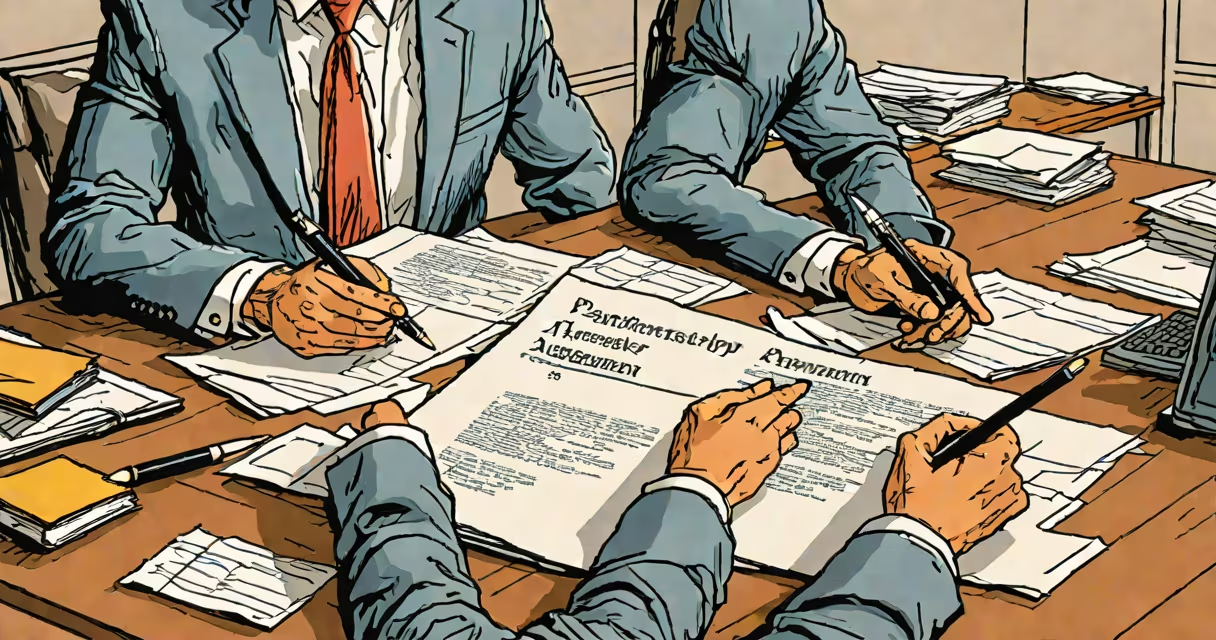
A partnership agreement attorney specializes in creating, reviewing, and enforcing legally binding contracts that define how co-owners of a business share responsibilities, profits, losses, and decision-making authority. These professionals ensure agreements comply with state laws and protect each partner's interests.
Businesses formed as partnerships-whether general, limited, or joint ventures-require clear written terms to prevent misunderstandings. A partnership agreement attorney ensures those terms are enforceable under state law, reducing risk during disputes, buyouts, or dissolution. Without such guidance, partners may face financial loss or litigation.
The American Bar Association confirms that nearly 60% of small business disputes stem from vague or missing partnership agreements. An experienced attorney reduces that risk by embedding precise language, exit strategies, and conflict resolution mechanisms into the document.
When you hire a partnership agreement attorney, they begin by gathering details about your business structure, roles, capital contributions, and goals. They then draft a customized agreement based on state-specific regulations, such as those in California's Corporations Code § 15000 or New York's Partnership Act.
For example, if two real estate investors plan to co-own a rental property, the attorney will specify how rent proceeds are split, who manages repairs, and what happens if one partner wants to sell their interest. They'll include clauses for dispute resolution, such as mediation or arbitration, to avoid court costs.
After drafting, the attorney reviews the agreement with all parties, explains key terms, and revises as needed. Once signed, the document becomes a binding contract enforceable in civil court.
These attorneys produce formal documents tailored to business type and jurisdiction. Common structures include:
| Type | Who It Suits | Key Provisions |
|---|---|---|
| General Partnership | Equal responsibility partners | Joint liability, equal profit sharing, unanimous consent for major decisions |
| Limited Partnership (LP) | Active managers and passive investors | General partners manage operations; limited partners contribute capital but have no management role |
| LLP (Limited Liability Partnership) | Professionals like lawyers or accountants | Protects individual partners from liabilities caused by others' actions |
| Operating Agreement (for LLCs) | Members of a limited liability company | Specifies voting rights, profit distribution, and member withdrawal procedures |
Each structure has distinct legal implications. For instance, in a general partnership, all partners are personally liable for debts-even if they didn't authorize the expense. An attorney prevents this by clarifying roles and limits of liability.
One non-obvious point: many states require partnership agreements to be in writing to be enforceable. Even informal verbal arrangements can fail in court if not documented. A partnership agreement attorney ensures compliance with the Uniform Partnership Act (UPA) or Revised Uniform Partnership Act (RUPA), which govern most U.S. states.
Partnership agreement attorneys are essential in high-stakes collaborations. Real estate ventures, tech startups, medical practices, and family-run businesses rely on them to prevent conflicts over control, equity, or exit plans.
Consider a scenario: two friends open a coffee shop in Austin, Texas. One contributes $50,000 in cash; the other provides a commercial lease and daily operations. Without a written agreement, the owner of the building may claim full control. A partnership agreement attorney would assign ownership percentages based on capital and labor contributions, set profit splits, and define how decisions are made.
According to the National Small Business Association, 40% of business failures result from poor partner relationships. Legal clarity prevents this. In a 2022 survey by the American Bar Foundation, 78% of business owners who used a lawyer for their partnership agreement reported fewer disagreements within five years.
Many assume a simple handshake or email exchange suffices. That's false. Courts treat oral agreements as unenforceable unless all parties agree in writing. A partnership agreement attorney ensures enforceability under state law.
Another myth: "I don't need an attorney because I can use a template." Templates lack customization. A generic form won't address unique risks-like intellectual property ownership in a creative firm or succession planning in a family business. An attorney tailors the document to your specific situation.
I once reviewed a partnership agreement drafted by a non-lawyer for a music production team. The clause on royalty splits was ambiguous: "profits will be shared fairly." This led to a year-long dispute. After hiring a partnership agreement attorney, the team revised the language to specify exact percentages per album, track, and streaming platform. The new version resolved all issues.
Look for someone with experience in business law, preferably with a focus on contracts or corporate governance. Check credentials through your state bar association. Ask for references from past clients in similar industries.
Specialization matters. A general practitioner may handle basic forms, but a specialist understands nuances like indemnification clauses, non-compete restrictions, and tax implications under IRS Section 701.
When discussing fees, expect hourly rates between $200 and $400 depending on location and expertise. Some offer flat fees for standard agreements-around $1,500 to $3,000. Always request a written fee estimate before work begins.
A partnership agreement attorney doesn't just write a contract-they build a foundation for trust, clarity, and long-term success. Their work prevents conflict, protects assets, and ensures the business runs as intended.