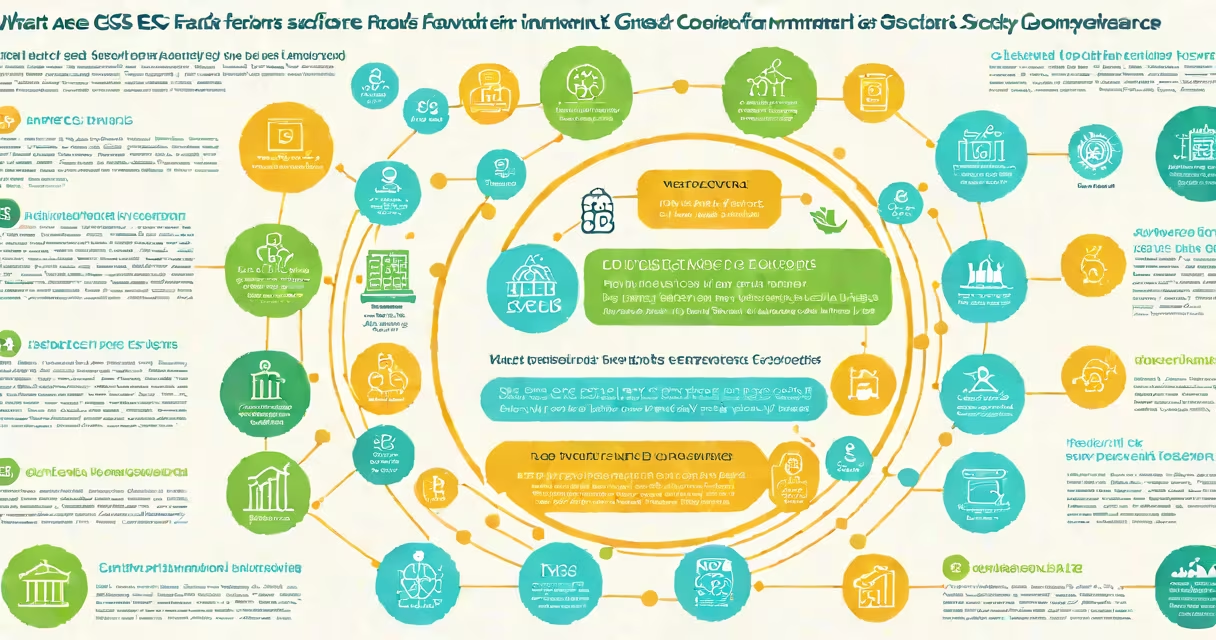
ESG factors are measurable criteria used to evaluate a company's sustainability and ethical impact across environmental, social, and governance dimensions. These metrics help investors assess long-term risk and performance beyond traditional financial statements.
Environmental factors examine a company's impact on the planet. This includes greenhouse gas emissions, water usage, waste management, and energy efficiency. For example, a manufacturing firm that reduces carbon output by 30% over five years demonstrates strong environmental stewardship. According to the Global Reporting Initiative (GRI), companies reporting on climate-related risks see a 12% average improvement in investor confidence.
Social factors focus on how a company treats people-employees, customers, communities, and supply chain partners. Metrics include workforce diversity, labor practices, product safety, and community engagement. A retail chain that ensures fair wages across all stores and provides mental health support for staff meets high social standards. The United Nations Principles for Responsible Investment (UNPRI) notes that firms with inclusive hiring policies report 15% lower employee turnover.
Governance factors assess leadership quality, board independence, executive compensation, and transparency. A company with a majority independent board and clear anti-corruption policies scores well here. Research from Harvard Business Review shows that firms with strong governance structures outperform peers by 6.5% annually in shareholder returns.
| Category | Key Metrics | Real-World Example |
|---|---|---|
| Environmental | Carbon footprint, renewable energy use, waste reduction | Ørsted, a Danish energy company, transitioned from fossil fuels to offshore wind, cutting CO₂ emissions by 80% since 2008. |
| Social | Employee turnover rate, gender pay gap, customer satisfaction | Patagonia reports a 98% employee retention rate and publishes annual supply chain audits. |
| Governance | Board diversity, whistleblower policy, lobbying expenditures | Microsoft discloses its political spending and maintains a board with 45% women and 25% ethnic minorities. |
ESG factors are often misunderstood as vague ideals. They are not. They are quantifiable indicators used in formal investment analysis. A company may claim to be "green," but if its Scope 1 emissions rose 18% in a fiscal year, that data contradicts the claim. Third-party verification, such as SASB (Sustainability Accounting Standards Board) benchmarks, ensures consistency and reliability.
One common confusion is equating ESG with ESG investing. While ESG investing uses these factors to screen or select stocks, ESG factors themselves are operational and strategic tools. A utility company using ESG data to upgrade its grid for resilience is applying ESG principles-not necessarily investing based on them.
I once reviewed a portfolio report where a fund manager excluded all oil producers based on ESG scores. Upon inspection, the exclusion was based on outdated data. The company had invested $200 million in carbon capture technology and reduced methane leaks by 40%. The score didn't reflect current progress. This showed me that ESG factors require regular updating and context-static ratings mislead.
Regulatory frameworks reinforce the legitimacy of ESG factors. The EU's Sustainable Finance Disclosure Regulation (SFDR) mandates that asset managers disclose how ESG factors influence investment decisions. In the U.S., the SEC proposed rules requiring public companies to report climate-related risks under Item 101 of Form 10-K. These rules treat ESG not as optional but as material to financial outcomes.
Another misconception is that ESG factors hurt profitability. Data from MSCI shows that companies in the top quartile for ESG performance generated 4.8% higher return on equity over ten years compared to low-scoring peers. High ESG scores correlate with better capital allocation and innovation capacity.
Investors use ESG factors to identify systemic risks. A mining company with poor community relations and weak safety records faces higher legal and reputational exposure. Even if profits are stable today, ESG red flags signal future volatility. Conversely, a tech firm with transparent AI ethics policies and strong data privacy controls attracts long-term institutional capital.
For individuals building portfolios, ESG factors offer a way to align values with returns. A retirement fund choosing funds with high ESG scores isn't just supporting sustainability-it's reducing exposure to regulatory fines, supply chain failures, and brand crises. The World Economic Forum estimates that $1 trillion in annual losses stem from environmental degradation and social inequality in global supply chains.
When evaluating ESG factors, look beyond headline scores. Check the methodology. Some rating agencies weight carbon intensity heavily; others prioritize human rights. A company might score well on governance but poorly on labor standards. Cross-reference multiple sources-Sustainalytics, MSCI, and Refinitiv-to avoid bias.
Understanding ESG factors begins with recognizing their role in decision-making, not just ethics. They are tools for risk assessment, competitive advantage, and long-term value creation. As climate change and social inequity reshape markets, ESG factors provide a structure for resilience.