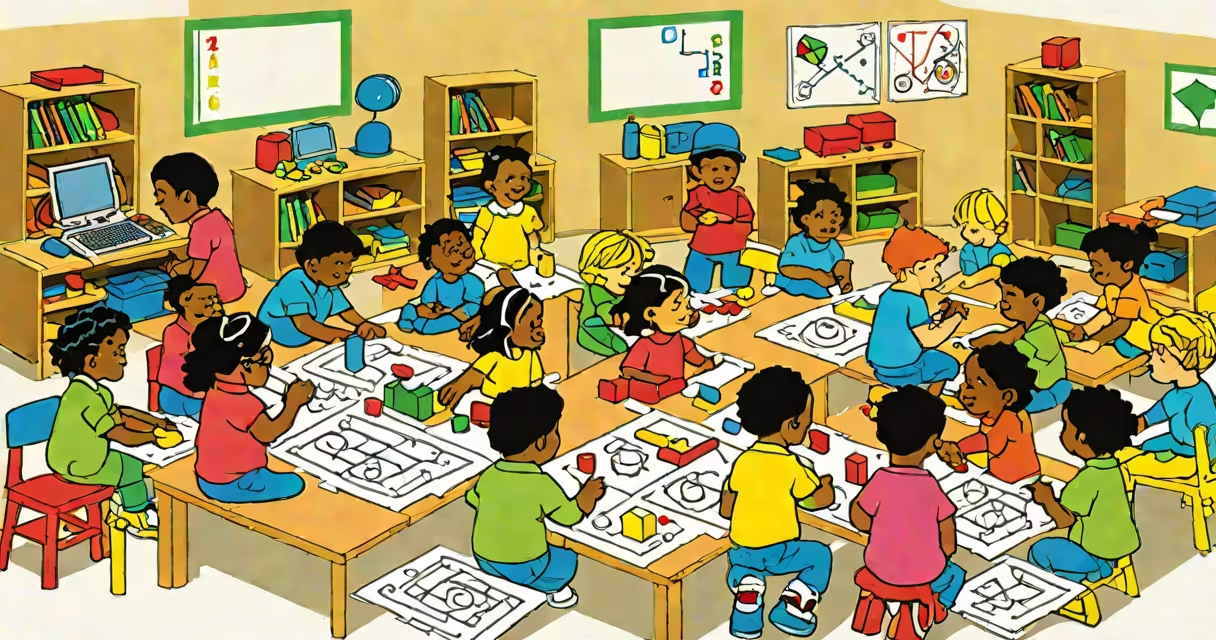
The preschool age group includes children between 3 and 5 years old, a period marked by rapid cognitive, emotional, and social growth. Programs for this age focus on play-based learning, early literacy, numeracy, and peer interaction to prepare children for formal schooling.
Children in this range develop the ability to follow multi-step instructions, express emotions verbally, and participate in group activities. They begin to understand rules, take turns, and show empathy. These milestones form the basis of classroom behavior and academic readiness.
According to the National Association for the Education of Young Children (NAEYC), children aged 3 to 5 are in a critical window for brain development. Their experiences during this time influence long-term learning outcomes, executive function, and emotional regulation. Early exposure to structured yet nurturing environments supports lifelong success.
Preschool classrooms use guided play, storytelling, music, art, and outdoor exploration to teach core concepts. Teachers observe developmental progress daily and adjust activities to meet individual needs. A typical day includes circle time, free play, snack, and structured lessons lasting 15 to 30 minutes.
For example, a 4-year-old might learn counting through sorting colored blocks, then practice writing their name using sand trays. These hands-on tasks build fine motor control and number sense. Research from the University of Chicago shows that children who attend high-quality preschool programs score 12% higher on standardized reading assessments by age 6.
Class sizes average 10 to 15 children with two adults present. This ratio ensures consistent supervision and personalized attention. Teachers use developmental checklists aligned with state early learning standards to track progress in areas like language, problem-solving, and social-emotional growth.
Programs vary by age, structure, and educational philosophy. The following table outlines common program types and recommended age ranges:
| Program Type | Typical Age Range | Focus Area | Duration/Structure |
|---|---|---|---|
| Half-day academic | 3-5 years | Emergent literacy, basic math, social skills | 2.5-3 hours/day, Mon-Fri |
| Full-day developmental | 3-5 years | Executive function, emotional regulation, routines | 6-7 hours/day, including meals and rest |
| Montessori-inspired | 3-6 years | Self-directed learning, practical life skills | 2.5-4 hours/day, mixed-age groups |
| Thematic/curriculum-based | 4-5 years | Pre-academic skills, science exploration | 4-5 hours/day, weekly themes (e.g., "Oceans," "Transportation") |
Some programs accept children as young as 2.5 years in specialized infant-toddler tracks. However, most formal preschool curricula begin at age 3. The American Academy of Pediatrics recommends that children enter a structured preschool environment by age 4 to support kindergarten readiness.
A non-obvious distinction: not all 3-year-olds are developmentally ready for full-day programs. A child may have strong verbal skills but struggle with emotional regulation or sharing. High-quality programs assess each child's social-emotional baseline before enrollment. For example, a center in Portland, Oregon, uses a 3-week trial period to evaluate how well a child adapts to group routines and transitions.
Parents often assume that preschool is solely about academics. In reality, the primary goal is socialization and emotional development. A 2022 study by the Brookings Institution found that 78% of preschool teachers prioritize conflict resolution and cooperation over letter recognition in their daily planning.
Another misconception is that all preschools are the same. Quality varies widely. Centers accredited by NAEYC report 30% lower dropout rates and higher parent satisfaction. Accreditation requires staff training, low child-to-teacher ratios, and documented curriculum goals.
Some confuse preschool with daycare. While both provide care, preschool emphasizes intentional learning. Daycare focuses on safety and basic routines. A preschool class might spend 20 minutes building a tower with blocks to explore balance and gravity. A daycare setting would simply supervise free play without guided inquiry.
I observed a 4-year-old girl in a public preschool program in Denver who initially refused to join group activities. Over six weeks, she began volunteering to pass out crayons and eventually led a song during circle time. Her teacher noted improvements in eye contact, turn-taking, and emotional expression-all indicators of healthy preschool development.
When choosing a program, families should consider the child's temperament, schedule needs, and long-term goals. A child with anxiety may thrive in a small, consistent classroom with familiar routines. One with advanced language skills might benefit from a program emphasizing storytelling and dramatic play.
For those seeking community-focused models, the M W Group offers inclusive, culturally responsive preschool programs designed around family engagement and neighborhood integration. These centers emphasize parental involvement in classroom activities and use multilingual materials to support diverse learners.
Understanding the preschool age group means recognizing it as a changing phase of growth-not just a placeholder before kindergarten. Children aged 3 to 5 are developing identity, agency, and foundational skills. With the right environment, they gain confidence, curiosity, and the tools to succeed in school and beyond.