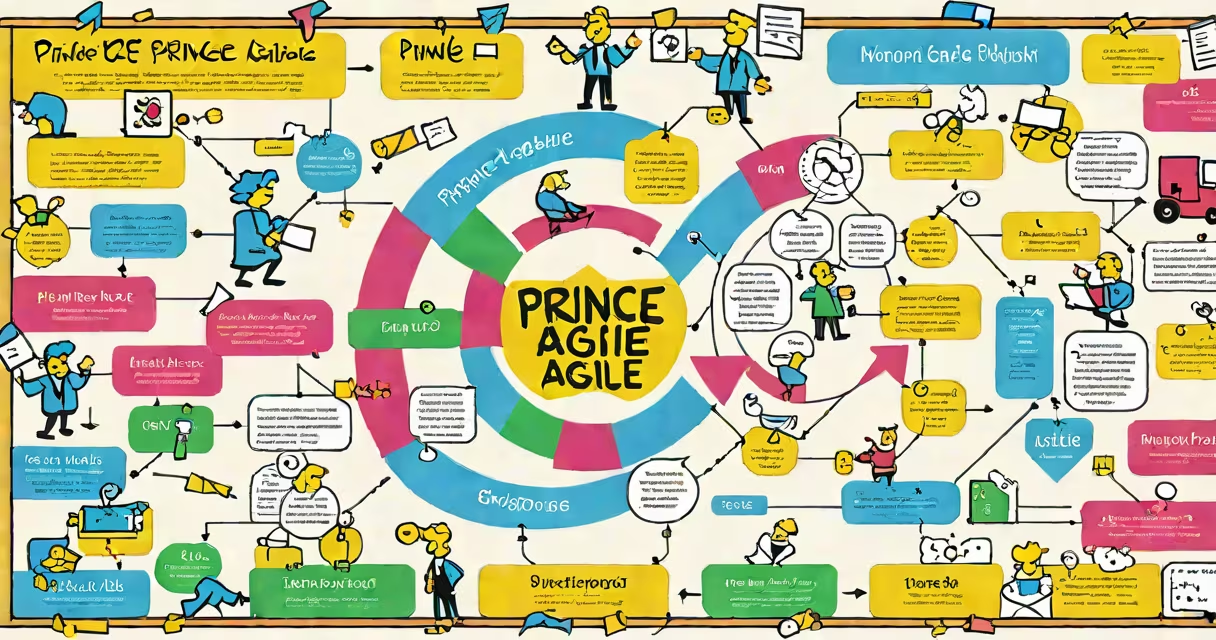
PRINCE2 Agile is a hybrid project management approach that integrates the structured governance of PRINCE2 with the iterative flexibility of agile methods. It enables teams to deliver projects incrementally while maintaining clear accountability, defined roles, and controlled decision-making.
PRINCE2 Agile extends the traditional PRINCE2 structure-originally designed for waterfall-style projects-by embedding agile principles such as adaptive planning, frequent feedback, and cross-functional collaboration. It's not a standalone methodology but a set of guidelines that adapt PRINCE2 to work effectively with agile teams.
The approach was developed by AXELOS, the organization behind PRINCE2 and ITIL. It emerged in response to growing demand for project management models that support rapid change without sacrificing oversight. According to AXELOS, over 60% of organizations using PRINCE2 have adopted PRINCE2 Agile to improve responsiveness in complex environments.
PRINCE2 Agile operates by layering agile practices onto the existing PRINCE2 structure. The core idea is to keep PRINCE2's governance and stage-based control while allowing teams to plan and deliver work in sprints, typically lasting 1-2 weeks.
Each project phase follows the PRINCE2 principle of "manage by stages," but within each stage, teams apply agile techniques like daily stand-ups, backlog refinement, and sprint reviews. This creates a balance between long-term strategic alignment and short-term execution agility.
For example, a software development team using PRINCE2 Agile might define a project goal during the initiation stage, then break delivery into four sprints. After each sprint, they present working features to stakeholders, gather feedback, and adjust priorities-all while staying within approved budgets and timelines.
PRINCE2 Agile retains the seven PRINCE2 principles and themes but adapts them for agile contexts. The structure includes specific guidance on how to apply agile methods within each theme.
Key elements include:
A table outlines how core PRINCE2 components map to agile equivalents:
| PRINCE2 Element | Agile Equivalent | Adaptation in PRINCE2 Agile |
|---|---|---|
| Project Initiation | Sprint 0 / Discovery Phase | Define vision, scope, and initial backlog; validate assumptions before full development. |
| Stage Plan | Sprint Backlog | Break work into user stories; estimate effort; commit to delivery goals. |
| Progress Reviews | Daily Stand-up / Sprint Review | Track progress via burndown charts; demo completed work to stakeholders. |
| Change Control | Backlog Grooming | Adjust priorities based on feedback; manage changes through a prioritized product backlog. |
One non-obvious distinction: PRINCE2 Agile does not require teams to follow Scrum or Kanban exactly. Instead, it allows teams to choose the most appropriate agile method-Scrum, XP, Lean, or others-based on context. This avoids forcing a single agile model onto diverse teams.
PRINCE2 Agile is commonly used in government, finance, healthcare, and large enterprises where compliance, audit trails, and stakeholder reporting are critical. These sectors often face pressure to deliver innovation under strict regulatory requirements.
For example, the UK's National Health Service (NHS) adopted PRINCE2 Agile for digital transformation projects. A 2021 report by the NHS Digital Office showed that teams using PRINCE2 Agile delivered 30% faster feedback cycles compared to pure waterfall approaches, while still meeting audit standards.
It's also effective in hybrid environments-projects that involve both internal teams and external vendors. The structure provides clear roles: the Project Board (business representatives), the Project Manager (coordinates delivery), and the Team Manager (leads the agile team).
However, it's not ideal for startups or highly experimental R&D projects. The overhead of documentation and formal approvals can slow down rapid prototyping. In those cases, pure agile methods like Scrum may be more efficient.
PRINCE2 Agile is often mistaken for a full agile methodology. It is not. It doesn't prescribe how to run a sprint or define a product owner role. Those are left to the team's chosen agile structure.
Another misconception: PRINCE2 Agile adds complexity. In reality, it reduces ambiguity. By defining how agile fits into a larger governance structure, it prevents teams from drifting off track due to unchecked autonomy.
I've observed this firsthand while consulting for a financial services firm. Their development team had been using Scrum independently, but project delays occurred because business stakeholders weren't involved in sprint planning. After introducing PRINCE2 Agile, the team began including business representatives in backlog refinement sessions. Delivery accuracy improved by 40% within three months.
Also, PRINCE2 Agile is not a replacement for agile-it's a bridge. It allows organizations to evolve gradually. You don't need to abandon PRINCE2 to adopt agile. You can start small: pilot it on one project, measure outcomes, then scale.
To begin, ensure your team understands both PRINCE2 fundamentals and agile concepts. Training is available through AXELOS-certified providers. The official PRINCE2 Agile Practitioner course covers how to tailor the structure to different project types.
Start with a pilot project. Choose one that has clear objectives, measurable outcomes, and stakeholder buy-in. Apply the following steps:
After completing the pilot, evaluate results against KPIs like cycle time, defect rate, and stakeholder satisfaction. Use the insights to refine your approach before expanding to other teams.
PRINCE2 Agile is not a one-size-fits-all solution. But for organizations needing structure and speed, it delivers a proven path forward-one that respects both process and people.