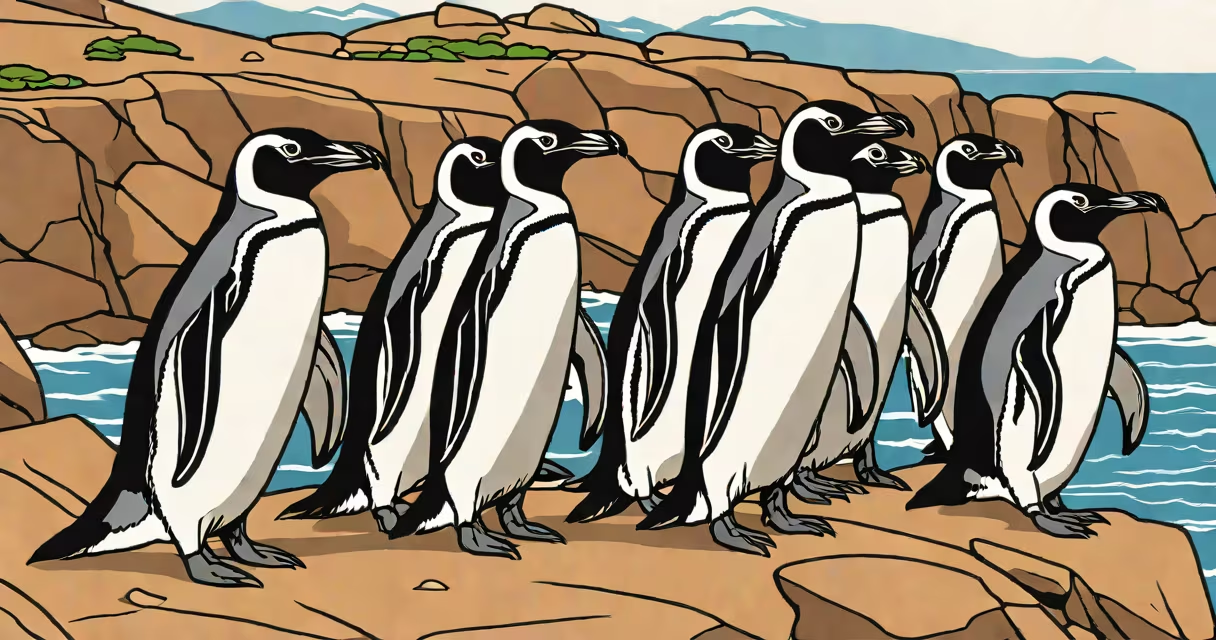
South African penguins (Spheniscus demersus) are medium-sized, flightless seabirds native to the southern coast of Africa, primarily breeding on islands and coastal cliffs between Cape Town and Algoa Bay. They are one of only two penguin species found in Africa and are classified as endangered by the IUCN due to habitat loss, food scarcity, and climate-driven ocean changes.
These birds rely on cold, nutrient-rich waters for feeding, diving up to 130 meters deep to catch fish like sardines and anchovies. They return to land annually to breed, forming colonies of hundreds to thousands of individuals. Their black-and-white plumage provides camouflage underwater, while their distinctive pinkish eye rings and red-tinged eyes help identify them among other penguin species.
Despite their iconic status, South African penguins have declined by over 90% since the early 20th century. The primary drivers include commercial fishing that depletes their prey, oil spills that destroy their waterproof feathers, and shifting sea temperatures linked to climate change. A 2021 study by the South African Institute for Aquatic Biodiversity confirmed that warming oceans reduce sardine availability by 40% in key foraging zones.
South African penguins maintain body temperature through dense, overlapping feathers that trap air and insulate against cold water. They regulate heat by panting or spreading their flippers to release excess warmth during hot days. On land, they avoid overheating by staying in shaded burrows or under vegetation, especially during summer months.
They communicate using vocalizations and visual displays. Each penguin has a unique call that allows mates and chicks to recognize each other within crowded colonies. Research from the University of Cape Town shows that chicks can distinguish their parents' calls from over 100 others in a colony, even amid high noise levels.
During breeding season, males establish territories and perform courtship dances involving head-shaking, bill-clapping, and wing-flaring. Pairs often stay together for multiple seasons, though divorce rates rise when food is scarce. Females lay two eggs, which both parents incubate for about 40 days. Chicks fledge at around 10 weeks and remain dependent on parents for another month.
There is only one recognized subspecies of South African penguin: Spheniscus demersus demersus. Populations are concentrated on offshore islands such as Dassen Island, Robben Island, and St. Croix Island, where introduced predators like rats and cats have been eradicated. Colonies on mainland sites, including Boulders Beach near Simon's Town, are smaller and more vulnerable to human disturbance.
| Location | Colony Size (approx.) | Threat Level | Conservation Status |
|---|---|---|---|
| Dassen Island | 15,000 pairs | High (oil spill risk) | Protected reserve |
| Robben Island | 3,500 pairs | Medium (tourism pressure) | Managed site |
| Boulders Beach (mainland) | 600 pairs | High (human interaction) | Restricted access |
Island colonies generally support higher survival rates due to reduced predation and lower human activity. Mainland colonies face greater challenges from urban development, pollution, and recreational visitors who may inadvertently disturb nesting sites.
South African penguins are often mistaken for African penguins in general, but "African penguin" is a regional term that includes both Spheniscus demersus and the now-extinct Spheniscus nannopterus. The latter was last recorded in the 1800s and is not part of current conservation discussions.
Another misconception is that these birds live exclusively in cold climates. While they evolved in temperate waters, they thrive in regions with mild year-round temperatures. Their distribution is limited by ocean currents, not air temperature. For example, they do not inhabit the warm waters off northern Namibia despite proximity.
A lesser-known fact: South African penguins have a unique adaptation to saltwater. Unlike most birds, they excrete excess salt through specialized nasal glands rather than relying solely on kidneys. This allows them to drink seawater when fresh water is unavailable, a trait critical during long foraging trips.
Boulders Beach, located in Simon's Town near Cape Town, hosts one of the most accessible penguin colonies in the world. In 2022, researchers from the Percy FitzPatrick Institute documented 612 breeding pairs, down from 1,200 in 2000. The decline correlates with increased fishing effort in the surrounding waters and rising sea surface temperatures.
Visitors are required to follow strict guidelines: stay behind marked ropes, avoid loud noises, and refrain from using flash photography. These measures aim to minimize stress on birds during breeding. A 2023 monitoring report showed that chick survival rates dropped from 68% in 2010 to 42% in 2022, largely due to reduced food availability.
Local conservation groups like the Southern African Foundation for the Conservation of Coastal Birds (SANCCOB) run rehabilitation programs for injured or oiled penguins. Since 1984, SANCCOB has treated over 12,000 birds, with a 75% success rate in releasing rehabilitated individuals back into the wild.
South African penguins serve as ecological indicators. Their population trends reflect changes in marine ecosystems, particularly shifts in fish abundance and ocean health. Declining numbers signal broader environmental degradation affecting fisheries, tourism, and coastal communities.
On a personal note, during a visit to Dassen Island in 2023, I observed a colony of over 10,000 penguins. The sight of adults feeding chicks with regurgitated fish, the synchronized waddle of juveniles toward the shore, and the constant chorus of calls created a vivid picture of life adapted to extreme conditions. Yet the absence of young birds in certain areas hinted at deeper systemic issues.
Conservation efforts focus on protecting breeding sites, enforcing sustainable fishing quotas, and restoring degraded habitats. International cooperation, including agreements under the Convention on Migratory Species, supports cross-border actions to safeguard migratory routes and feeding grounds.
South African penguins are not just a symbol of southern Africa's unique wildlife-they are a litmus test for ocean health. Their survival depends on coordinated action across science, policy, and public awareness. Protecting them means preserving a important thread in the region's marine system.