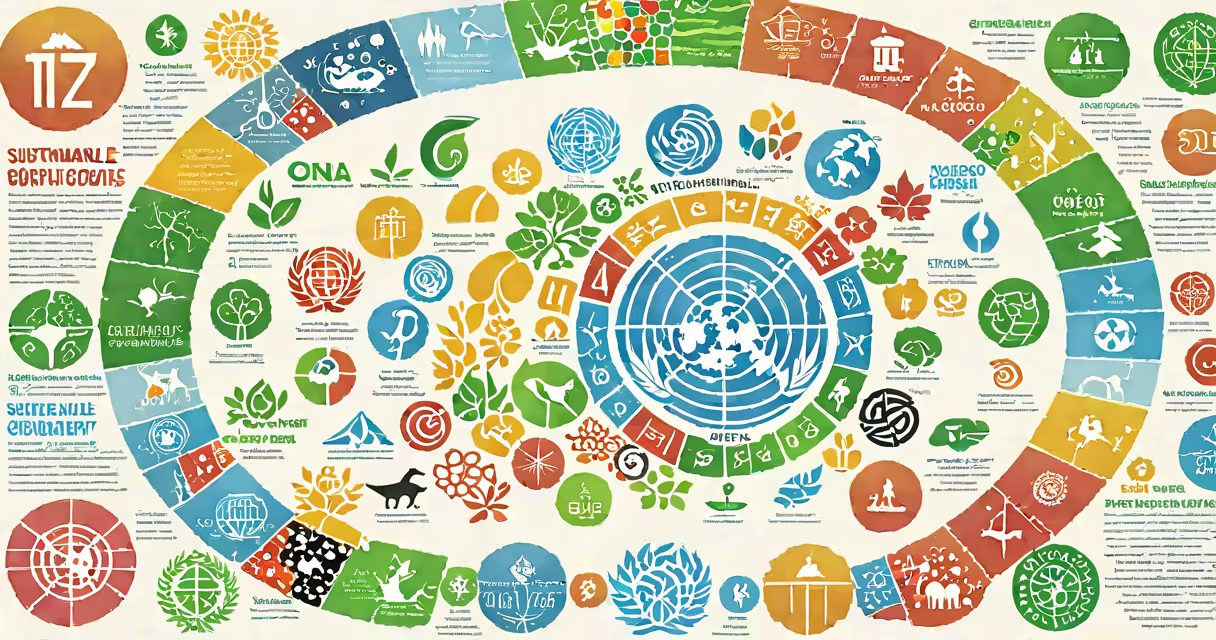
The sustainable development goals (SDGs) are a set of 17 interconnected global objectives established by the United Nations in 2015 to end poverty, protect the planet, and ensure peace and prosperity for all by 2030. They form the core of the UN 2030 Agenda for Sustainable Development, guiding national policies and international cooperation across economic, social, and environmental dimensions.
These goals were adopted by all United Nations member states as a universal call to action. They build on the Millennium Development Goals (MDGs), which ended in 2015, but expand the focus beyond poverty reduction to include climate change, inequality, and sustainable consumption. The SDGs apply to both developed and developing countries, recognizing that progress in one area affects outcomes in others.
Each goal includes specific targets-169 in total-that define measurable milestones. Progress toward these targets is tracked annually through the Sustainable Development Goal Index, published by the Sustainable Development Solutions Network (SDSN). Countries report data through national statistical systems, and the UN compiles results for global monitoring.
The SDGs operate through a structure of accountability and collaboration. Governments integrate the goals into national development plans, while civil society, businesses, and academic institutions contribute through research, innovation, and advocacy. The goals are designed to be interdependent: improving education (Goal 4) supports gender equality (Goal 5), which in turn strengthens health outcomes (Goal 3).
Implementation relies on domestic resource mobilization, international financing, and technology transfer. The Addis Ababa Action Agenda, adopted in 2015, outlines mechanisms for funding, including official development assistance (ODA), private investment, and debt relief. For example, low-income countries receive grants and concessional loans through the World Bank's International Development Association (IDA) to support SDG-aligned projects.
A key feature is the principle of "leaving no one behind." This means that progress must be measured across demographic groups-by income, gender, age, disability, and geography. The UN's High-Level Political Forum on Sustainable Development reviews national voluntary reports every year, ensuring transparency and peer learning among member states.
The 17 goals cover three broad areas: people, planet, and prosperity. They are grouped as follows:
| Category | Goals | Focus Areas |
|---|---|---|
| People | 1, 2, 3, 4, 5, 6, 8, 10 | Poverty, hunger, health, education, gender equality, clean water, decent work, reduced inequalities |
| Planet | 7, 11, 12, 13, 14, 15 | Responsible consumption, climate action, life below water, life on land, sustainable cities |
| Prosperity | 1, 9, 16, 17 | Partnerships, industry innovation, peace and justice, and the overarching goal of ending poverty |
Goal 17-Partnerships for the Goals-is unique in that it enables implementation across all others. It calls for strengthened global cooperation, increased aid effectiveness, and inclusive multilateralism. Without it, progress on the other goals would stall due to lack of coordination and resources.
One often overlooked aspect is that the SDGs do not replace national priorities. Instead, they provide a common language for aligning national strategies with global commitments. For example, Ethiopia's Growth and Transformation Plan II (2015-2020) explicitly referenced SDGs 1, 2, and 10 to guide agricultural investment and rural development.
Many assume the SDGs are legally binding. They are not. Member states voluntarily commit to the goals through national policy integration. However, reporting obligations under the 2030 Agenda create political and reputational incentives for compliance. Non-compliance doesn't trigger sanctions, but public disclosure of lagging performance can influence donor funding and international partnerships.
Another misconception is that the SDGs are solely about developing countries. In reality, high-income nations face significant challenges in meeting targets like Goal 13 (climate action) and Goal 10 (reduced inequalities). The United States, for example, ranked 17th out of 193 countries in the 2023 SDG Index, with weak scores in climate resilience and income equity.
A third error is equating the SDGs with corporate sustainability programs. While companies adopt SDG-aligned practices-such as reducing carbon emissions or promoting fair labor-the SDGs are a policy structure, not a branding tool. A company cannot claim to "achieve" a goal simply by launching a green product line. True alignment requires systemic changes in operations, supply chains, and governance.
In 2021, Rwanda launched a nationwide program to achieve SDG 6 (clean water and sanitation) by expanding access to safe drinking water in rural areas. The government partnered with the World Bank and UNICEF to build 1,200 boreholes and train local water committees. By 2023, 89% of rural households had access to improved water sources, up from 62% in 2015.
This success relied on three elements: baseline data collection, community ownership, and cross-sector coordination. The Ministry of Health monitored water quality using standardized testing protocols. Local leaders managed maintenance funds, preventing system failures. Data was reported quarterly to the National Statistics Office, which updated the country's SDG dashboard.
Without this integrated approach, isolated infrastructure projects would have failed. The program demonstrates that achieving the sustainable development goals requires more than funding-it demands institutional capacity, local engagement, and continuous monitoring.
During fieldwork in Kigali in 2022, I observed a village committee reviewing monthly water usage logs. Their discussion included concerns about seasonal droughts and child absenteeism from school due to water-fetching duties. These insights directly informed adjustments to the project's rollout schedule and hygiene education campaigns. Real-time feedback loops like this are essential for long-term impact.
The sustainable development goals are a globally agreed-upon structure for addressing interconnected challenges in human well-being, environmental protection, and economic fairness. They are not a checklist but a changing system of targets, indicators, and collaborative action. Countries, organizations, and individuals can advance progress by integrating SDG principles into planning, budgeting, and evaluation processes.