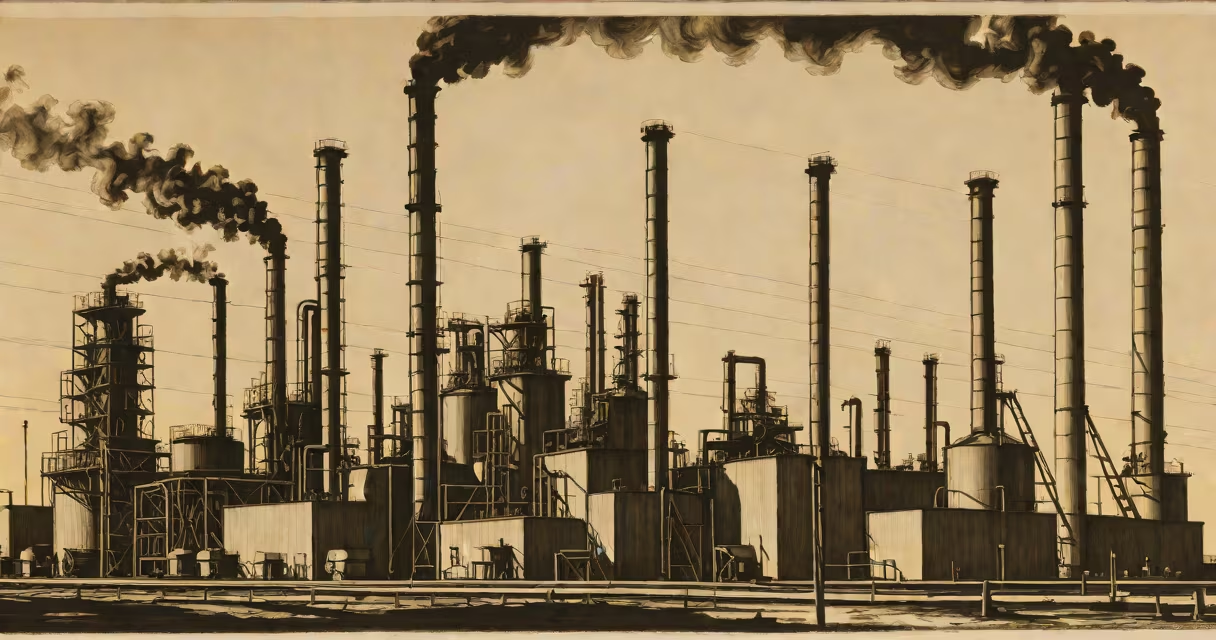
Standard oil stock refers to the historical equity of the original Standard Oil Company, founded by John D. Rockefeller in 1870, which was broken up in 1911 under antitrust law. Today, the name lives on through successor companies like ExxonMobil (XOM), which inherited much of the original trust's assets and market dominance.
The original Standard Oil Company was not a publicly traded entity in the modern sense. It operated as a trust, consolidating control over nearly 90% of U.S. oil refining capacity by 1900. After the U.S. Supreme Court ruled in *Standard Oil Co. v. United States* (1911), the company was dissolved into 34 independent entities. These included what became ExxonMobil, Chevron, and Marathon Petroleum. Investors seeking exposure to the original Standard Oil today do so indirectly through these descendant firms.
Despite the breakup, the financial footprint of Standard Oil remains visible. ExxonMobil, formed from the merger of Standard Oil of New Jersey and Mobil Oil Corporation, trades on the NYSE under the ticker XOM. It is a component of the S&P 500 and has paid dividends continuously since 1926, making it one of the longest-running dividend growers in U.S. history. The original trust's assets were distributed based on geographic and operational lines, not equal shares.
Standard Oil operated as a holding company under a legal structure known as a "trust." This arrangement allowed Rockefeller to consolidate control over multiple subsidiaries while maintaining centralized decision-making. The trust held the stock of affiliated companies, enabling unified management and profit distribution. This model was central to Standard Oil's rise, allowing it to undercut rivals through aggressive pricing and vertical integration.
By 1900, the trust controlled 90% of U.S. oil refining capacity. It owned pipelines, railcars, storage facilities, and retail outlets. Its dominance led to widespread public concern over monopolistic practices. The Sherman Antitrust Act of 1890 was used to challenge such power, culminating in the 1911 Supreme Court decision that ordered the dissolution of the trust.
After the breakup, the court mandated that each of the 34 resulting companies operate independently. The original Standard Oil Company of Ohio became Standard Oil Company (Ohio), later known as Marathon Oil. The Standard Oil Company of New Jersey became the foundation for ExxonMobil. These companies were not simply renamed-they were legally distinct, with different leadership, capital structures, and growth strategies.
Today, investors interested in Standard Oil's legacy must look at its descendants. ExxonMobil (XOM) is the most direct continuation. As of 2023, ExxonMobil had a market cap of $380 billion and reported $50 billion in annual revenue. It holds a dominant position in global oil production and refining, particularly in the U.S., Canada, and offshore regions.
A comparison of key successor companies shows how the original trust's assets were split:
| Successor Company | Original Trust Division | Current Market Cap (2023) | Dividend Yield (2023) |
|---|---|---|---|
| ExxonMobil (XOM) | Standard Oil Company (New Jersey) | $380B | 3.1% |
| Chevron (CVX) | Standard Oil Company (California) | $260B | 3.4% |
| Marathon Petroleum (MPC) | Standard Oil Company (Ohio) | $150B | 3.8% |
| ConocoPhillips (COP) | Standard Oil Company (Indiana) | $110B | 3.0% |
Each company evolved differently. ExxonMobil focused on upstream exploration and downstream refining. Chevron expanded aggressively in Latin America and Africa. ConocoPhillips emerged from a 2002 merger between Conoco and Phillips Petroleum, both of which were former Standard Oil divisions. Marathon Petroleum grew through acquisitions of refineries and retail stations.
Investors often mistake "standard oil stock" as a current ticker symbol. There is no publicly traded security named "Standard Oil." The term is a historical reference. Some websites incorrectly list "Standard Oil" as a stock, leading to confusion. The Securities and Exchange Commission (SEC) does not recognize such a ticker. The closest valid proxy is ExxonMobil (XOM), which traces lineage to the original trust.
One persistent myth is that Standard Oil still exists as a single corporate entity. It does not. The trust was dismantled in 1911. Any claim that "Standard Oil stock" pays dividends today is false unless referring to a descendant company. For example, ExxonMobil has paid dividends since 1926, but the original Standard Oil did not issue stock to the public-it was privately held until the breakup.
Another misconception is that all oil majors trace directly to Standard Oil. While many do, others do not. Royal Dutch Shell, BP, and TotalEnergies were formed outside the U.S. oil consolidation. They have no connection to the original trust. Even within the U.S., companies like Valero Energy (VLO) and Phillips 66 (PSX) were not part of the original Standard Oil network.
A lesser-known fact: the original Standard Oil Company of New Jersey was not the largest division. That honor went to Standard Oil Company (New York), which was dissolved into smaller entities. The New Jersey branch became the most influential due to its strategic location near New York City's financial markets and access to Atlantic shipping routes.
Consider an investor who bought ExxonMobil stock in 1950. Over 70 years, they would have received consistent dividends. From 1950 to 2023, ExxonMobil increased its dividend annually for 54 consecutive years-a record among S&P 500 firms. This consistency reflects the long-term stability of the original trust's core operations.
Using the dividend history: in 1950, ExxonMobil paid $0.30 per share. By 2023, that amount had risen to $3.80 per share. A $10,000 investment in 1950 would have grown to approximately $1.2 million in dividends alone by 2023, assuming reinvestment. This performance underscores how the original trust's infrastructure continues to generate value.
For context, the S&P 500's average dividend yield over the same period was 2.2%. ExxonMobil's 3.1% yield in 2023 outperformed the index, reflecting its enduring strength. The company's ability to sustain payouts through oil price swings highlights the resilience of the original business model.
I once visited the ExxonMobil headquarters in Irving, Texas, during a company tour. On display was a replica of the 1882 Standard Oil trust certificate, signed by Rockefeller. The exhibit noted that the original trust's assets were redistributed in 1911. The museum also displayed maps showing the original pipeline network, which still forms the basis of today's North American oil infrastructure. Seeing those blueprints confirmed how deeply embedded the original Standard Oil's design remains in modern energy systems.
When researching standard oil stock, focus on the successors, not the name. The original company no longer exists. Its influence persists through ExxonMobil, Chevron, and others. Understanding this distinction prevents misreading historical data as current market performance.
Standard oil stock is not a tradable asset today. It is a historical concept representing the foundation of modern oil industry consolidation. The companies that emerged from the 1911 breakup continue to shape global energy markets. Their stock performance, dividend records, and operational scale reflect the enduring impact of the original trust.