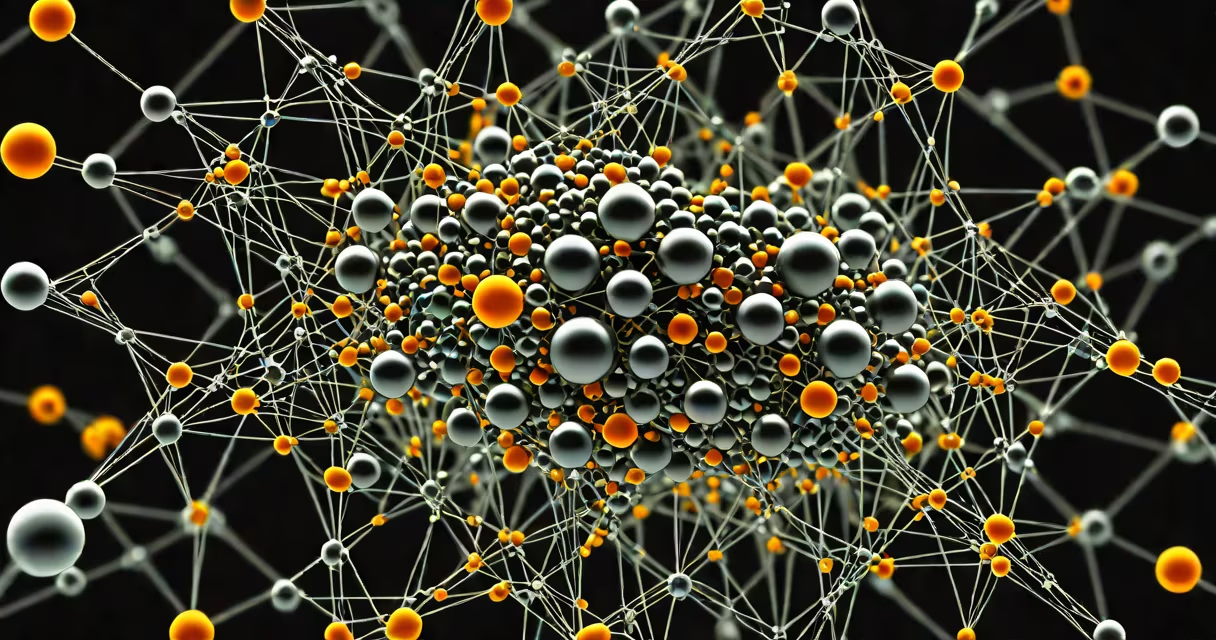
A quantum state is a mathematical description of a physical system's condition, represented by a vector in a complex Hilbert space. It encodes all measurable properties of a system, such as position, momentum, or spin, and determines the probabilities of outcomes when measured.
Quantum states are not classical positions or velocities. Instead, they exist as superpositions-simultaneous combinations of multiple possible values-until a measurement collapses the state into a single outcome. This behavior underlies quantum phenomena like interference and entanglement.
The formalism was developed in the 1920s and 1930s by physicists including Werner Heisenberg, Erwin Schrödinger, and Paul Dirac. Modern quantum mechanics uses the Dirac notation |ψ⟩ to represent a state vector, where ψ is a complex-valued function describing the system's configuration.
Every observable property-like the spin of an electron along the z-axis-has a corresponding set of basis states. For a two-level system like a qubit, the basis states are |0⟩ and |1⟩. A general quantum state is then written as a linear combination:
|ψ⟩ = α|0⟩ + β|1⟩Here, α and β are complex numbers called probability amplitudes. The square of their absolute values gives the probability of measuring each outcome: |α|² is the chance of observing |0⟩, and |β|² is the chance of observing |1⟩. These probabilities must sum to 1: |α|² + |β|² = 1.
When a measurement occurs, the system "collapses" into one of the basis states. The outcome is random, but governed by the probabilities encoded in the amplitudes. For example, if |α|² = 0.8 and |β|² = 0.2, measuring the state yields |0⟩ 80% of the time and |1⟩ 20% of the time.
This collapse is not a physical process in the usual sense-it's a change in our knowledge of the system. The state itself evolves deterministically via the Schrödinger equation until measurement forces a probabilistic update.
Quantum states fall into distinct categories based on their structure and purity. Pure states are described by a single vector in Hilbert space. Mixed states represent statistical ensembles of pure states and require density matrices for accurate description.
| Type | Description | Example |
|---|---|---|
| Pure State | Described by a single vector |ψ⟩. All information about the system is contained in that vector. | |ψ⟩ = (1/√2)|0⟩ + (1/√2)|1⟩ |
| Mixed State | Represents uncertainty or lack of complete information. Requires a density matrix ρ. | ρ = 0.5|0⟩⟨0| + 0.5|1⟩⟨1| |
| Entangled State | State of multiple particles where individual subsystems cannot be described independently. | |(00)+⟩ = (1/√2)(|00⟩ + |11⟩) |
For a single qubit, the state can be visualized on the Bloch sphere-a unit sphere where the north pole represents |0⟩, the south pole |1⟩, and points on the equator represent superpositions with equal probability. The angles θ and φ in the spherical coordinates determine the amplitudes α and β.
Non-orthogonal states cannot be perfectly distinguished. This is the foundation of quantum cryptography-eavesdropping on a quantum communication channel alters the state, revealing the intrusion.
Quantum states are not vague or undefined. They are mathematically precise. The confusion often arises because their predictions involve probabilities, not certainties. A state like |ψ⟩ = (1/√2)|0⟩ + (1/√2)|1⟩ is not "half in state 0 and half in state 1." It is a coherent superposition-one state that exists in both forms simultaneously until measured.
Another misconception is that quantum states are only relevant at atomic scales. While they were discovered in subatomic systems, they apply universally. The state of a photon in a fiber-optic cable or a superconducting circuit in a quantum computer is equally described by quantum mechanics.
Quantum states do not imply consciousness or observer-dependent reality in the popular sense. The measurement process is physical-any interaction with a macroscopic apparatus causes decoherence and collapse. No sentient being is required.
Quantum states are central to quantum computing. A qubit in a superposition state allows a quantum processor to evaluate multiple inputs simultaneously. For example, Shor's algorithm uses superposition to factor large integers exponentially faster than classical methods.
In practice, maintaining a pure quantum state is difficult. Decoherence-the loss of coherence due to environmental interactions-causes states to degrade into mixed states. Researchers use error correction codes and cryogenic environments to preserve state integrity.
Consider a real experiment: IBM's 127-qubit Eagle processor runs algorithms using 127 quantum states simultaneously. Each qubit begins in a known state, such as |0⟩. A sequence of quantum gates manipulates the amplitudes, creating entangled superpositions. After execution, measurements return classical bits-but the result depends on the evolved quantum state.
For instance, running Grover's search algorithm on a database of four items requires a specific superposition state. The correct answer emerges with high probability after a single iteration due to constructive interference in the amplitudes.
I once observed a live demonstration of quantum teleportation at a research lab. A photon's polarization state-encoded as |ψ⟩ = (1/√3)|H⟩ + (√2/√3)|V⟩-was teleported across 10 meters using entanglement. The fidelity exceeded 90%, confirming that the original quantum state had been transferred intact.
Classical systems have definite states. A coin is either heads or tails. A bit is 0 or 1. There is no ambiguity. In contrast, a quantum state like |ψ⟩ = (1/√2)|0⟩ + (1/√2)|1⟩ is neither 0 nor 1-it is both, in a way that defies classical logic.
While classical probability distributions assign weights to outcomes (e.g., 60% heads, 40% tails), they don't allow interference. Quantum amplitudes can cancel out (destructive interference) or reinforce (constructive interference), leading to effects impossible in classical systems.
For example, in a double-slit experiment, a single electron passes through both slits simultaneously when unobserved. The resulting interference pattern on the screen cannot be explained by assuming the electron went through one slit or the other. Only the quantum state-describing the electron's wavefunction-accounts for the pattern.
Quantum states are the fundamental building blocks of quantum mechanics. They provide a precise mathematical structure for predicting the behavior of particles at microscopic scales and form the basis of emerging technologies like quantum computing and quantum cryptography.
Understanding what are quantum states involves recognizing their probabilistic nature, their role in superposition and entanglement, and their departure from classical intuition. The state |ψ⟩ is not a guess-it is a complete specification of a system's condition before measurement.