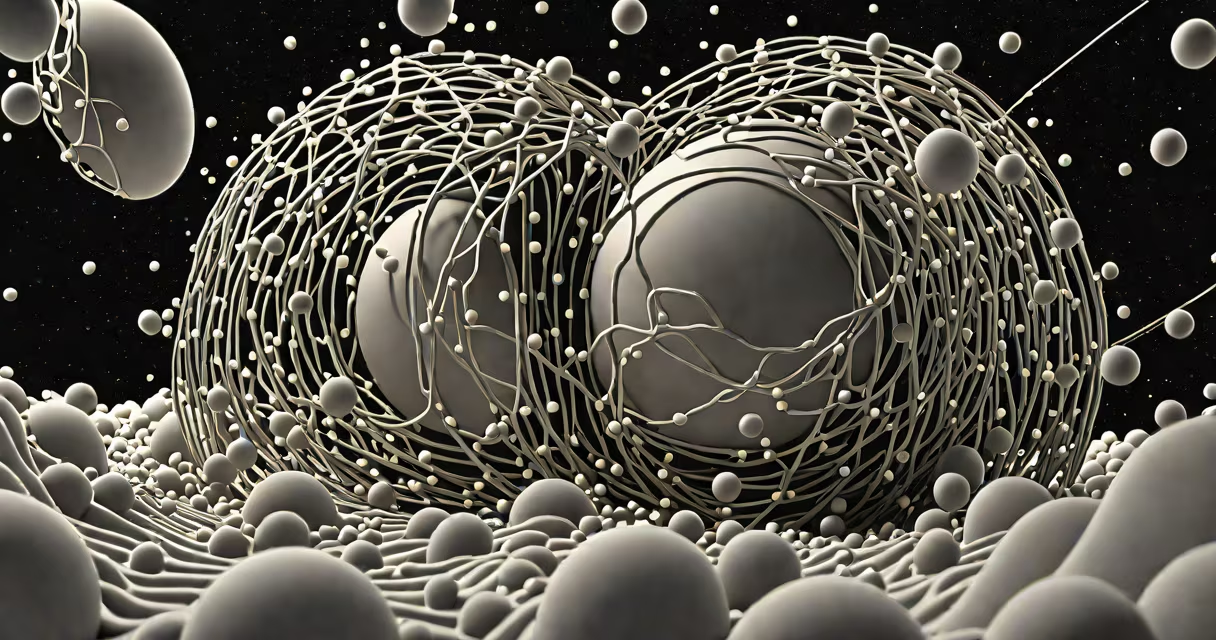
Gravity arises from the curvature of spacetime caused by mass and energy, according to Einstein's general theory of relativity. This curvature dictates how objects move, replacing the idea of a mysterious force pulling them together.
General relativity, published in 1915, redefined gravity not as a force between masses but as a geometric property of space and time. Massive objects like stars and planets distort the fabric of spacetime around them. Smaller objects then follow curved paths through this warped geometry, which we perceive as gravitational attraction.
For example, Earth orbits the Sun not because the Sun exerts a direct pull, but because the Sun's mass bends spacetime. Earth moves along the shortest path in this curved region-what's called a geodesic. This model accurately predicts planetary motion, light bending near massive bodies, and the behavior of GPS satellites.
Spacetime combines three dimensions of space with one dimension of time into a single four-dimensional structure. Mass and energy cause this structure to curve, much like placing a heavy ball on a stretched rubber sheet. The deeper the dent, the stronger the gravitational effect.
When a smaller object enters this curved region, it follows the path dictated by the geometry. A satellite in orbit, for instance, is not being "pulled" by Earth-it's moving in a straight line through curved spacetime. Its trajectory appears curved to us because the underlying space itself is bent.
This concept was confirmed during the 1919 solar eclipse expedition led by Arthur Eddington. Observations showed starlight passing near the Sun was deflected by the amount predicted by general relativity, not Newtonian physics. That result marked the first major empirical validation of Einstein's theory.
While mass is the most familiar source of gravity, energy contributes equally. Einstein's equation E = mc² shows mass and energy are interchangeable. Any form of energy-heat, light, pressure-can warp spacetime.
For example, photons (particles of light) carry energy and therefore contribute to spacetime curvature. Although their individual effect is negligible, the collective energy of a star's radiation adds to its gravitational field. Even vacuum energy-the quantum fluctuations in empty space-has a measurable gravitational influence, though it remains poorly understood.
A common misconception is that gravity depends only on mass. But the stress-energy tensor in Einstein's field equations includes pressure, momentum, and shear forces. For instance, neutron stars have extreme internal pressures that affect their gravity beyond what mass alone would predict.
| Source of Gravity | Role in Spacetime Curvature | Example |
|---|---|---|
| Mass | Primary contributor; warps space and time | Earth's mass curves spacetime enough to keep the Moon in orbit |
| Energy | Equal to mass in generating curvature | Light passing near the Sun bends due to energy's gravitational effect |
| Pressure | Contributes to curvature, especially in dense objects | Internal pressure in neutron stars affects their gravitational field |
Many assume gravity is a force acting at a distance, like magnetism. But in general relativity, no force is involved-objects simply follow the natural geometry of spacetime. The sensation of weight comes from resistance to free fall, not from a pull.
Another error is thinking gravity only exists where mass is present. In reality, spacetime curvature extends into regions far from mass. The gravitational influence of a black hole, for example, persists even in empty space beyond its event horizon.
Some believe gravity is instantaneous. But changes in gravity propagate at the speed of light. When a star collapses, the resulting change in spacetime curvature spreads outward at light speed. This was confirmed in 2017 when gravitational waves from a neutron star merger arrived at Earth just 1.7 seconds after the first gamma-ray burst-consistent with both traveling at light speed.
GPS systems rely on corrections from general relativity. Satellites orbiting Earth experience weaker gravity than ground-based receivers, so their clocks tick faster by about 38 microseconds per day. Without adjusting for this time dilation, GPS positions would drift by over 10 kilometers per day.
In 2019, the Event Horizon Telescope captured the first image of a black hole's shadow. The ring-like structure around the dark center matched predictions based on general relativity's description of extreme spacetime curvature near a singularity.
I once stood at the edge of a large-scale simulation of a binary black hole merger. The visual representation showed spacetime folding into itself, with light rays bending wildly. Seeing the actual distortion helped me grasp how gravity isn't a pull-but a consequence of geometry.
Understanding what causes gravity reshapes how we interpret cosmic phenomena. It explains why galaxies rotate faster than expected unless dark matter provides extra mass. It underpins the search for gravitational waves and the study of black holes.
Current research explores whether gravity can be unified with quantum mechanics. Some theories propose gravitons-hypothetical particles carrying gravity-but these remain unverified. General relativity still stands as the most accurate description of gravity at macroscopic scales.
What causes gravity? It's not a force, but the geometry of spacetime shaped by mass and energy. This insight, rooted in Einstein's work and verified by decades of observation, defines our understanding of the universe's largest-scale interactions.