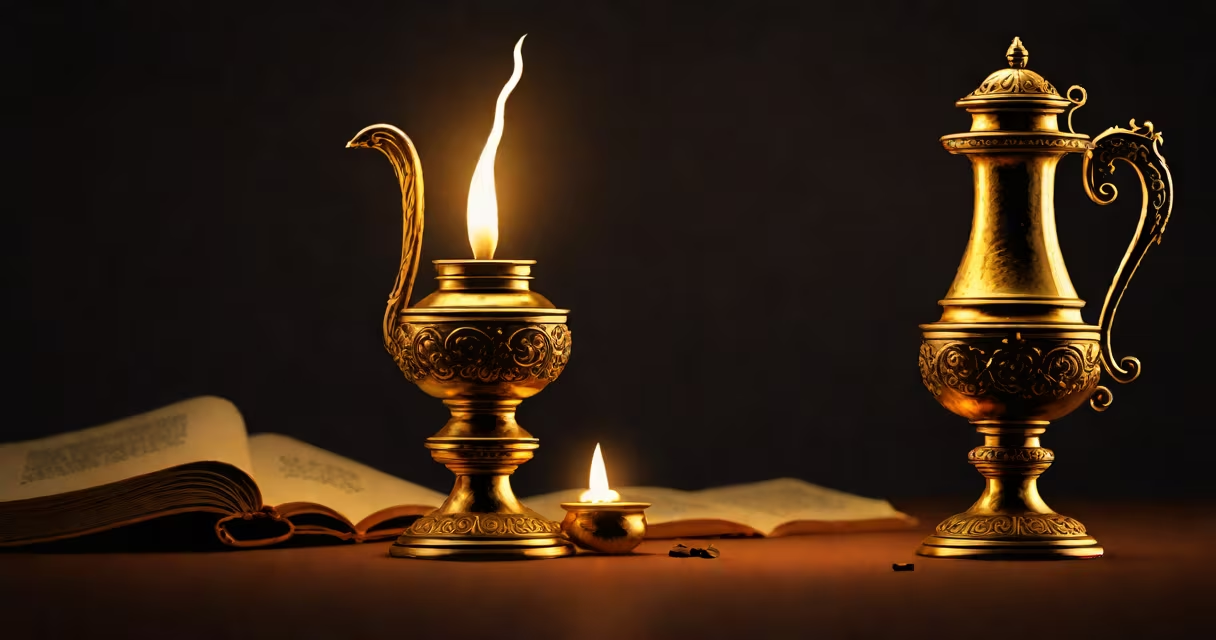
A lamp in the Bible represents divine guidance, spiritual insight, and the presence of God. It is not merely a source of physical light but a symbol of moral clarity, revelation, and eternal life. The image appears in both Old and New Testaments, often tied to worship, prophecy, and personal holiness.
The lamp's role begins in Exodus, where God commands Moses to have the Israelites bring pure olive oil for the menorah in the Tabernacle. This seven-branched lampstand was lit daily and stood as a permanent sign of God's dwelling among His people. According to Exodus 25:31-40, the design was divinely inspired-every detail meant to reflect sacred order and heavenly reality. The lamp burned continuously, symbolizing God's unbroken presence and the ongoing need for spiritual vigilance.
In the Gospels, Jesus uses the lamp metaphor explicitly. In Matthew 5:15, He says, "Neither do people light a lamp and put it under a bowl. Instead, they put it on a stand, and it gives light to everyone in the house." Here, the lamp becomes a call to live openly and faithfully. A believer's life should shine-not hide. The lamp is not for concealment but for revelation. This teaching echoes Isaiah 60:1-3, where nations are drawn to Jerusalem's light, symbolizing the global mission of God's people.
Jesus also calls Himself "the light of the world" in John 8:12. He reframes the lamp not as an object but as a person. The light is not external-it is incarnate. This shifts the focus from ritual objects to living identity. The lamp is no longer passive; it is active, changing, and relational. The believer is called to carry that light, not by their own power, but through union with Christ.
| Biblical Reference | Context | Symbolic Meaning |
|---|---|---|
| Exodus 25:31-40 | Menorah in the Tabernacle | Divine presence, sacred order, continuous worship |
| Matthew 5:15 | Jesus' Sermon on the Mount | Open witness, ethical visibility, faith in action |
| John 8:12 | Jesus declares Himself light | Self-revelation, salvation, divine identity |
| Proverbs 6:23 | Wisdom as a lamp | Moral direction, spiritual discernment |
One lesser-known but useful use of the lamp appears in Proverbs 6:23: "For the commandment is a lamp, and the teaching is light." Here, wisdom literature equates divine instruction with illumination. The lamp is not just spiritual-it is intellectual and ethical. It guides choices, corrects behavior, and prevents stumbling. This idea persists in Psalm 119:105: "Your word is a lamp to my feet and a light to my path." The Bible itself becomes the source of light, not a symbol of it.
Many readers confuse the lamp with the candle, especially in modern depictions. But in biblical context, the lamp is typically an oil lamp-burning olive oil, requiring maintenance, and producing a steady flame. Candles were not common in ancient Israel. The oil lamp's sustained burn reflects enduring faith, not fleeting emotion. Its flame flickers only when the oil runs low-just as spiritual vitality fades when communion with God weakens.
Another common misunderstanding is that the lamp symbolizes individual enlightenment. While personal insight matters, the biblical lamp is communal. The menorah stood in the Holy Place, visible to priests and worshippers. Light was not private-it was public. This aligns with Jesus' teaching that believers are "the light of the world," not isolated individuals but a collective testimony. The church, as a body, is meant to shine together.
I once visited the archaeological site of Qumran, where fragments of the Dead Sea Scrolls were discovered. Among them was a passage from the Community Rule that describes the community's practice of lighting lamps during nightly prayers. The scrolls refer to the lamp as "the fire of the covenant," linking it to purity and readiness. This historical detail shows how deeply embedded the lamp was in Jewish spiritual life-beyond ritual, into identity.
A non-obvious distinction: the lamp in the Bible is rarely associated with death or mourning. Unlike in some cultures where candles mark funerals, the biblical lamp is tied to life, presence, and continuity. Even in Revelation, where the seven churches are described with "seven golden lampstands," the imagery is of vibrant, living communities-not fading embers. The lamp stands as a sign of resurrection hope.
When Jesus says, "I am the light of the world," He does not replace the lamp-he fulfills it. The Old Proof lamp pointed forward. The New Proof lamp is fulfilled in Christ. The believer's task is not to maintain the lamp but to walk in the light He provides. As 1 John 1:5 states, "God is light; in him there is no darkness at all." The lamp is not a symbol of human effort-it is a reflection of divine nature.
Understanding the lamp's meaning helps interpret passages like Luke 11:33: "No one lights a lamp and puts it in a hidden place or under a bowl." The lamp belongs in the open-on a stand, where it serves others. This is not about performance but purpose. The light is not for show-it is for service. A believer's actions should explain truth, not obscure it.