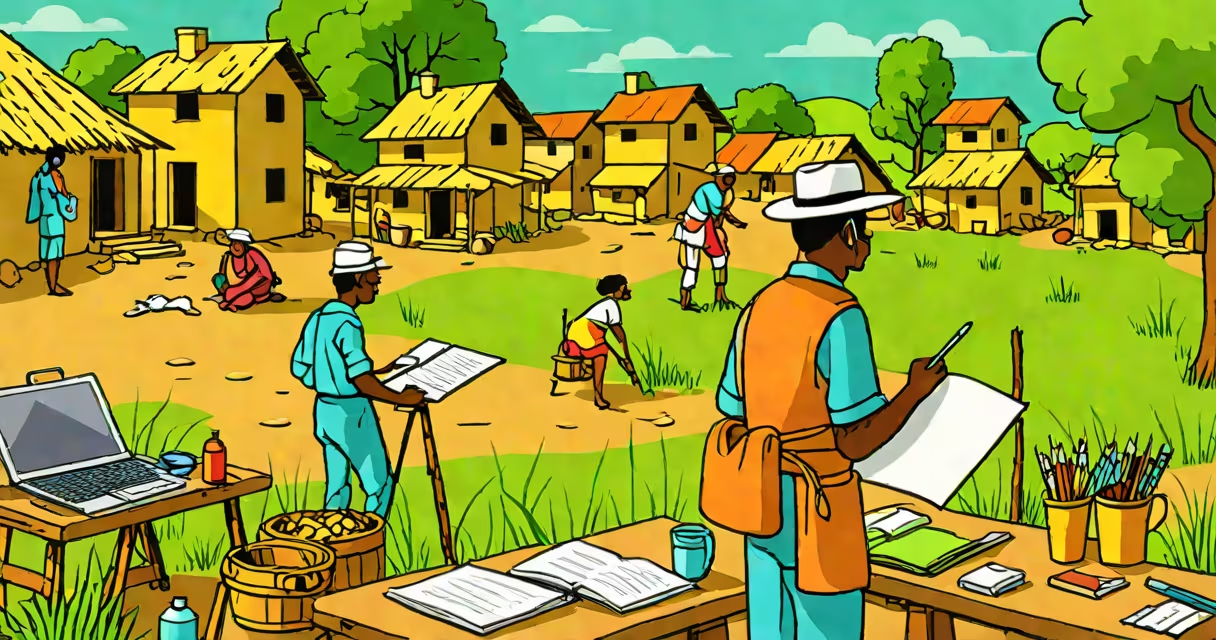
An anthropologist studies humans in all their historical, cultural, and biological dimensions-through direct observation, excavation, and analysis of material culture, language, and social systems. They investigate how people live, adapt, and change across time and space, using scientific methods grounded in evidence.
Anthropologists work in four main subfields: cultural anthropology, biological (physical) anthropology, archaeology, and linguistic anthropology. Each focuses on a different aspect of human existence. Cultural anthropologists observe living communities, biological anthropologists study human origins and variation, archaeologists analyze past human activity through artifacts, and linguistic anthropologists examine how language shapes identity and society.
Fieldwork is central to the discipline. Unlike many academic roles, anthropologists often spend months or years embedded in communities-sometimes in remote regions-to gather data firsthand. This requires building trust, learning local languages, and adapting to unfamiliar environments. Their findings inform public policy, conservation efforts, and cross-cultural understanding.
Anthropologists begin with a research question. For example: "How do indigenous communities manage water resources during drought?" They then design a study using qualitative and quantitative methods. Interviews, participant observation, surveys, and measurements of skeletal remains or artifact composition are standard tools.
Fieldwork involves long-term presence. A cultural anthropologist studying kinship patterns in a West African village may live there for 18 months, attending births, funerals, and market days. They record observations in journals, audio-record conversations, and analyze social networks. Data is coded and compared across groups to identify patterns.
Biological anthropologists use lab techniques. When analyzing ancient human remains, they measure bone density, assess trauma, and extract DNA. A 2018 study published in *Nature* used genome sequencing to trace migration routes of early Homo sapiens out of Africa-revealing that modern humans interbred with Neanderthals around 50,000 years ago.
The four core branches of anthropology differ in focus and methodology:
| Subfield | Focus Area | Methods | Example Find |
|---|---|---|---|
| Cultural Anthropology | Social behavior, belief systems, rituals | Participant observation, interviews, ethnographic films | Documenting how a Pacific island community adapted to rising sea levels through traditional land-use practices |
| Biological Anthropology | Human evolution, genetics, primate behavior | Bone analysis, DNA testing, field studies of primates | Identifying a 3.8-million-year-old hominin fossil as Australopithecus afarensis based on pelvic structure and limb proportions |
| Archaeology | Material culture, past societies | Excavation, radiocarbon dating, GIS mapping | Uncovering a 2,000-year-old Roman settlement in southern England using ground-penetrating radar and stratigraphic analysis |
| Linguistic Anthropology | Language, communication, symbolic systems | Discourse analysis, phonetic transcription, sociolinguistic surveys | Reconstructing the oral history of a Native American tribe through narrative structure and metaphor use |
Some anthropologists specialize further. Forensic anthropologists assist law enforcement by identifying human remains from skeletal fragments. Medical anthropologists study how illness is perceived and treated across cultures-such as the role of spiritual healing in rural Haiti.
People often confuse anthropology with archaeology or sociology. Archaeology is a subset of anthropology focused on material remains. Sociology studies social structures but typically excludes evolutionary and biological contexts. Anthropology uniquely integrates all aspects of human life-past and present, biology and culture.
Another misconception is that anthropologists only study "exotic" or "primitive" societies. In reality, they study urban centers, refugee camps, tech startups, and online communities. A 2020 study by the American Anthropological Association found that 60% of U.S.-based anthropologists now conduct research in metropolitan areas.
There's also a myth that anthropologists don't use science. On the contrary, they apply rigorous standards. Ethnographic data is validated through peer review, replication, and transparency in field notes. The American Journal of Physical Anthropology publishes peer-reviewed research on human variation, including statistical models of cranial morphology.
Anthropologists contribute to global health initiatives. During the 2014 Ebola outbreak in West Africa, anthropologists helped design effective public messaging by understanding local burial customs and mistrust of Western medical teams. Their insights reduced transmission rates by improving community engagement.
In development work, anthropologists assess how aid programs affect local cultures. A project in Nepal distributing solar lamps failed until researchers realized villagers used light for storytelling and ritual-not just illumination. Adjusting the program to include cultural narratives increased adoption.
I once observed a team of anthropologists working with Indigenous elders in northern Canada to document traditional ecological knowledge. Over six weeks, they recorded oral histories about caribou migration patterns. This data later informed wildlife management policies, showing that Indigenous knowledge complements satellite tracking data.
These examples show that what does an anthropologist do extends beyond academia. Their work shapes healthcare, environmental policy, education, and international relations. They are not passive observers-they are active participants in solving complex human problems.
Understanding what an anthropologist does reveals a discipline rooted in empathy, evidence, and long-term thinking. Whether decoding ancient pottery shards or analyzing social media discourse, they seek to understand humanity in its full complexity.