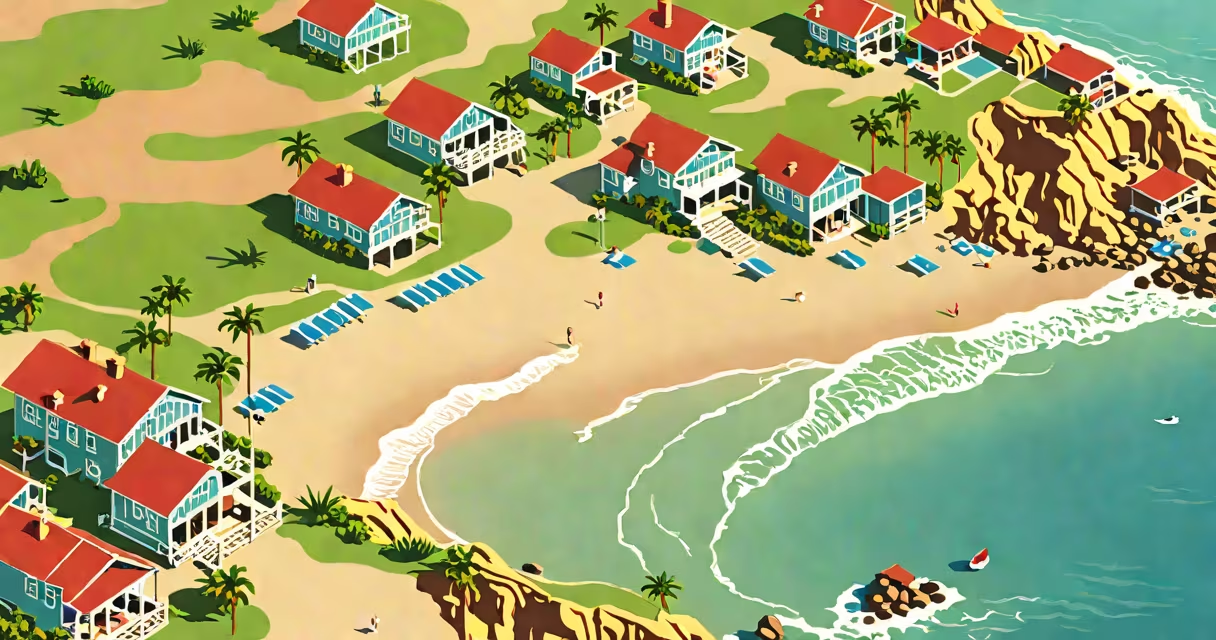
Crystal Cove State Beach is a protected coastal park located along the Pacific coastline in Orange County, California, featuring sandy shores, tide pools, hiking trails, and preserved historic beach cottages. It lies within the larger Crystal Cove State Park complex and is managed by the California Department of Parks and Recreation.
The beach spans approximately 1.5 miles of shoreline between the bluffs of the Santa Ana Mountains and the Pacific Ocean. Its name derives from the crystalline quality of the sand and rock formations visible at low tide, particularly in the intertidal zones where sunlight refracts through seawater and mineral deposits.
Visitors access the area via a network of marked trails descending from the main parking lot near Coast Highway 1. The site includes designated picnic areas, restrooms, and a small visitor center with interpretive displays on local marine life and the history of the beach's early 20th-century cottage community.
Crystal Cove State Beach operates under standard California state park regulations. Entry requires a daily parking fee, currently $15 per vehicle, collected at the gate. Parking is limited to 400 spots, and overflow is common during weekends and holidays. Reservations are not accepted; arrival early is recommended.
The park is open daily from 6 a.m. to 10 p.m. During daylight hours, visitors may walk the shoreline, explore tide pools, or hike the Coastal Trail. Swimming is permitted but not advised due to strong rip currents and cold water temperatures. Surfing is prohibited in the cove area due to safety concerns and ecological protection zones.
Dogs are allowed on leash in designated areas but not on the beach itself. Fires are banned except in approved fire pits at picnic sites. Overnight camping is not available-this is a day-use-only facility.
The beach's geology consists of sandstone and shale bedrock formed over 10 million years ago. Intertidal zones expose barnacles, mussels, sea stars, and anemones. Tide pool exploration is best during spring and summer months when low tides occur between 6 a.m. and 9 a.m., offering visibility into underwater ecosystems.
Historic structures include 19 original beach cottages built between 1910 and 1930. These were privately owned until 1958, when the state acquired the land. Today, six restored cottages serve as museum exhibits and educational spaces. They feature period furnishings, photographs, and oral histories from early residents.
A non-obvious fact: the cottages are listed on the National Register of Historic Places. Their preservation is governed by strict guidelines to maintain authenticity. Visitors cannot enter the interiors unless participating in a guided tour, which runs twice daily during peak season.
Crystal Cove State Beach attracts families, photographers, and nature educators. It hosts seasonal programs such as "Tide Pool Discovery Days" and "Beach Cleanup Events," coordinated by the nonprofit Friends of Crystal Cove. These events draw hundreds annually and include hands-on learning about marine conservation.
One popular activity is the 1.2-mile Coastal Trail walk, which begins at the main trailhead and ends at the historic lighthouse ruins. The path passes through native coastal sage scrub and offers views of sea lions resting on offshore rocks. Average walking time is 45 minutes round-trip.
For example, on a typical Saturday in August, the park sees 2,800 visitors. Over 60% arrive between 9 a.m. and 12 p.m. The most common reason cited in visitor surveys is "to see tide pools and take photos." Nearly 40% report bringing children under 12, making it a top-rated destination for family outings in Southern California.
Many mistake Crystal Cove State Beach for a private resort or a hotel property. It is not. The red-roofed cottages are public museum spaces, not rental units. No overnight stays are permitted on-site.
Another misconception: the beach is often confused with nearby Huntington Beach or Corona del Mar. While all three lie within Orange County, Crystal Cove is distinct in its focus on ecological preservation and historical interpretation. It is not a surf hotspot-waves are too weak for consistent surfing.
A lesser-known correction: the term "Crystal Cove" refers to the entire coastal preserve, not just the beach. The park encompasses 1,400 acres, including forested trails, wetlands, and the former site of the Crystal Cove Colony, a 1920s artists' retreat.
| Feature | Details |
|---|---|
| Location | Coast Highway 1, between Newport Beach and Laguna Beach, CA |
| Operating Hours | 6 a.m. - 10 p.m. daily |
| Parking Fee | $15 per vehicle (cash or card) |
| Best Time to Visit | Weekdays, early morning, late summer |
| Key Attractions | Tide pools, Coastal Trail, historic cottages, marine education center |
I visited Crystal Cove State Beach in October 2022 during a low-tide window. I walked the coastal trail with a ranger-led group and documented over 15 species of intertidal invertebrates. The experience confirmed that the park's educational value extends beyond sightseeing-it delivers tangible environmental literacy.
Crystal Cove State Beach remains a model of balanced public access and ecological stewardship. Its combination of natural beauty, historical preservation, and science-based programming makes it one of California's most consistently visited state parks.