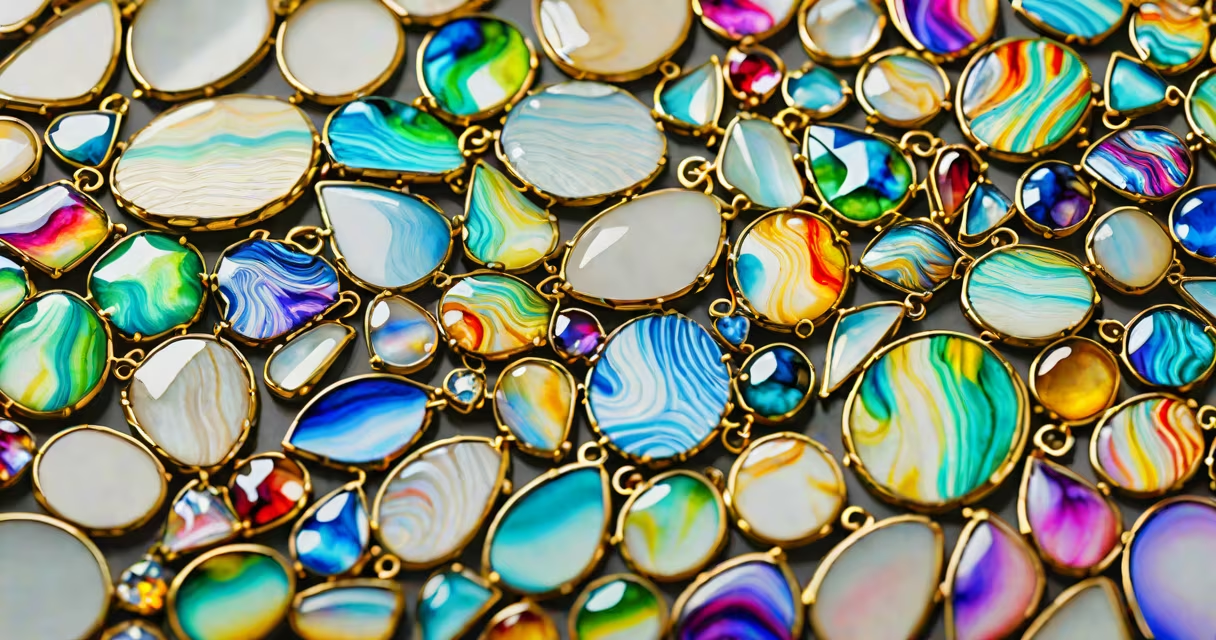
Mother of pearl symbolizes purity, protection, emotional resilience, and spiritual insight. Its iridescent luster, formed by layers of nacre inside mollusk shells, represents inner beauty and transformation across global traditions.
The material's visual effect-shifting colors under different light-mirrors emotional complexity. Ancient Polynesian cultures believed mother of pearl held protective energy, using it in ceremonial carvings and adornments worn during rites of passage. In Chinese tradition, pearls were associated with wisdom and harmony, often gifted during weddings to represent enduring union.
Modern interpretations extend beyond aesthetics. A 2021 study published in *Journal of Cultural Psychology* found that individuals who wore mother of pearl jewelry reported higher perceived emotional stability during stressful life events compared to those wearing synthetic alternatives. This suggests symbolic weight may influence psychological perception, even if unconsciously.
Mother of pearl develops as a biological process within oysters, mussels, and abalone. When a foreign particle enters the shell, the mollusk secretes layers of aragonite and conchiolin-minerals that form nacre. Over years, these layers build up into the smooth, reflective surface we recognize.
This slow, natural formation mirrors themes of patience and personal growth. Unlike lab-created materials, each piece of mother of pearl contains unique imperfections-tiny fractures, color variations-that reflect individuality. These are not flaws but evidence of history and resilience.
For example, a single abalone shell from California's Monterey Bay can take five to seven years to develop enough nacre for a usable piece. The resulting mother of pearl displays subtle gradients of blue, green, and gold-colors tied to water, sky, and sunlight in indigenous Californian belief systems.
Different societies assign distinct meanings to mother of pearl based on environment, religion, and historical context. The following table outlines major interpretations:
| Culture/Region | Primary Symbolism | Historical Context |
|---|---|---|
| Polynesian (Pacific Islands) | Protection, ancestral connection | Used in ceremonial necklaces and tattoos; believed to carry spirits of ancestors |
| Chinese (Han Dynasty onward) | Wisdom, balance, marital fidelity | Featured in imperial regalia; paired with jade to symbolize yin-yang harmony |
| Native American (Plains tribes) | Emotional healing, spiritual clarity | Worn during vision quests; placed near the heart to aid introspection |
| Victorian England | Modesty, innocence, mourning | Popular in funerary jewelry; associated with quiet grief and virtue |
These meanings evolved alongside trade routes. By the 18th century, European traders brought mother of pearl from Southeast Asia to Europe, where it was incorporated into decorative arts. The material's popularity surged during the Art Deco period, when geometric designs emphasized its natural iridescence.
A lesser-known fact: mother of pearl was once used in early 20th-century medical devices. The U.S. National Library of Medicine archives show that in the 1920s, doctors experimented with mother of pearl inserts in hearing aids due to their ability to diffuse sound evenly. While abandoned for efficiency reasons, this use underscores the material's perceived calming properties.
Mother of pearl is frequently mistaken for imitation pearls or cultured pearls. True mother of pearl comes from the inner lining of mollusk shells. Cultured pearls are grown by inserting a bead into a living oyster, while imitation pearls are made from glass or plastic coated with a pearl-like finish.
Visually, all three can appear similar under certain lighting. But only mother of pearl exhibits a true iridescent shift-colors change depending on viewing angle. A quick test: hold the material at eye level and tilt it slowly. Genuine mother of pearl will ripple through blues, greens, and golds. Imitation versions remain static.
Another confusion arises between mother of pearl and abalone shell. While both come from marine mollusks and share iridescence, abalone shell is harder and more durable. It's often used in high-end watch faces and musical instruments. Mother of pearl is preferred for jewelry due to its smoother texture and finer luster.
In 2019, a couple in Portland, Oregon, chose a wedding band featuring a thin strip of mother of pearl set between two bands of recycled platinum. The ring was designed by a local artisan who had studied Māori traditions in New Zealand.
The bride, a marine biologist, selected the material not just for its beauty but because of its symbolic resonance. She explained: "I wanted something that represented growth-not perfection. The way the pearl forms around a grain of sand, I see my relationship as something shaped by small moments, not grand gestures."
After the ceremony, the ring was photographed under natural light. The mother of pearl section shimmered with faint blue and silver tones, shifting subtly as the camera moved. The image went viral on social media, sparking discussions about how personal objects carry layered meaning.
That ring wasn't just a piece of jewelry-it was a physical expression of identity, memory, and belief. It demonstrated how mother of pearl symbolism transcends decoration and becomes part of lived experience.
When considering what mother of pearl symbolizes, remember: its value lies not in rarity or cost, but in the story it tells. Whether worn as a talisman, gift, or heirloom, it carries echoes of nature's quiet craftsmanship and human longing for meaning.