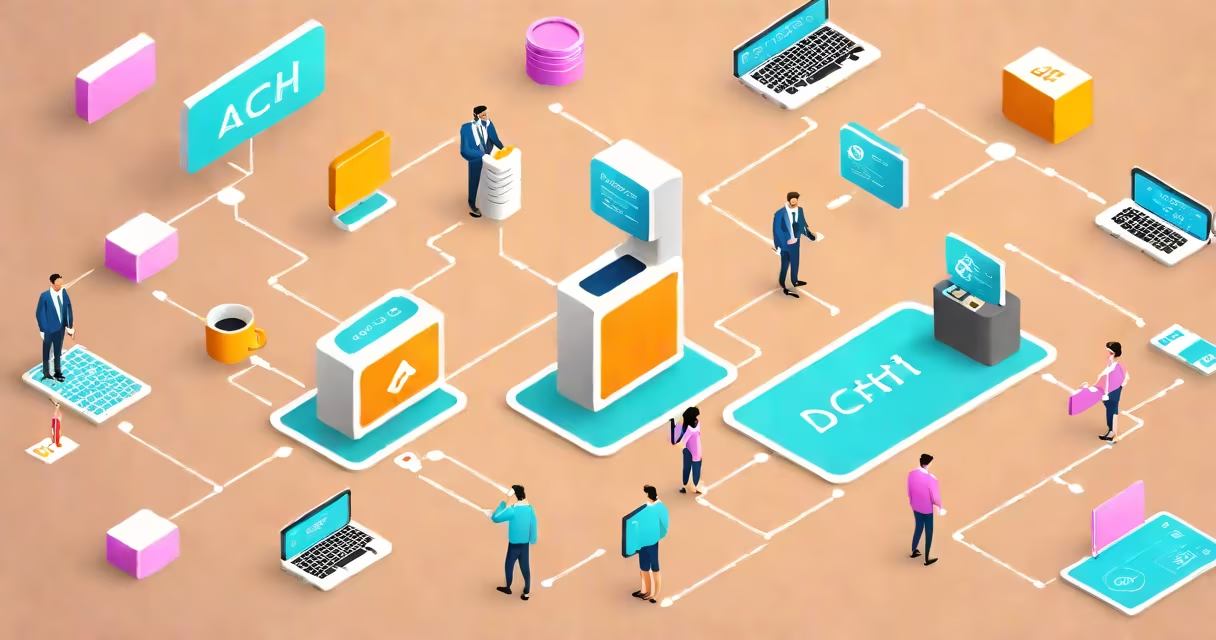
An ACH debit payment is an electronic funds transfer initiated by a payee through the Automated Clearing House network, withdrawing money directly from a payer's bank account with prior authorization. It enables recurring bill payments, vendor payouts, and direct deposits using standardized routing and account numbers.
ACH debit transactions move money between U.S. bank accounts via the ACH network, operated by Nacha. They process in batches during designated settlement windows, typically settling within one to two business days. Unlike wire transfers, ACH debits are low-cost and widely used for regular payments such as rent, utilities, subscriptions, and loan repayments.
For example, when you sign up for a streaming service and provide your bank details, the company uses your account number and routing number to initiate a monthly ACH debit. The payment clears automatically on the due date unless canceled in advance. This method reduces processing delays and avoids paper checks.
The process begins when a payee-such as a utility provider or subscription service-requests a payment from a customer's bank account. The request includes the customer's bank routing number and account number, verified through prior consent. The payee sends the transaction to their financial institution, which forwards it to the ACH network.
Nacha's rules require that the payer authorize the transaction in writing or electronically. Without consent, the transaction cannot proceed. Once approved, the ACH network routes the payment to the payer's bank. The receiving bank verifies the account and funds availability, then posts the debit to the account. Settlement occurs in batches processed overnight, usually between 8 PM and midnight Eastern Time.
Settlement times vary. Most ACH debits settle within one business day, though some may take two. For instance, a rent payment scheduled for the 1st of the month is typically posted by the 2nd. If the account lacks sufficient funds, the transaction fails and returns to the payee with a reason code, such as "R01 - Insufficient Funds."
ACH debits fall into two categories based on who initiates the transaction. The most common is the "push" model, where the payee sends the request. The less frequent "pull" model allows the payer to initiate the transfer, often used in person-to-person payments via apps like Zelle.
| Type | Initiator | Use Case | Example |
|---|---|---|---|
| Direct Debit (Push) | Payee | Recurring bills, payroll deductions | Monthly gym membership charge |
| Person-to-Person (Pull) | Payer | Peer-to-peer transfers | Friend sending $50 via Zelle |
Some institutions offer same-day ACH, which settles within four hours. This option is available for urgent payments but incurs higher fees. For example, a medical provider may use same-day ACH to collect a co-pay within hours of a visit, reducing administrative delays.
ACH debits are governed by Nacha's Operating Rules, which mandate that all transactions include written or electronic authorization. The payer must receive a clear notice of the amount, frequency, and purpose. Failure to obtain consent makes the transaction invalid and subject to reversal under Regulation E.
Unlike credit card payments, ACH debits do not rely on a credit line. Instead, they draw from actual balances. This reduces risk of overspending but increases exposure to overdrafts. If a payment fails due to insufficient funds, the payee may charge a returned item fee, typically $25 to $35.
A key distinction many overlook: ACH debits are not the same as direct deposits. Direct deposits involve funds going into an account, while ACH debits remove funds. Confusing the two leads to errors in budgeting and reconciliation. For example, mistaking a monthly ACH debit for a deposit can cause cash flow mismanagement in small businesses.
Many assume ACH debits are unsecured because they're automated. In reality, they are protected under federal law. Under Regulation E, consumers have up to 60 days to dispute unauthorized transactions. If reported within two business days, liability is limited to $50. After that, it rises to $500. Full protection applies if reported within 60 days.
I've personally used ACH debits to automate student loan payments. By setting up a monthly automatic withdrawal from my checking account, I avoided late fees and maintained a consistent repayment history. The lender confirmed each payment was processed within 48 hours of the due date, with no manual intervention required.
Another non-obvious fact: ACH debits are not limited to U.S. banks. International transfers can use ACH-like systems, but they require conversion through correspondent banks. For example, a Canadian business paying a U.S. vendor via ACH must ensure the recipient's bank supports cross-border ACH routing. Not all institutions do.
When comparing ACH debits to wire transfers, the difference lies in speed and cost. Wire transfers settle in real time but cost $15 to $30 per transaction. ACH debits cost less than $0.50 per transaction and settle in one to two days. For large-volume payments, such as payroll for 500 employees, ACH is far more efficient and economical.
ACH debit payments are a foundational element of electronic banking. They enable predictable, low-cost transfers across millions of accounts daily. Their reliability and regulatory oversight make them a preferred choice for both individuals and organizations.