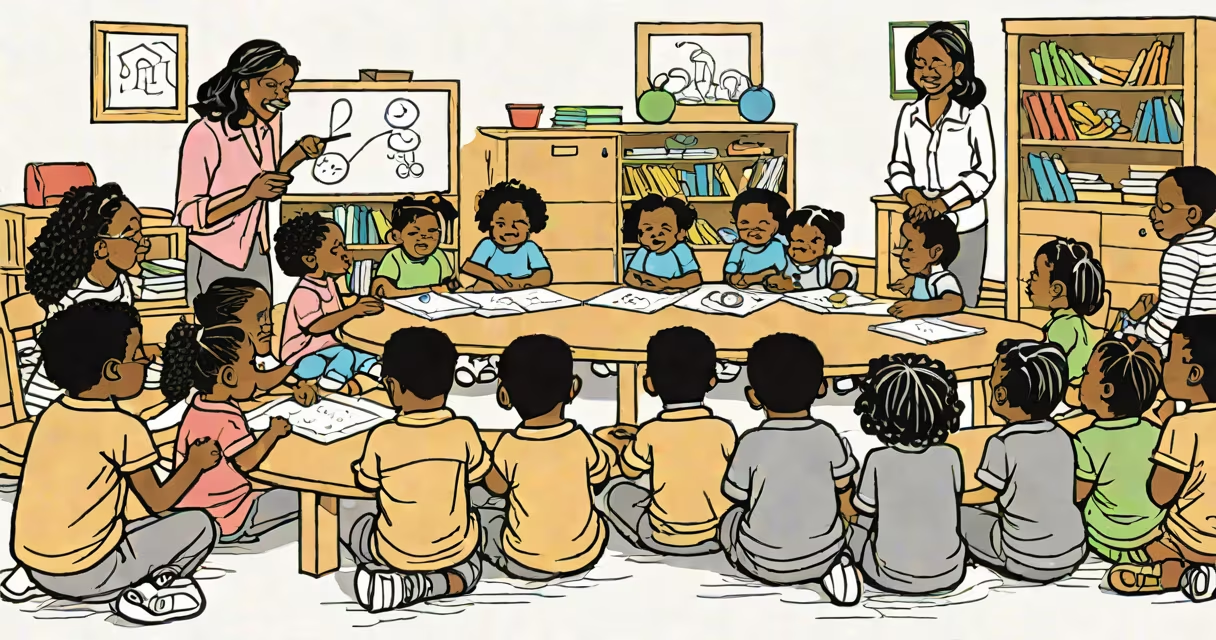
Pre-K is a formal early childhood education program designed for children ages 3 to 5, typically offered before kindergarten. It focuses on developing cognitive, emotional, and social skills through play-based and guided instruction. The goal is to prepare children for academic and behavioral expectations in kindergarten.
Pre-K programs vary by state and school district but generally include structured lessons in letter recognition, counting, fine motor skills, sharing, and following routines. They are not daycare or informal childcare-they are curriculum-driven and often taught by certified early childhood educators.
According to the National Association for the Education of Young Children (NAEYC), high-quality Pre-K programs improve school readiness, reduce achievement gaps, and support long-term academic success. A 2021 study by the Brookings Institution found that children who attended quality Pre-K were 15% more likely to graduate high school on time compared to peers who did not.
Pre-K operates on a daily schedule that balances free play, teacher-led activities, and structured learning. Classrooms typically run 2.5 to 4 hours per day, five days a week, though some offer half-day or extended options.
Activities are designed around developmental milestones. For example, children may sort blocks by color and size to build early math reasoning. They might engage in storytelling circles to develop listening and verbal expression. Teachers assess progress through observation, not standardized tests.
A 2022 report from the U.S. Department of Education noted that 67% of public Pre-K programs in the U.S. follow state-developed early learning standards. These standards define what children should know and be able to do by the end of the year, such as recognizing 10 letters, identifying basic shapes, or using polite language during interactions.
Pre-K is available in several formats, each with distinct eligibility and funding models:
| Type | Funding Source | Eligibility | Example |
|---|---|---|---|
| Public Pre-K | State/local government | Age 4, residency required | California's Statewide Pre-K Program |
| Head Start | Federal grant | Low-income families, ages 3-5 | Head Start centers in rural Mississippi |
| Private Pre-K | Parent tuition | Open enrollment, no income cutoff | Montessori schools in Austin, Texas |
| Charter School Pre-K | Public funding with private management | Lottery-based admission | Success Academy Pre-K in Brooklyn |
Some programs offer dual-language instruction. For instance, New York City's Dual Language Pre-K initiative teaches math and science in both English and Spanish. Children in these programs show stronger vocabulary growth in both languages, according to a 2023 study by the University of California, Los Angeles.
Pre-K is used to close early learning gaps, especially for children from low-income households. Research from the National Institute for Early Education Research (NIEER) shows that children in high-quality Pre-K programs outperform peers in reading and math by the end of kindergarten.
Programs are most effective when they have small class sizes (no more than 15 students), trained teachers, and consistent daily routines. A 2020 NIEER report found that programs with fewer than 12 children per teacher had higher student engagement and behavior outcomes.
Parents often enroll children in Pre-K to build independence, routine-following, and peer interaction skills. One parent in Chicago shared that her son, who previously avoided group settings, began initiating conversations with classmates after six weeks in Pre-K. "He came home saying he helped a friend tie his shoes," she said. "That was the first time he'd mentioned helping someone."
Pre-K is not the same as daycare. Daycare focuses on supervision and basic care; Pre-K emphasizes intentional learning. A child in a licensed daycare center may spend most of the day playing independently or napping. A Pre-K classroom includes planned activities like circle time, phonics games, and art projects with specific learning goals.
Another misconception is that Pre-K teaches formal academics. In reality, children learn through exploration. They don't write letters yet-they trace them with fingers in sand trays. They don't solve equations-they count blocks during snack time. The focus is on process, not performance.
There's also confusion about when children should start. While many programs accept 3-year-olds, research suggests that readiness matters more than age. A child should be able to follow two-step instructions, identify emotions, and sit for 15 minutes without constant redirection. If a child struggles with these, waiting until age 4 may be better.
Pre-K is not a test of intelligence. It is not a race to read or write early. It is not a substitute for family bonding time. Instead, it's a supportive environment where children explore, make mistakes, and grow under adult guidance.
High-quality Pre-K doesn't push academic skills-it nurtures curiosity. A child may not know the letter 'A' at the beginning of the year, but by spring, they'll recognize it in books, songs, and their name. That progress happens through repetition, play, and encouragement-not drills.
Understanding what Pre-K is-and what it isn't-helps families choose the right program. Whether public, private, or federally funded, the core purpose remains the same: to lay a foundation for lifelong learning.