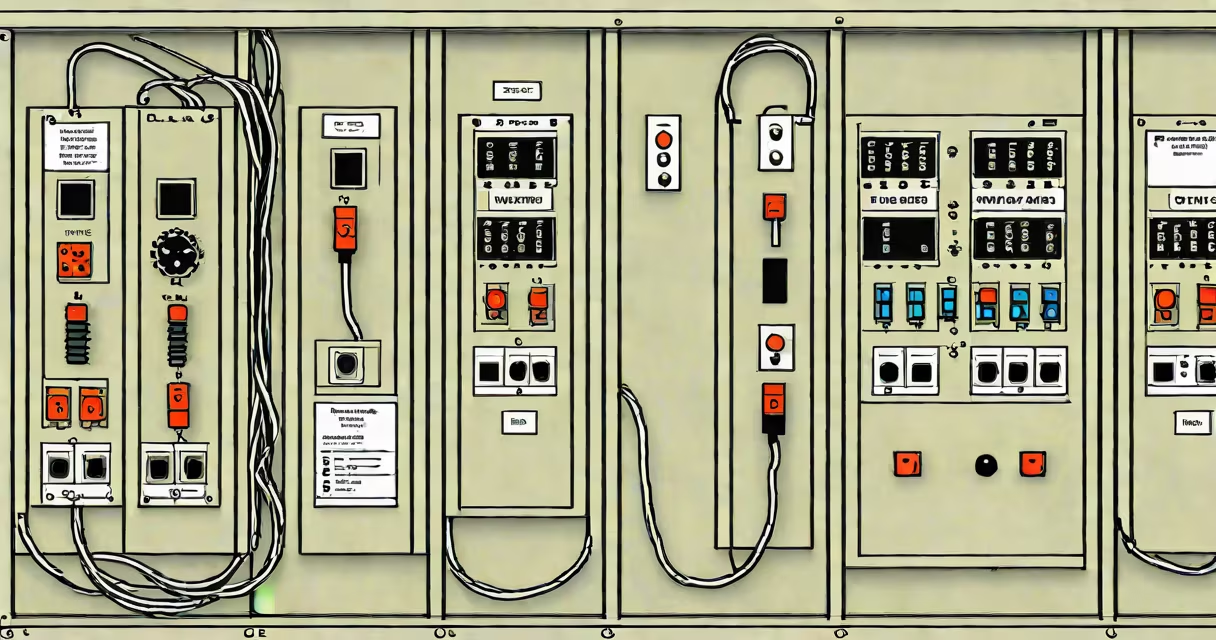
Three phase voltage uses three alternating current waveforms offset by 120 degrees, delivering consistent power with lower conductor losses than single phase. Common voltages include 208V, 240V, 400V, and 480V, depending on region and application.
Three phase systems distribute power across three conductors, each carrying a sinusoidal current that peaks at different times. This staggered timing ensures constant power delivery, reducing fluctuations and improving efficiency. The voltage between any two conductors-called line-to-line voltage-is higher than the voltage from any conductor to neutral-line-to-neutral voltage.
For example, in a 480V three phase system, the line-to-line voltage is 480V, while the line-to-neutral voltage is approximately 277V. This difference arises because the three phases are spaced 120° apart, creating a vector sum between lines. The relationship follows the formula: line-to-line voltage = √3 × line-to-neutral voltage.
Power distribution relies on synchronized alternating currents. In a three phase setup, three sine waves cycle at 60 Hz (in North America) or 50 Hz (in Europe), each delayed by 1/3 of a cycle. This creates a stable, continuous power flow ideal for heavy machinery.
When loads are balanced-meaning equal current flows through each phase-the neutral conductor carries little or no current. This allows smaller neutral wires or even elimination of the neutral in some installations, saving material and cost.
Unbalanced loads cause current to return via the neutral, which must be sized accordingly. For example, a factory with three large motors connected to each phase may draw 100A per phase. If one motor fails, the remaining two phases carry more load, increasing neutral current and requiring careful monitoring.
Standard three phase voltages vary by country and application. In the U.S., common levels include 208V, 240V, 400V, and 480V. In Europe, 400V line-to-line is standard for industrial buildings.
| Region | Line-to-Line Voltage | Line-to-Neutral Voltage | Typical Use |
|---|---|---|---|
| North America (commercial) | 208V | 120V | Lighting, HVAC, office equipment |
| North America (industrial) | 480V | 277V | Motors, compressors, large machinery |
| Europe (industrial) | 400V | 230V | Manufacturing, pumps, elevators |
| High-voltage transmission | 13.8kV, 34.5kV | 7.97kV, 19.9kV | Long-distance power transfer |
These values are standardized under IEEE and IEC guidelines. For example, IEEE Standard 141-1993 defines acceptable tolerances for three phase systems in industrial environments, ensuring equipment operates within safe voltage ranges.
Fact: A 480V three phase system can deliver nearly twice the power of a 240V single phase system using the same wire size, due to better current distribution and reduced harmonic distortion.
Industries such as manufacturing, data centers, and water treatment rely on three phase voltage for high-power equipment. Motors rated above 1 horsepower typically require three phase power for efficient torque and reduced heat buildup.
A real-world example: A 50-horsepower industrial motor running on 480V three phase draws about 60 amps. At 480V, the power delivered is roughly 40,000 watts (P = √3 × V × I × PF, assuming 0.85 power factor). The same motor on single phase 240V would require over 100 amps, demanding thicker wiring and greater heat dissipation.
Commercial buildings often use 208V three phase for lighting and air conditioning. This voltage is derived from a wye-connected transformer with a neutral tap. The 208V line-to-line value comes from √3 × 120V, allowing both 120V outlets and 208V circuits in the same facility.
Many assume three phase voltage is inherently "higher" than single phase. That's incorrect. The voltage level depends on the system design. A 120V three phase system exists-used in some older industrial facilities-but it's rare and inefficient compared to higher voltage setups.
Another error: thinking all three wires carry the same voltage relative to ground. In reality, each conductor alternates between positive and negative relative to neutral. Measuring one phase against neutral gives 277V in a 480V system, but measuring between two phases gives 480V.
I once measured a three phase panel during a maintenance check and saw 480V between L1 and L2, 480V between L2 and L3, and 480V between L3 and L1. But each phase read 277V to ground. The readings confirmed balanced load distribution-critical for preventing overheating and equipment failure.
Single phase systems use two wires: hot and neutral. They're common in homes and small offices. Three phase systems use three or four wires (three hot, one neutral). The extra phase enables smoother power delivery and supports larger loads.
Three phase systems reduce voltage drop over long distances. A 100-foot run of #6 AWG copper wire carrying 50A at 240V single phase drops about 1.5 volts. The same run at 480V three phase drops less than 0.5 volts due to lower current per conductor.
Also, three phase motors don't need capacitors to start-they generate rotating magnetic fields internally. This simplifies control and increases reliability. Single phase motors require external starting mechanisms, adding complexity and failure points.