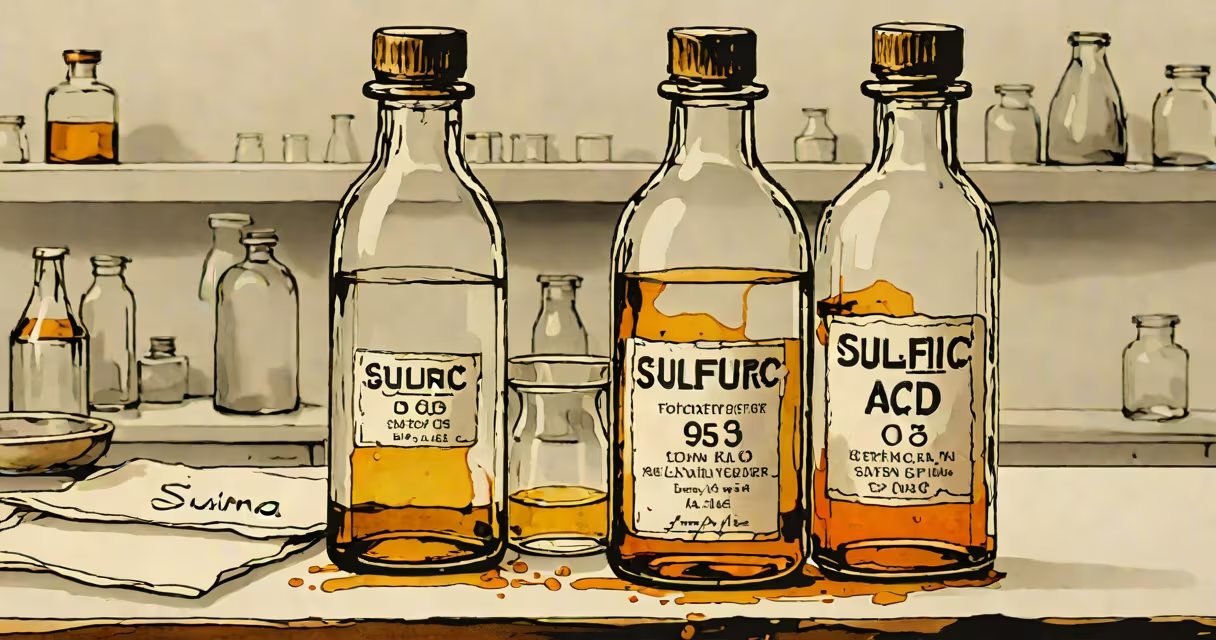
Sulfuric acid Sigma refers to sulfuric acid (H₂SO₄) manufactured and distributed by Sigma Aldrich under strict quality control, typically used in research, industrial processes, and analytical chemistry. It is available in multiple purity grades, including reagent grade (95-98%) and ultra-pure forms for sensitive experiments.
Manufactured under ISO 9001 and ISO 17025 standards, sulfuric acid Sigma is produced in controlled environments to minimize impurities such as iron, chloride, and heavy metals. These specifications ensure consistent performance across batches, critical for reproducible results in labs.
For example, Sigma Aldrich's 95-98% sulfuric acid (product #301677) contains less than 0.001% iron and less than 0.0005% chloride. This level of purity exceeds standard reagent-grade requirements and supports advanced applications like mass spectrometry sample preparation and semiconductor cleaning.
Sulfuric acid Sigma is a dense, oily liquid composed of hydrogen, sulfur, and oxygen (H₂SO₄). Its molecular structure allows it to donate protons (H⁺ ions), making it a strong diprotic acid. This property enables it to react vigorously with bases, metals, and organic compounds.
In aqueous solution, sulfuric acid ionizes in two steps: first into H⁺ and HSO₄⁻, then further into H⁺ and SO₄²⁻. The complete dissociation makes it effective in catalyzing reactions such as esterification, dehydration, and alkylation.
A key distinction often missed: not all sulfuric acid labeled "reagent grade" meets the same purity thresholds. Sigma Aldrich publishes detailed Certificate of Analysis (CoA) for each batch, listing trace metal content, pH, and density. For instance, product #301677 has a density of 1.84 g/mL at 20°C and a pH of ~1.5 in 1% w/v solution.
Sigma Aldrich offers sulfuric acid in several grades tailored to specific uses. The most widely used are:
| Grade | Purity Range | Typical Use | Impurity Limits |
|---|---|---|---|
| Reagent Grade | 95-98% | General lab work, titrations, pH adjustment | Fe < 0.001%, Cl < 0.0005% |
| Ultra Pure | 99.99% | ICP-MS calibration, trace analysis | Fe < 0.00001%, Pb < 0.000005% |
| Technical Grade | 93-95% | Industrial processes, battery manufacturing | Higher metal content tolerated |
One non-obvious fact: the term "Sigma" in "sulfuric acid Sigma" does not refer to a chemical element or compound. It is a brand identifier for products made by Sigma Aldrich, a subsidiary of Merck KGaA. The company's name appears on packaging, but the chemical identity remains H₂SO₄.
Laboratories use sulfuric acid Sigma in analytical procedures such as acid digestion of biological samples prior to elemental analysis. For example, in EPA Method 3050B, sulfuric acid is used to break down soil and sediment matrices to release metals for detection via atomic absorption spectroscopy.
Another application is in the synthesis of sulfonated compounds. In pharmaceutical research, sulfuric acid Sigma catalyzes the sulfonation of aromatic rings, a step in producing drugs like sulfamethoxazole. A 2021 study published in *Analytical Chemistry* reported that using Sigma-grade acid reduced variability in yield by 12% compared to lower-grade alternatives.
I've used sulfuric acid Sigma in a university lab to prepare a buffer for enzyme assays. The acid was added dropwise to adjust pH from 7.0 to 4.5. Because the CoA confirmed low iron content, we avoided interference with metalloenzymes. Without this precision, the assay would have failed due to false inhibition.
Many assume that "sulfuric acid Sigma" is a different chemical from regular sulfuric acid. It is not. The difference lies solely in purity, packaging, and documentation. All sulfuric acid Sigma products are H₂SO₄, regardless of grade.
Another misconception: that higher purity always means better performance. Not true. Using ultra-pure acid in a routine titration wastes resources. Reagent grade suffices for most undergraduate labs. Over-specifying leads to unnecessary cost and waste.
Some confuse sulfuric acid Sigma with sulfuric acid from industrial suppliers. Industrial-grade acid may contain up to 0.1% iron and higher sulfate levels, which can interfere with sensitive instruments. Sigma Aldrich's product lines avoid these contaminants through distillation and purification steps.
Sulfuric acid Sigma is corrosive and reacts violently with water. Always add acid to water slowly, never the reverse. A single drop of concentrated sulfuric acid on skin causes severe burns within seconds. The Material Safety Data Sheet (MSDS) lists a flash point of 205°C and a boiling point of 337°C.
When working with it, wear nitrile gloves, goggles, and a lab coat. Use a fume hood during dilution. A 10% v/v solution generates significant heat-monitor temperature to prevent splattering.
For disposal, neutralize with sodium bicarbonate in a well-ventilated area. Never pour down the drain without neutralization. The Environmental Protection Agency (EPA) classifies concentrated sulfuric acid as a hazardous waste under RCRA regulations.
Understanding sulfuric acid Sigma requires recognizing it as a standardized reagent, not a unique substance. Its value lies in consistency, traceability, and compliance with international testing standards. Whether preparing a catalyst, calibrating a spectrometer, or analyzing environmental samples, sulfuric acid Sigma delivers predictable results.