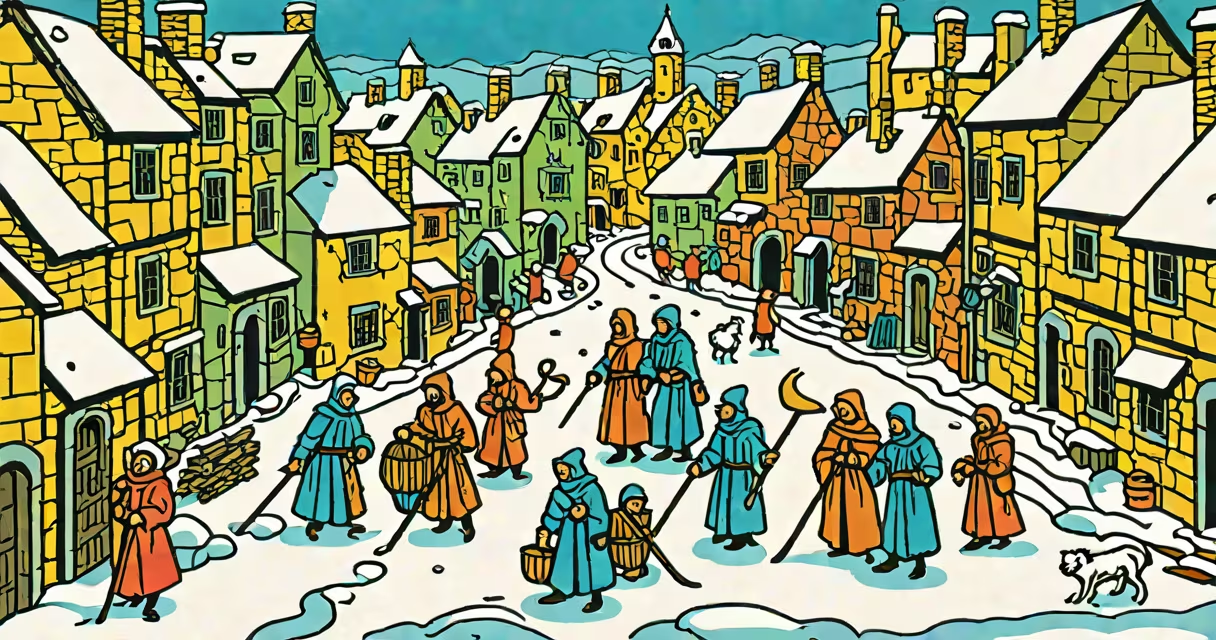
Life during the Black Plague (1347-1351) in Europe was defined by sudden death, mass panic, and the collapse of normal routines. Entire villages vanished, families were torn apart, and religious rituals failed to stop the spread. Survivors lived under constant threat of infection, with no understanding of germ theory or effective medical care.
The plague arrived via merchant ships from Asia, spreading rapidly through trade routes. By 1350, it had killed an estimated 30% to 50% of Europe's population-up to 50 million people. In cities like London and Florence, corpses piled in streets until authorities ordered mass graves. People fled towns, but movement offered little protection. Rural areas saw entire farming communities wiped out, leaving fields untended and harvests lost.
Every aspect of daily existence shifted. Markets closed. Churches held fewer services. Families stopped visiting each other. Children were left orphaned. The dead were buried quickly, often in shallow pits. Survivors reported hearing screams from homes where no one answered the door. There was no precedent for such widespread loss.
The Black Plague was caused by the bacterium Yersinia pestis, carried by fleas on rats. Infected rats rode trade ships from Central Asia into Mediterranean ports. Once ashore, they infested urban centers where poor sanitation and overcrowding accelerated transmission. Fleas bit humans, injecting the bacteria into their bloodstreams.
Three forms of the disease emerged: bubonic (swollen lymph nodes), septicemic (blood infection), and pneumonic (lung infection). Bubonic plague had a 60% fatality rate. Symptoms included fever, chills, vomiting, and painful swellings called buboes. Death often came within days.
Without antibiotics or hygiene practices, people relied on superstition. Some believed the plague was divine punishment. Others turned to astrology or herbal remedies. Monks and priests were overwhelmed. In many places, clergy abandoned their posts due to fear or death. The Church's inability to stop the plague eroded public faith.
Entire villages disappeared. In England, the village of Eyam isolated itself in 1665-not during the Black Plague, but as a later example of quarantine-yet the concept existed then. In 1348, villagers in northern France sealed off their town to prevent entry. They died in place, but no outsiders were infected.
With labor shortages, surviving peasants demanded higher wages. Feudal lords resisted, but the imbalance of power shifted. Wages rose 25% to 50% in some regions. Serfs gained freedom to move. This contributed to the decline of feudalism.
Art reflected despair. Paintings showed skeletons dancing with the living. The Danse Macabre motif appeared in churches across Germany and France. One fresco in the church of San Lorenzo in Florence depicts death leading nobles, peasants, and clergy into the afterlife.
Many assume the plague ended abruptly in 1351. It didn't. Outbreaks recurred for centuries. The Great Plague of London in 1665 killed 100,000 people-about 15% of the city's population. The last major outbreak in Europe occurred in 1720 in Marseille.
Another myth is that the plague only affected cities. Rural populations suffered equally. In parts of rural Italy, entire hamlets were abandoned. Fields lay fallow. Animals roamed freely. The famine that followed the plague killed more people than the disease itself.
Some believe people knew how to avoid infection. They didn't. Doctors wore bird-like masks filled with herbs, believing foul air caused illness. These "plague doctor" costumes were ineffective. The practice of burning aromatic herbs continued for decades despite no scientific basis.
In 1348, Florence lost 45% of its population. Giovanni Boccaccio, who lived through it, wrote in *The Decameron* that "the dead were carried out by the cartload." He described streets choked with corpses and families too afraid to mourn.
In the English town of Eyam, 350 people died out of a population of 350. The village leaders chose to isolate themselves after a cloth merchant brought infected goods. They built a stone wall around the village and refused entry. No one escaped. The sacrifice saved surrounding towns.
Modern genetic analysis confirms the strain of Yersinia pestis found in 14th-century skeletons matches today's version. A 2011 study published in *Nature* analyzed DNA from teeth of plague victims in London and confirmed the pathogen's presence. The study ruled out alternative causes like typhus or smallpox.
Another study from 2017 in *The Lancet Infectious Diseases* estimated that the Black Plague reduced Europe's population from 75 million to 35 million between 1347 and 1351. That's a drop of 53%. The economic impact lasted for generations.
| Aspect | Before the Plague | During the Plague | After the Plague |
|---|---|---|---|
| Population Density | High in cities | Declining rapidly | Recovery took 100+ years |
| Labor Supply | Abundant serfs | Severely depleted | Wages rose 25-50% |
| Religious Authority | Centralized control | Challenged by failure | Church influence declined |
| Medical Practices | Bloodletting, astrology | No effective treatment | Gradual shift toward observation |
I once visited the ruins of a 14th-century monastery in southern France. Inside, a stone slab bore the names of monks who died in 1349. Their deaths were recorded in Latin: "Mortui sunt in die quarta mensis Aprilis." I stood in silence. The weight of that loss felt immediate, not historical.
One overlooked fact: the plague did not kill everyone equally. Wealthier individuals had better access to food, clean water, and isolation. A 2020 study in *PLOS ONE* found that urban elites in Paris were 30% less likely to die than the poor. Social class determined survival odds.
Despite the horror, some communities adapted. In Venice, officials created the first permanent quarantine system in 1423-long after the Black Plague ended. Ships arriving from infected ports had to wait 40 days before docking. The word "quarantine" comes from the Italian *quaranta giorni*, meaning "forty days."
Understanding life during the Black Plague requires rejecting romanticized views. It wasn't a time of noble resistance or heroic saints. It was a period of fear, confusion, and immense suffering. Yet it reshaped Europe's economy, politics, and culture. The trauma lingered for centuries.