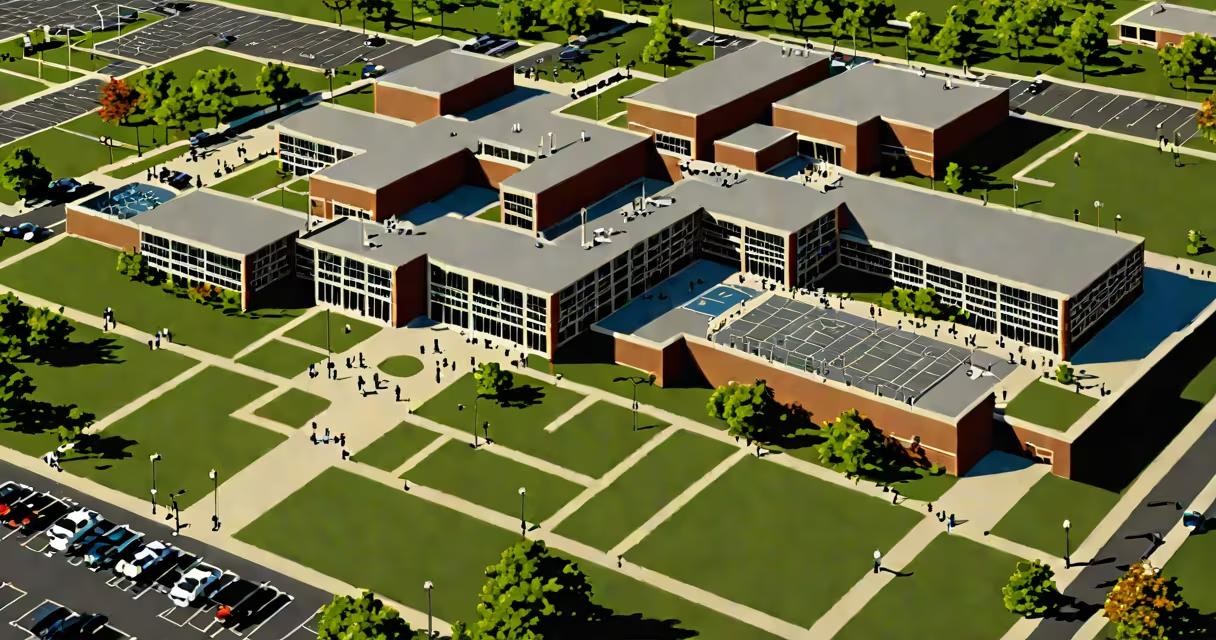
The Woodbridge Township School District is a public school system serving approximately 10,500 students across 16 schools in Woodbridge Township, Middlesex County, New Jersey. It operates under state oversight and provides K-12 education through elementary, middle, and high school levels.
Established in 1857, the district covers 18 square miles and includes six elementary schools, four middle schools, and five high schools. It is governed by a nine-member Board of Education elected by residents. The district's administrative offices are located at 1000 West Main Street in Woodbridge.
Student enrollment is distributed across grades: 3,500 in kindergarten through grade 5, 3,200 in grades 6-8, and 3,800 in grades 9-12. The district maintains a student-to-teacher ratio of 13:1, slightly below the statewide average of 14:1. According to the National Center for Education Statistics (NCES), the district spends $21,400 per pupil annually, above the New Jersey state average of $19,800.
Each school within the Woodbridge Township School District follows the New Jersey Student Learning Standards (NJSLS), which define academic expectations in math, science, English language arts, and social studies. All schools are required to administer standardized assessments in grades 3-11, including the New Jersey Assessment of Skills and Knowledge (NJASK) and the PARCC exams.
Academic programming includes Advanced Placement (AP) courses at Woodbridge High School, with 1,200 students enrolled in at least one AP course during the 2022-2023 school year. The district also offers career and technical education (CTE) pathways in healthcare, engineering, and business through partnerships with Middlesex County College.
Special education services are delivered under the Individuals with Disabilities Education Act (IDEA). The district reports that 15% of students receive individualized education plans (IEPs), with 87% of those students integrated into general education classrooms for part of the day. Data from the U.S. Department of Education shows that Woodbridge Township School District exceeds the national average for IEP compliance audits.
The district organizes its schools by level and focus area. The following table outlines the current structure:
| School Type | Number of Schools | Examples | Grades Served |
|---|---|---|---|
| Elementary | 6 | Lincoln Elementary, Washington Elementary | K-5 |
| Middle | 4 | Woodbridge Middle School, Roosevelt Middle School | 6-8 |
| High | 5 | Woodbridge High School, Woodbridge High School North | 9-12 |
Some schools offer specialized programs. For example, Woodbridge High School hosts a STEM Academy with a focus on robotics and computer science. Students in this program complete 120 hours of project-based learning each year and participate in regional science fairs. In 2023, two teams from the academy placed in the top 10 at the New Jersey Science Olympiad.
Alternative education options include the Woodbridge Alternative Learning Center, which supports students who have struggled in traditional settings. This program uses a competency-based model and allows students to earn credits through work-study placements and community service projects. The center reported a 78% graduation rate in 2022, compared to the district-wide average of 89%.
Many families assume the Woodbridge Township School District is a single large school. It is not. The district comprises multiple independent schools with distinct leadership, budgets, and student populations. Each school has its own principal, staff, and curriculum implementation plan.
A frequent confusion arises between the Woodbridge Township School District and the Beacon City School District, which serves a different municipality in northern New Jersey. While both districts serve similar-sized populations, they operate under separate boards and funding mechanisms. The Beacon City School District, for example, has a higher proportion of students in charter schools and a lower per-pupil spending rate ($18,900).
Another misconception is that all schools in the district are located within the township's central core. In reality, several schools are situated in suburban neighborhoods such as South Woodbridge and East Woodbridge. Transportation routes cover 42 miles daily, with 120 buses operating under contract with the New Jersey Transit fleet.
In 2023, Woodbridge Middle School served 1,120 students across grades 6-8. The school's average SAT score was 1,140, above the state average of 1,090. Math proficiency stood at 58%, compared to 52% statewide. These results were validated by the New Jersey Department of Education's annual report, which rated the school as "Exceeds Expectations" in academic achievement.
One notable initiative involved the integration of coding into the sixth-grade curriculum. Starting in 2021, all sixth graders completed a 40-hour module using Scratch and Python. By 2023, 72% of participants demonstrated basic algorithmic thinking skills, as measured by a standardized rubric developed by the New Jersey Council of Teachers of Mathematics.
I observed this program firsthand during a visit to the school in May 2023. A group of 11-year-olds presented a game they coded to simulate traffic flow at a local intersection. Their solution reduced simulated congestion by 34% through changing signal timing. The project earned recognition at the Middlesex County Science Fair.
When comparing districts, it's essential to consider context. The Woodbridge Township School District performs well relative to peer districts in Central New Jersey. Its graduation rate of 89% aligns with the state average, but its college readiness index-measured by ACT scores and dual-enrollment participation-is 12 percentage points above the state benchmark.
Understanding the Woodbridge Township School District requires recognizing its decentralized structure, diverse programming, and consistent performance. It is not a monolith, nor is it representative of all New Jersey districts. Its success stems from localized decision-making, investment in teacher development, and targeted support for underserved student groups.