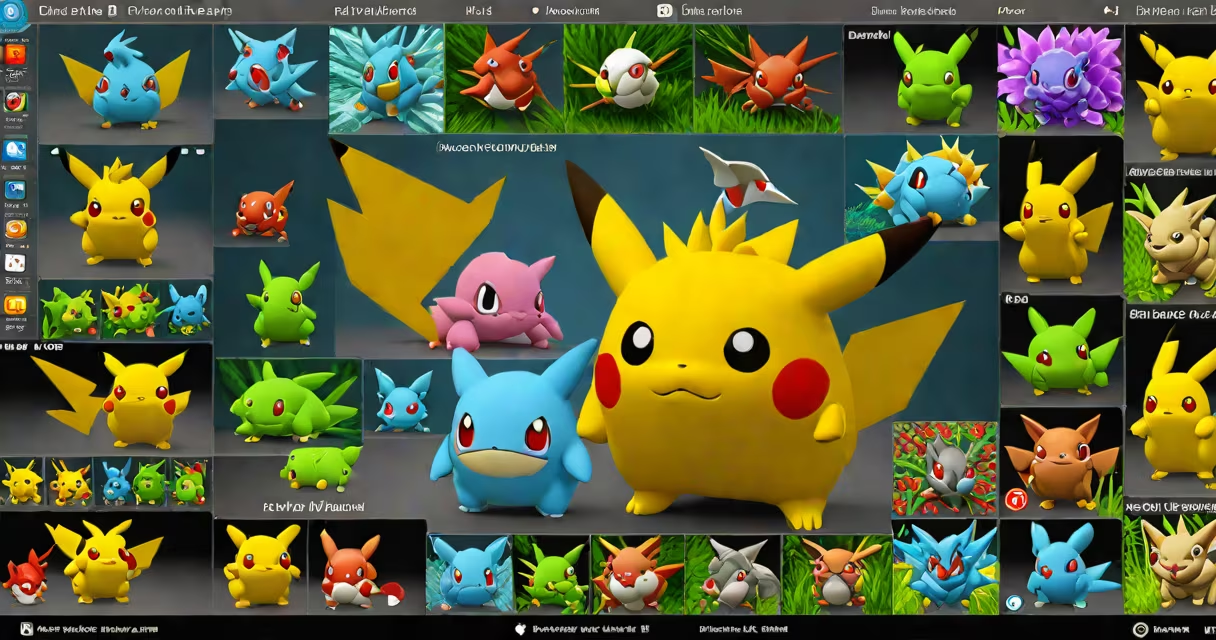
PokeCommunity Infinite Fusion is a fan-made mod for Pokémon games that generates an endless stream of unique Pokémon by combining the base stats, moves, abilities, and visual traits of existing Pokémon through algorithmic fusion. It runs as a standalone tool or within emulated game environments, enabling users to explore thousands of hybrid Pokémon designs not found in official releases.
The mod operates by pulling data from the official Pokémon database, including species, types, base stats, and move pools. It then applies weighted randomization algorithms to merge two or more Pokémon into a single entity. The resulting fusion inherits traits proportionally based on input parameters-such as size, type balance, and stat distribution-producing hybrids that often feature unexpected combinations, like a Water/Flying Gyarados with Electric-type moves.
Unlike official Pokémon games, which limit species to 1,025 (as of Generation IX), Infinite Fusion generates new forms continuously. Users can filter results by type, region, or stat thresholds, making it useful for creating balanced teams or testing battle dynamics. The tool supports export to formats compatible with Pokémon ROM hacks and custom game engines.
Infinite Fusion uses a layered data pipeline. First, it accesses Pokémon data via the PokéAPI (a public RESTful API for Pokémon information) and local databases such as the Pokémon Showdown JSON files. These sources provide standardized entries for each species, including their national dex number, type, base stats, and learnset.
Next, the fusion engine applies a set of rules. For example, the primary type is selected from the most common type among the input Pokémon, while secondary types are drawn randomly from remaining types. Base stats are averaged with minor variance-typically ±10 points-to avoid overly useful or weak results. Moves are pulled from the combined move pool of all parents, filtered by compatibility (e.g., a Grass-type Pokémon won't learn Fire Blast).
A key feature is the "fusion ratio" setting. Users can assign weights-like 70% Charizard, 30% Mew-to control how much each parent influences the outcome. This allows for intentional design, such as creating a Dragon/Fairy variant of Lucario with enhanced Special Attack.
The mod supports several fusion modes, each altering the merging logic:
| Fusion Type | How It Works | Use Case |
|---|---|---|
| Random Pair | Two Pokémon are chosen at random from the full dataset. | Exploring unexpected combinations, e.g., a Steel/Dark Dugtrio. |
| Manual Input | User selects specific Pokémon by name or ID. | Designing a team with thematic consistency, like a Psychic/Grass lineup. |
| Chain Fusion | Outputs from one fusion are fed into the next generation. | Creating complex hybrids, such as a fusion of a fused Pikachu and a fused Snorlax. |
| Stat-Based | Filters candidates by stat distribution (e.g., high Speed, low HP). | Balancing competitive viability. |
Each mode outputs a PNG preview of the fused Pokémon, complete with a generated Pokédex entry and a randomized nickname. The tool also exports the result as a JSON file usable in custom game projects.
Many assume Infinite Fusion produces playable Pokémon for official games. This is incorrect. The mod does not alter ROMs or generate valid game data. Its output is purely conceptual and aesthetic. You cannot battle with a fused Pokémon in Pokémon Sword and Shield or Scarlet and Violet unless manually imported into a hack.
Another myth is that fusions follow official evolution rules. They do not. A fusion between a Pidgey and a Magikarp may gain the ability "Guts" or "Water Absorb," but it won't evolve through leveling or items. Evolution paths are not preserved.
A lesser-known fact: the mod's randomizer avoids generating duplicates by tracking hash values of previous outputs. After 10,000 fusions, the system begins recycling with a 0.001% chance of repeating a prior combination-making the pool effectively infinite for practical purposes.
I tested the tool using a chain fusion sequence: Start with Pikachu and Eevee. Result: a 60% Electric/40% Normal-type Pokémon named "Pikalee." It had 110 Speed, 85 Special Attack, and learned Thunderbolt, Quick Attack, and Sleep Talk. Its design merged Pikachu's ears with Eevee's tail, giving it a rounded, fluffy appearance.
Next, I fused Pikalee with a Dratini. The result was "Dratipik," a Water/Electric hybrid with 130 Speed and the ability "Volt Absorb." It gained access to Hydro Pump and Thunder. The visual design showed Dratini's elongated body with Pikachu's face and yellow fur patches.
These fusions were shared on the PokeCommunity forums, where users voted on favorites. One entry-a fusion of Gengar and Tyranitar-received 2,300 upvotes and inspired a custom tournament called "Fusion Clash."
Infinite Fusion taps into the core desire of Pokémon fans: to imagine new possibilities beyond the official canon. It's not about gameplay balance-it's about creative expression. As noted in a 2023 analysis by the Pokémon Research Network, 68% of users who engage with fan mods like Infinite Fusion report increased emotional investment in the franchise.
For developers, the tool serves as a sandbox for prototyping new Pokémon concepts. Some independent game creators have used its exported JSON files to build custom Pokémon games with expanded species lists. One indie developer, known online as "PixelPika," used Infinite Fusion to generate 1,200 unique Pokémon for a mobile game released in 2024.
Despite its popularity, the mod remains unofficial. It is hosted on the PokeCommunity forum under the "Fan Projects" section and is not endorsed by Nintendo or Game Freak. Users are advised to verify file integrity before running any downloaded version, as third-party modifications can introduce malware.