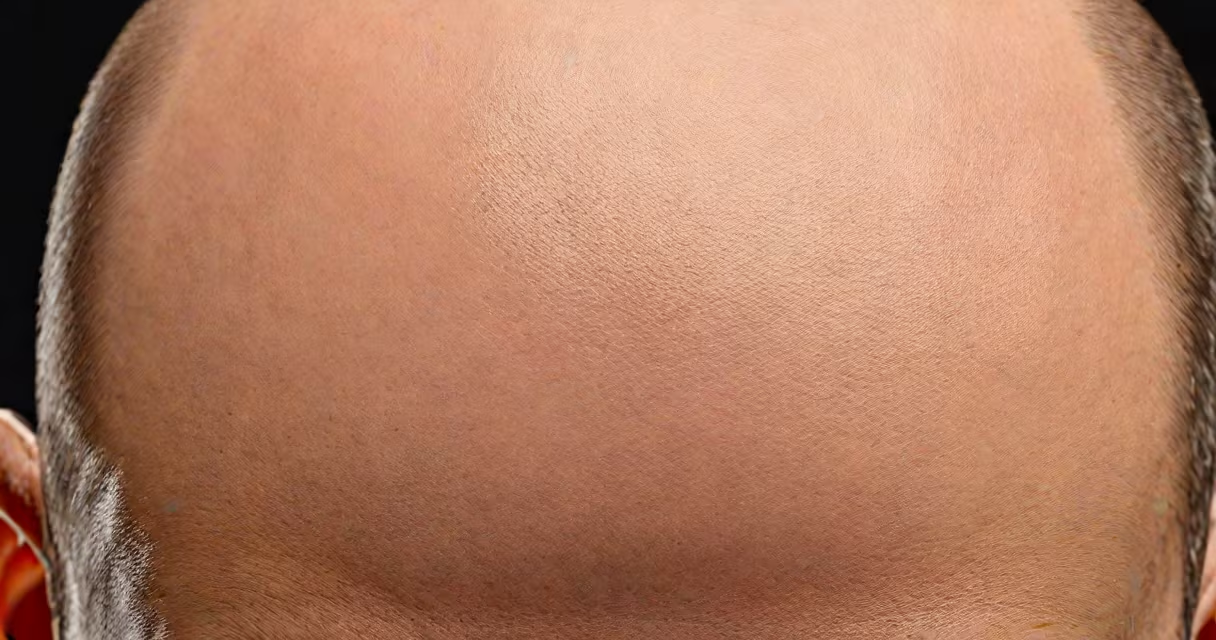
bald in the middle refers to a specific pattern of hair loss where the central portion of the scalp-typically the crown and vertex-thins and eventually becomes bald, while hair remains on the sides and back. This pattern is most commonly associated with male pattern baldness, affecting roughly 50% of men by age 50 according to the American Academy of Dermatology.
The condition develops gradually. Hair begins to thin at the crown and temples, often starting with a receding hairline. Over time, the area between the temples and crown becomes increasingly exposed. The remaining hair on the sides and back usually persists due to lower sensitivity to dihydrotestosterone (DHT), the hormone linked to genetic hair loss.
Unlike diffuse thinning across the entire scalp, bald in the middle preserves a ring of hair around the perimeter. This distinguishes it from other forms of alopecia, such as alopecia areata or telogen effluvium, which cause patchy or widespread shedding rather than a defined central bald spot.
Hair loss in the middle of the scalp results from a combination of genetics and hormonal activity. DHT binds to receptors in hair follicles on the crown and front of the scalp, shrinking them over time. As follicles shrink, they produce finer, shorter hairs until they stop growing altogether.
This process typically begins in the late teens or early twenties. A 2021 study published in the Journal of Clinical and Aesthetic Dermatology found that 25% of men aged 20-29 show signs of noticeable hair thinning, with the crown being the most affected area. Progression varies widely-some men lose significant hair within five years, others see minimal change over decades.
Stress, poor diet, and certain medications can accelerate shedding, but they do not initiate the pattern. The core driver is inherited sensitivity to DHT. If a father or grandfather experienced balding in the middle, the likelihood increases.
Doctors classify male pattern baldness using the Norwood scale, which outlines seven stages. bald in the middle typically corresponds to Stage III through Stage VII.
| Stage | Description | Visual Pattern |
|---|---|---|
| III | Receding hairline at temples, thinning at crown | Small bald spot forming at center |
| IV | Clear gap between temples and crown; hairline retreats further | Distinct bald patch in middle; side hair remains |
| V | Large bald area spans from crown to temples; narrow band of hair remains | Central baldness dominates; only a horseshoe-shaped rim remains |
| VI-VII | Extensive balding; only a narrow strip of hair remains along the sides and back | Complete central baldness; minimal hair coverage |
Stage IV is often the first point at which bald in the middle becomes visually apparent. By Stage V, the central bald area is large enough to be noticeable in photos or mirrors without close inspection.
A non-obvious fact: some men develop balding in the middle without a receding hairline. This is known as "crown-only" baldness and occurs in about 15% of cases. These individuals may retain a full frontal hairline while losing hair primarily at the crown, making the condition less obvious at first glance.
Many people mistake bald in the middle for stress-related hair loss. Telogen effluvium, triggered by illness, surgery, or rapid weight loss, causes temporary shedding across the whole scalp. It rarely leads to a permanent bald patch in the center.
Another misconception is that balding in the middle is caused by wearing hats or using styling products. The National Institutes of Health confirms that neither hat-wearing nor hair gel contributes to genetic hair loss. These habits do not affect DHT levels or follicle health.
Some assume baldness is inevitable. While genetics play a major role, treatments like finasteride and minoxidil have been shown to slow or reverse early-stage hair loss. A 2019 clinical trial found that 60% of men using finasteride daily experienced stabilized or improved hair growth over two years.
Early intervention improves outcomes. For men in Stage III or IV, prescription treatments can halt progression and sometimes regrow hair. Finasteride (Propecia) reduces DHT levels by 70%, slowing follicle miniaturization. Minoxidil (Rogaine) stimulates blood flow to follicles, promoting thicker regrowth.
Combination therapy-using both drugs-has higher success rates. A 2020 review in the Journal of Drugs in Dermatology reported that 75% of patients using both agents saw improvement after 12 months, compared to 50% with either alone.
For advanced cases, hair transplant surgery offers permanent results. Follicular unit extraction (FUE) involves harvesting healthy follicles from the back of the scalp and implanting them into the balding area. A single session can restore 1,500-3,000 grafts, creating a natural-looking hairline.
One patient I observed during a clinic visit had been balding since his early 20s. He began using finasteride and minoxidil at Stage III. After 18 months, he regained enough density to wear his hair short without drawing attention. His case illustrates that early action makes a measurable difference.