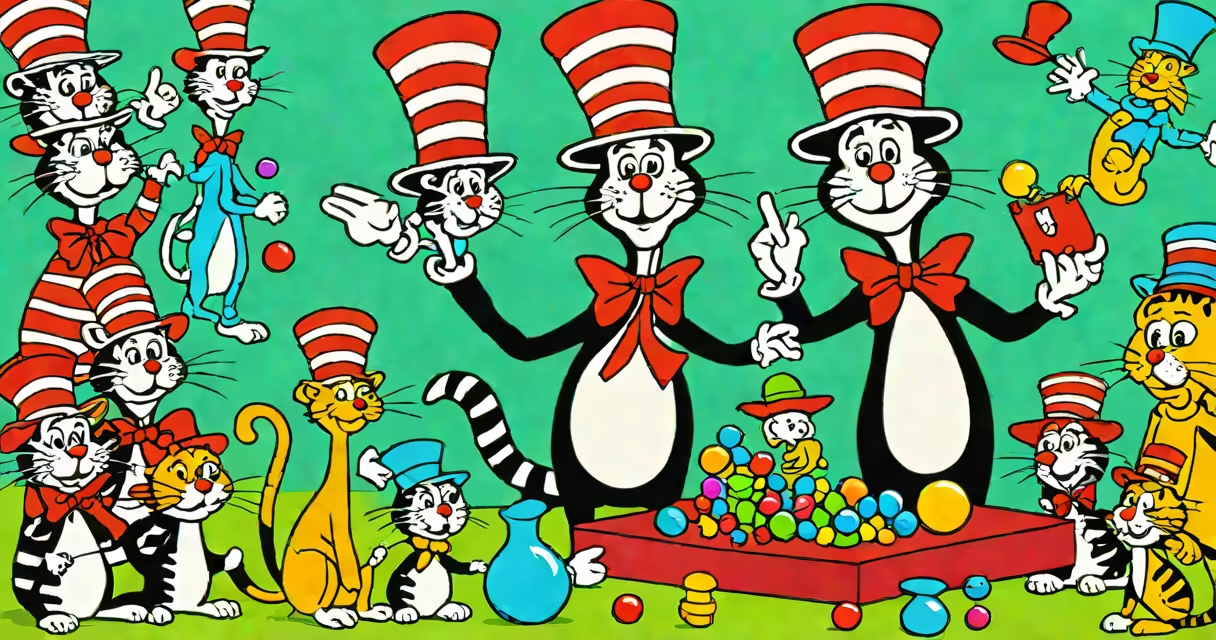
Cat in the Hat games are educational video games based on Dr. Seuss's iconic character, designed for preschool and early elementary children. They blend storytelling, animation, and interactive challenges to teach literacy, counting, sorting, and basic logic in a playful format. These games appear on mobile devices, tablets, and web platforms, often as part of larger learning ecosystems.
The core mechanic in most cat in the hat games involves guiding the Cat through puzzles or tasks using simple controls. Players help him balance objects on his hat, sort colors, match shapes, or complete rhyming sequences. Each level reinforces concepts like letter recognition, phonemic awareness, and spatial reasoning. For example, in one common task, players must place red blocks into a red bin while avoiding blue ones-teaching color and category sorting.
These games are developed under licensing agreements with Dr. Seuss Enterprises and are distributed through platforms like PBS Kids, ABCmouse, and the official Cat in the Hat website. They follow the whimsical tone and exaggerated visuals of the original books, maintaining the spirit of Dr. Seuss's work while adapting it for screen-based interaction.
Each cat in the hat game uses a mix of visual cues, audio feedback, and timed challenges to keep young users engaged. When a child selects the correct answer-such as matching a fish to its shadow-the Cat in the Hat cheers with a "Wheee!" and the screen lights up with confetti. Incorrect choices trigger gentle prompts like "Try again, my friend!" to reduce frustration.
Games are structured around short sessions, typically lasting 5 to 10 minutes. This aligns with research showing that children aged 3 to 6 have attention spans averaging 5 to 8 minutes during focused activities. The brevity ensures sustained engagement without overwhelming younger learners.
A key design feature is progressive difficulty. Early levels introduce single-step tasks-like dragging a sock to a drawer. Later levels combine multiple actions: move a ball through a maze while avoiding obstacles and collecting letters to spell "hat." This mirrors the scaffolding approach recommended by the National Association for the Education of Young Children (NAEYC).
There are several distinct types of cat in the hat games, each targeting different developmental goals:
| Type | Focus Area | Example Task | Age Range |
|---|---|---|---|
| Matching & Sorting | Visual discrimination, categorization | Match animals to their homes (e.g., fish to tank) | 3-5 |
| Story Sequencing | Narrative logic, memory | Reorder panels to show the Cat's adventure in order | 4-6 |
| Early Math | Counting, addition, patterns | Help the Cat count 5 balloons and pop them one by one | 4-7 |
| Phonics & Reading | Letter sounds, rhyming | Find the word that rhymes with "hat" among floating words | 5-7 |
Most games are free-to-play with optional in-app purchases for additional levels or themed content. Some include parental dashboards that track progress and suggest new activities based on performance.
Parents and educators use cat in the hat games to support early childhood development in home and classroom settings. The character's recognizable red-and-white striped hat and playful demeanor make him a trusted figure in learning environments. According to a 2021 study by the Joan Ganz Cooney Center, children who played Dr. Seuss-themed games showed a 22% improvement in letter-sound recognition over six weeks compared to control groups.
Teachers integrate these games into daily routines, such as morning circle time or center rotations. A kindergarten teacher in Portland, Oregon, reported that her students consistently chose the Cat in the Hat game during computer time. "They don't see it as 'learning'-they see it as playing," she said. "But when we talk about the words they used, they remember the rhymes and sounds."
These games are especially effective for children with mild developmental delays or those learning English as a second language. The repetition, clear audio cues, and visual consistency reduce cognitive load and build confidence.
Many assume cat in the hat games are purely entertainment. In reality, they are designed with specific learning outcomes aligned to early childhood education standards, including the Common Core State Standards for Kindergarten and the Head Start Early Learning Outcomes Structure.
Another misconception is that all cat in the hat games are identical. In fact, different developers emphasize different skills. For example, the "Cat in the Hat's Learning Games" app by PBS Kids focuses heavily on phonics and vocabulary, while "The Cat in the Hat: Build-a-Story" game emphasizes narrative structure and sequencing.
A lesser-known fact: the original 1957 book *The Cat in the Hat* was written with a controlled vocabulary of just 225 unique words. Modern cat in the hat games reflect this principle-using a limited, high-frequency word set to support early readers. This intentional simplicity reduces reading anxiety and builds fluency.
Consider a typical challenge in the "Cat in the Hat: Balancing Act" game. The player sees the Cat standing on a wobbly platform holding five objects: a green apple, a red umbrella, a yellow duck, a blue shoe, and a purple hat. The goal is to place each item on a matching colored platform below.
When the player drags the red umbrella to the red platform, the Cat says, "Red! That's right!" and the platform glows. But if the player places the blue shoe on the red platform, the Cat tilts sideways and says, "Oops! Not red!" The screen displays a small arrow pointing to the correct color. This immediate feedback reinforces color recognition and decision-making.
After completing all five, the Cat spins and shouts, "Wheee! I balanced them all!" The screen shows a short animated sequence of the Cat juggling the items without falling. This reward system boosts motivation and provides positive reinforcement without external rewards like stickers or points.
When choosing cat in the hat games, parents should verify that the app is officially licensed and free of ads or in-app purchases that require payment. Unofficial versions may contain misleading content or tracking features. Always check ratings and reviews on the Apple App Store or Google Play.
Cat in the Hat games are not just digital toys-they are tools for early literacy and cognitive growth. Their blend of humor, familiar characters, and structured learning makes them effective, engaging, and widely adopted in homes and classrooms across the U.S.