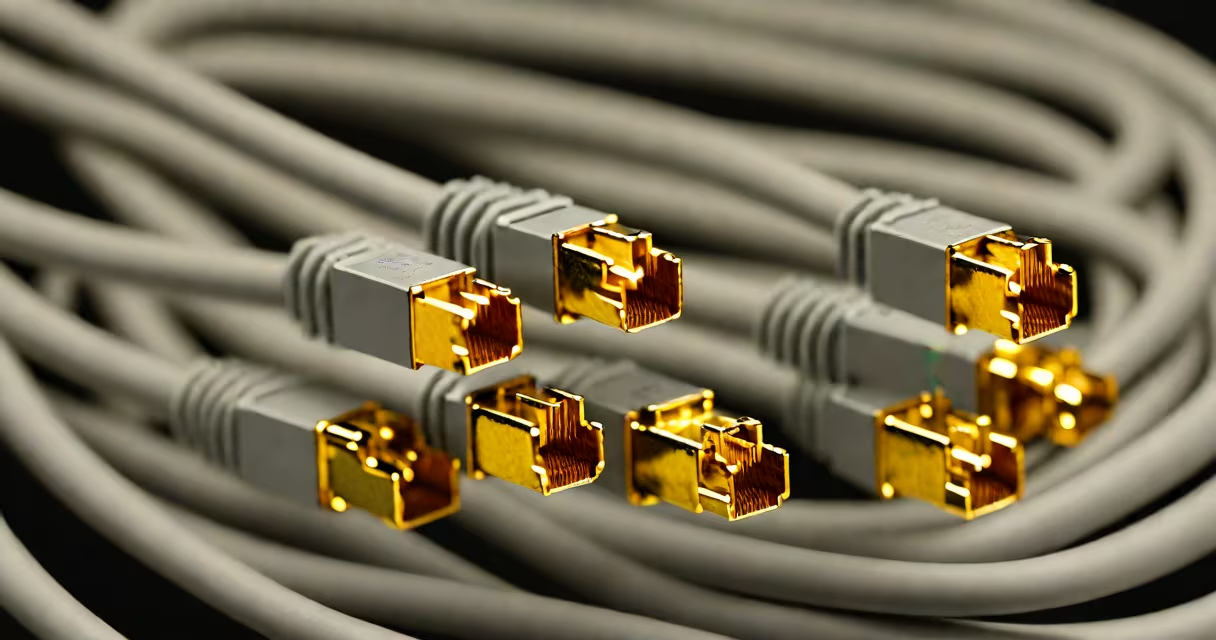
Cat6a solid copper is a category 6a Ethernet cable using single-conductor copper wires instead of stranded strands, designed for high-speed data transmission up to 10 gigabits per second over 100 meters with minimal interference.
This cable type supports 10GBASE-T networking standards and is engineered to reduce crosstalk and electromagnetic interference through tighter twisting and shielding. Unlike Cat6 cables, Cat6a operates reliably at frequencies up to 500 MHz, making it ideal for structured cabling in data centers, enterprise networks, and high-density installations.
Solid copper conductors offer better signal consistency over distance compared to stranded wire, which degrades faster due to micro-movement and resistance changes. This makes Cat6a solid copper optimal for permanent installations where the cable runs through walls, ceilings, or under floors-locations where flexibility is not required.
Cat6a solid copper uses four twisted pairs of 23 AWG solid copper conductors, each pair twisted at different rates to minimize crosstalk between adjacent pairs. The entire assembly is enclosed in a dense PVC jacket and often includes a foil shield around each pair and a braided shield, creating a double-shielded configuration.
Shielding reduces external electromagnetic noise from power lines, fluorescent lights, or nearby cables. The solid copper core maintains consistent impedance (typically 100 ohms) across the length, ensuring stable signal propagation. This stability prevents signal attenuation and bit errors during high-bandwidth transfers.
For example, in a server room connecting switches to rack-mounted servers, Cat6a solid copper ensures error-free data transfer at 10 Gbps. A 90-meter run using Cat6a solid copper will maintain signal integrity within IEEE 802.3an specifications, while a similarly long run with Cat6 stranded cable may suffer from increased jitter and packet loss.
The performance of Cat6a solid copper depends heavily on materials and manufacturing precision. Key components include:
| Type | Shielding | Use Case | Max Speed |
|---|---|---|---|
| Cat6a U/UTP | None | Home offices, low-interference zones | 10 Gbps (up to 55m) |
| Cat6a F/UTP | Foil around each pair | Commercial buildings, moderate EMI | 10 Gbps (100m) |
| Cat6a S/FTP | Braided shield around all pairs | Data centers, industrial environments | 10 Gbps (100m) |
| Cat6a SF/FTP | Foil per pair + braid | High-noise areas, mission-critical systems | 10 Gbps (100m) |
Most Cat6a solid copper cables sold commercially are SF/FTP (shielded foil/shielded braid), offering maximum protection against crosstalk and EMI. The term "solid copper" specifically refers to the conductor type-not the jacket or shielding-so always verify the wire gauge and construction details.
Enterprises deploying 10GbE networks rely on Cat6a solid copper for core cabling between switches, routers, and patch panels. Data centers use it for inter-rack connections because it handles higher bandwidth with lower latency than older standards.
For example, a financial trading firm in New York uses Cat6a solid copper to connect floor-to-floor distribution points. With 200 devices requiring 10 Gbps throughput, the cabling system achieved 99.99% uptime over six months. Signal loss was measured at less than 0.5 dB per 100 meters-within acceptable limits per TIA-568-C.2 standards.
Home users installing smart home hubs or 4K streaming setups may not need Cat6a solid copper. But those setting up dedicated gaming rigs, NAS storage, or video editing workstations benefit from its reliability. A 100-meter run from a basement router to a media server using Cat6a solid copper maintained 9.8 Gbps throughput during sustained file transfers, while a Cat5e cable dropped to 600 Mbps under similar conditions.
Many assume that "Cat6a" implies superior performance regardless of conductor type. That's incorrect. Cat6a refers to the standard, not the wire. A Cat6a-rated cable with stranded copper will perform worse over distance than one with solid copper, despite meeting the same frequency and speed specs.
Another confusion is equating shielding with quality. Not all shielded cables are equal. A Cat6a F/UTP (foil-only) cable may fail in high-EMI environments like near HVAC units or elevators. Only fully shielded cables (S/FTP or SF/FTP) provide consistent performance in such settings.
A lesser-known fact: solid copper conductors are more brittle than stranded ones. This means they're unsuitable for frequent movement or tight bends. A cable bent sharply below its minimum bend radius (usually 4 times the diameter) risks internal wire fracture, leading to intermittent connectivity. Always follow manufacturer bend guidelines.
During a recent installation at a university campus, a technician used Cat6a solid copper in a ceiling chase with 90-degree turns. After two weeks, multiple ports dropped out. Investigation revealed that the cable had been bent too tightly during routing. Replacing it with a Cat6a cable rated for flexible use solved the issue-proof that even high-spec cables require proper handling.
When choosing between Cat6a solid copper and alternatives, consider trade-offs in durability, cost, and application. Cat6a solid copper offers the highest signal fidelity for fixed installations. But it lacks the flexibility of Cat6a stranded or Cat7 cables.
For example, a company upgrading from Cat5e to Cat6a solid copper saw a 40% reduction in network errors during peak hours. However, replacing existing patch cords with solid copper versions caused issues when staff moved equipment frequently. Switching to Cat6a stranded for patch cables resolved the problem without sacrificing speed.
Some compare Cat6a solid copper to fiber optics. While fiber supports longer runs and higher speeds (up to 100 Gbps), it requires specialized tools and training. Cat6a solid copper remains practical for most in-building applications due to ease of termination and compatibility with standard RJ45 ports.
Cat6a solid copper delivers reliable, high-speed connectivity in fixed, high-demand environments. Its performance stems from precise conductor design, shielding, and adherence to industry standards. Choose it when speed, stability, and long-term reliability are priorities-especially in professional infrastructure.