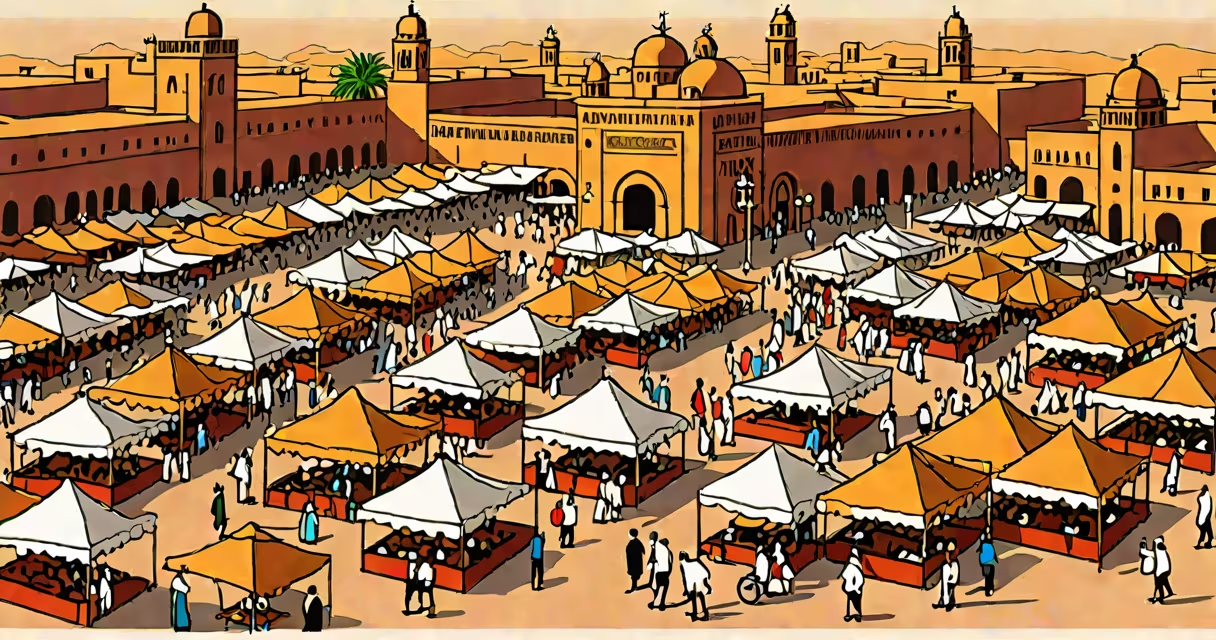
Marrakech's top sights include the bustling Jemaa el-Fna square, the ornate Bahia Palace, the serene Majorelle Garden, and the historic Koutoubia Mosque. These landmarks reflect centuries of Berber, Arab, and Islamic influence, forming a layered urban experience shaped by trade, craftsmanship, and spiritual life.
Jemaa el-Fna is the city's beating heart. By day, it hosts snake charmers, storytellers, and fruit juice vendors. By night, it transforms into a food market where grilled lamb, harira soup, and mint tea fill the air. The square lies at the center of the medina, a UNESCO World Heritage site since 1985 due to its intact medieval layout and cultural continuity.
The medina itself is a maze of narrow alleys lined with shops selling spices, leather goods, and handwoven textiles. Its architecture uses mudbrick (adobe), carved stucco, and zellige tilework-geometric patterns made from small ceramic pieces. These materials regulate temperature in the desert climate, keeping interiors cool during summer heat.
| Sight | Best Time to Visit | Entry Fee (2024) | Notes |
|---|---|---|---|
| Jemaa el-Fna | Evening (6-10 PM) | Free | Street performances begin at dusk; avoid crowds during Ramadan |
| Bahia Palace | Afternoon (1-4 PM) | 100 MAD (~$10 USD) | Open Tues-Sun; closes early on Fridays |
| Majorelle Garden | Morning (8-10 AM) | 150 MAD (~$15 USD) | Includes Yves Saint Laurent Museum; book online to skip lines |
| Koutoubia Mosque | Daytime (9 AM-4 PM) | Free (non-Muslims cannot enter) | Visible from many points in the city; photo spot at sunset |
Not all attractions are public. The Saadian Tombs, discovered in 1917 under a garden, remain a private site managed by the Ministry of Culture. Entry requires a ticket, but the interior-featuring marble sarcophagi, carved cedar ceilings, and a central courtyard-is among the most preserved royal tombs in North Africa. The site was buried for nearly 300 years after the fall of the Saadian dynasty in 1668.
Many visitors mistake the El Badi Palace ruins for a single structure. In reality, it was a 16th-century complex built by Sultan Ahmad al-Mansur to rival the wealth of European courts. After his death, construction halted. Today, only foundations and fragments of columns remain. The site is best visited at midday when sunlight casts long shadows across the rubble, revealing the original scale.
A lesser-known but essential stop is the Musée de Marrakech, housed in the Dar Si Said palace. This museum displays traditional Moroccan crafts: Berber carpets, metal lanterns, and ceramics from the Atlas Mountains. Admission includes access to the rooftop terrace, which offers panoramic views of the city's red walls and the snow-capped High Atlas peaks beyond.
One non-obvious fact: Marrakech's medina has no numbered streets. Addresses are based on neighborhood names and landmark proximity. A visitor might be told "near the fountain behind the spice shop" rather than "Avenue Mohammed V, 12." This system persists because the city's layout hasn't changed since the 11th century.
For a complete experience, combine sightseeing with a guided walking tour. Local guides often speak Arabic, French, and English. They explain architectural details-like the use of muqarnas (stalactite-like vaulting) in the Ben Youssef Madrasa-and share stories about the city's history. A two-hour tour costs around 300 MAD (~$30 USD) and covers five major sites.
I spent a morning exploring the souks with a guide who pointed out the difference between hand-dyed indigo and synthetic blue in the dyehouses near the Mellah quarter. He showed me how saffron threads are sorted by color intensity and explained why the scent of dried rose petals is stronger in the afternoon. That day, I bought a small bag of rosewater and a pair of leather slippers made in the nearby artisan district.
Some travelers confuse Marrakech with Fes, another imperial city in Morocco. While both have medinas and mosques, Fes preserves older urban planning and more religious schools. Marrakech, by contrast, is more commercial and tourist-focused. Its architecture emphasizes decoration over function-highly carved gates, colorful tiles, and fountains in courtyards.
For those planning ahead, consider visiting in spring (March-May) or autumn (September-November). Temperatures average 20-28°C (68-82°F), avoiding the extreme heat of June-August (up to 45°C/113°F). During Ramadan, many shops close earlier, and street food stalls operate only after sunset.
When planning your trip, prioritize sites that open late in the day-like the gardens and palaces-to avoid midday heat. Bring water, sunscreen, and a hat. Dress modestly when entering religious sites. And always negotiate prices in markets beforehand-vendors expect haggling.
Understanding what to see in Marrakech means seeing beyond the postcard view. The city thrives on contrasts: quiet courtyards beside noisy alleys, ancient rituals alongside modern cafes. Each site tells a story of resilience, artistry, and adaptation across time.