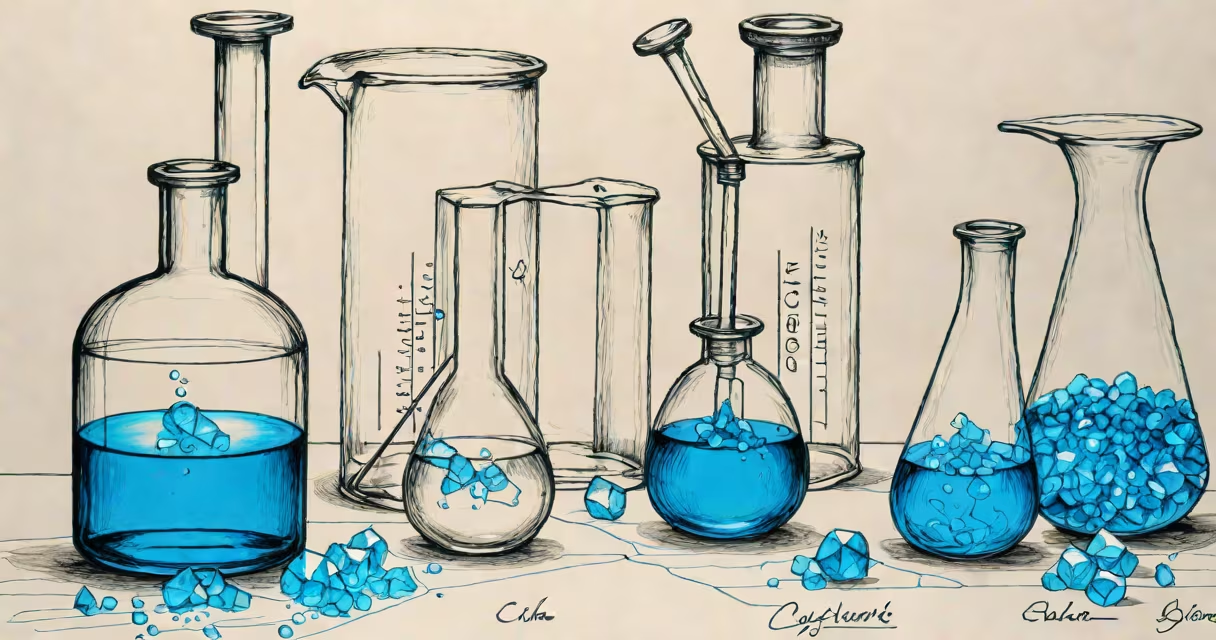
Inorganic chemistry focuses on compounds that lack carbon-hydrogen bonds, including metals, salts, acids, and coordination complexes. These substances form the foundation of materials science, industrial manufacturing, and biological systems.
Unlike organic chemistry, which centers on carbon-based molecules like proteins and plastics, inorganic chemistry deals with elements and their interactions beyond hydrocarbons. This includes minerals, catalysts, semiconductors, and metal ions essential in biological processes such as oxygen transport in hemoglobin.
Reactions in inorganic chemistry often involve electron transfer, acid-base behavior, or ligand exchange. These processes govern everything from battery function to pollution control. For example, the formation of rust (iron oxide) results from oxidation in the presence of water and oxygen-a classic inorganic redox reaction.
Inorganic compounds fall into several categories based on structure and bonding. The most prevalent are ionic compounds, coordination complexes, and network solids.
Salts like sodium chloride (NaCl) form through ionic bonding between metals and nonmetals. They dissolve in water to produce mobile ions, enabling electrical conductivity. This property makes NaCl important in electrolysis and biological fluid balance.
Coordination complexes feature a central metal ion bonded to surrounding ligands via coordinate covalent bonds. Hemoglobin's iron center binds oxygen through such a mechanism. Another example is cisplatin, a platinum-based compound used in chemotherapy, where the Pt²⁺ ion coordinates with nitrogen atoms in DNA bases, disrupting replication.
| Type | Structure | Example | Use Case |
|---|---|---|---|
| Binary ionic | Simple cation-anion lattice | Sodium chloride (NaCl) | Food seasoning, deicing roads |
| Acidic oxides | Nonmetal + oxygen | Sulfur trioxide (SO₃) | Production of sulfuric acid |
| Coordination complex | Central metal + ligands | Cisplatin [Pt(NH₃)₂Cl₂] | Cancer treatment |
| Network solid | Extended covalent lattice | Quartz (SiO₂) | Optical fibers, watches |
Many everyday materials arise from inorganic chemistry. Concrete relies on calcium silicate hydrates formed during cement hydration. Glass, primarily composed of silicon dioxide (SiO₂), is shaped by controlled melting and cooling to prevent crystallization.
Industrial catalysts often involve transition metals. Iron in the Haber-Bosch process converts nitrogen and hydrogen into ammonia-an essential step in fertilizer production. Without this inorganic reaction, global food supply would collapse due to nitrogen deficiency.
Another example is titanium dioxide (TiO₂), used in paints, sunscreens, and toothpaste. Its high refractive index scatters light effectively, making it ideal for opacity. The pigment is produced via the sulfate or chloride process, both relying on inorganic reactions at elevated temperatures.
People often confuse inorganic compounds with synthetic ones. Not all man-made chemicals are inorganic. Plastics, for instance, are organic despite being manufactured. Conversely, many inorganic compounds occur naturally-such as calcite (CaCO₃) in limestone or hematite (Fe₂O₃) in iron ore.
A frequent error is assuming that inorganic chemistry lacks complexity. Coordination compounds like those in vitamin B₁₂ (cobalamin) contain complex ring structures and cobalt ions coordinated to nitrogen atoms. The molecule's function in methyl transfer reactions depends entirely on its inorganic core.
Inorganic chemistry is not limited to metals. Nonmetals form key inorganic species: ammonia (NH₃), phosphoric acid (H₃PO₄), and boron trifluoride (BF₃) are all nonmetal-based and essential in agriculture, cleaning agents, and semiconductor doping.
I once observed the color change in a solution of potassium permanganate (KMnO₄) during titration. As the purple MnO₄⁻ ions reacted with reducing agents like oxalic acid, they turned from deep violet to pale brown Mn²⁺. The transformation occurred in distinct steps, each corresponding to a different oxidation state. This visual shift illustrates how inorganic redox chemistry drives analytical techniques used in labs worldwide.
The boundary between organic and inorganic chemistry lies in the presence of carbon-hydrogen bonds. Carbon dioxide (CO₂) contains carbon but no hydrogen, so it is classified as inorganic. Similarly, cyanide (CN⁻) is inorganic despite containing carbon because it lacks C-H bonds.
Even some carbon-containing compounds are inorganic. Calcium carbonate (CaCO₃), found in seashells and antacids, is inorganic. It forms through precipitation in aqueous solutions and plays a role in carbon cycling. According to the Royal Society of Chemistry, this classification reflects historical usage rather than molecular structure alone.
Another non-obvious fact: some inorganic compounds exhibit properties typically associated with organic materials. For example, certain metal-organic frameworks (MOFs) combine metallic nodes with organic linkers but are studied under inorganic chemistry due to their stability and catalytic functions. However, MOFs remain a hybrid field, not strictly inorganic.
Ammonium nitrate (NH₄NO₃) is a widely used fertilizer and explosive. Its production involves two inorganic reactions:
NH₃(g) + HNO₃(aq) → NH₄NO₃(aq)This exothermic process releases heat and forms an aqueous salt solution.
Each mole of NH₃ reacts with one mole of HNO₃ to yield one mole of NH₄NO₃. A 100 kg batch requires approximately 64 kg of ammonia and 136 kg of nitric acid. The reaction is monitored using pH sensors to ensure complete neutralization and avoid acidic or basic impurities.
This example shows how inorganic chemistry enables large-scale agricultural support. Global production exceeds 20 million metric tons annually, according to the U.S. Geological Survey.
Understanding examples of inorganic chemistry reveals how fundamental these reactions are to daily life-from the air we breathe to the medicines we take. From the rust on a car to the titanium in a hip replacement, inorganic chemistry shapes the physical world around us.