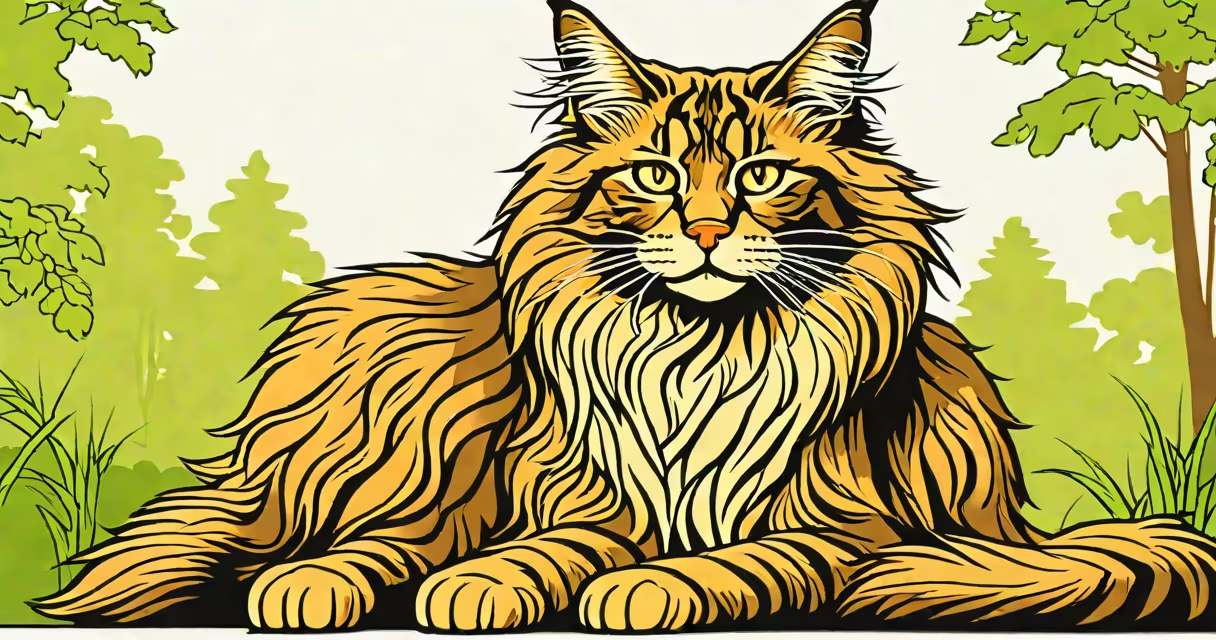
The Maine Coon is a large, long-haired domestic cat breed known for its thick, water-resistant coat, tufted ears, and expressive eyes. Originating in the U.S. state of Maine, it is one of the oldest natural breeds in North America, recognized for its gentle temperament and distinctive physical traits.
Maine Coons typically weigh between 13 and 18 pounds, with males often reaching 20 pounds or more. Their bodies are muscular and rectangular in shape, with a broad chest and sturdy limbs. This build supports their reputation as one of the largest domestic cat breeds. According to the Cat Fanciers' Association (CFA), the breed standard specifies a "long, rectangular body with a well-muscled frame," emphasizing proportionality over extreme size.
Coat texture and length are defining features. Maine Coons have a dense double coat-soft undercoat and coarse outer guard hairs-that resists moisture and cold. This adaptation helped them survive harsh New England winters. The fur is longer on the neck, chest, and tail, forming a ruff and plume-like tail tip. Tufts of hair grow between the toes, acting like snowshoes on icy terrain. These traits are genetically linked to the breed's survival in northern climates.
Maine Coons possess a unique face structure. Their muzzle is moderately long and slightly rounded, giving them a fox-like expression. The jawline is strong, and the cheeks are full, contributing to a broad, triangular-shaped head. The ears are large and set wide apart, with prominent tufts at the tips-known as "lynx tips"-that improve hearing and provide insulation.
Eyes are large, oval, and set at a slight angle. They come in various colors, including green, gold, copper, and blue, though green and gold are most common. Eye color may change during kittenhood; many kittens are born with blue eyes that darken by six months of age. The CFA notes that eye color should be in balance with coat color and facial structure.
A common misidentification occurs with Norwegian Forest Cats, which share similar coat thickness and ear tufts. However, Norwegian Forest Cats tend to have a more compact body and shorter legs. Maine Coons are taller at the shoulder and have a longer stride. A side-by-side comparison shows that Maine Coons display a more elongated spine and a greater sense of height and presence.
Maine Coons are known for their dog-like loyalty and playful nature. They often follow their owners around the house, enjoy being involved in daily activities, and respond to their name. Unlike many cats, they frequently vocalize-not with loud meows, but with soft chirps, trills, and purrs. This vocalization pattern is called "chirping" and is a sign of the breed.
They are highly social and generally get along well with children, other pets, and strangers. Their calm demeanor makes them suitable for households with multiple animals. A 2021 study published in *Frontiers in Veterinary Science* found that Maine Coons scored higher on sociability scales compared to other breeds, particularly in interactions with unfamiliar people.
One non-obvious trait is their affinity for water. Many Maine Coons enjoy playing with running taps, splashing in sinks, or even swimming. This behavior is rare among cat breeds and likely stems from their ancestral adaptation to wet, forested environments. Observing a cat dipping a paw into a bowl of water or chasing a floating toy is a strong behavioral clue.
Some people mistake large, fluffy cats like Persians or Ragdolls for Maine Coons due to their size and long coats. However, these breeds differ in body shape and movement. Persians have flat faces, short legs, and a rounder body. Ragdolls are smaller, with a more delicate frame and a tendency to go limp when picked up-a trait absent in Maine Coons.
Another misconception is that all Maine Coons are aggressive or overly dominant. In reality, they are consistently ranked among the most affectionate and low-aggression breeds. The American Society for the Prevention of Cruelty to Animals (ASPCA) lists Maine Coons as one of the top five most family-friendly cat breeds based on temperament surveys.
Even within the breed, variation exists. Some Maine Coons have a more pronounced ruff, others less. Coat patterns include tabby, solid, bi-color, and calico. A single cat may have a mix of colors and patterns, especially in the wild-type tabby markings on the face and legs. This diversity can confuse owners who expect uniformity.
Consider a cat named Max found at a local animal shelter. He weighs 16 pounds, stands 14 inches tall at the shoulder, and has a long, muscular body. His fur is medium-long, thick, and water-resistant. He has tufted ears, a bushy tail, and a ruff around his neck. His eyes are large and golden, set at a slight angle. When approached, he walks up, rubs against the handler's leg, and chirps softly.
These traits align with the CFA breed standard. The combination of size, coat, facial structure, and behavior strongly indicates a Maine Coon. A DNA test confirmed his lineage, showing 98% match to purebred Maine Coon markers. This example illustrates how visual and behavioral cues, combined with breed standards, allow accurate identification.
| Breed | Body Shape | Ear Tufts | Coat Type | Vocalization |
|---|---|---|---|---|
| Maine Coon | Long, rectangular, muscular | Prominent, with lynx tips | Dense double coat, water-resistant | Chirps, trills, soft meows |
| Norwegian Forest Cat | Long, broad, sturdy | Prominent, tufted | Dense double coat, weatherproof | Mellow, low-pitched meows |
| Persian | Compact, round-bodied | Small, minimal tufts | Very long, silky, prone to matting | Soft, quiet purring |
| Ragdoll | Medium-large, delicate frame | Medium-sized, tufted | Long, semi-wool, low-shedding | Low-volume, melodic meows |
When evaluating a cat's breed, rely on multiple physical and behavioral indicators rather than a single feature. A cat with long fur and big ears might still be a mixed breed. Confirming a Maine Coon requires consistency across size, coat, facial structure, and temperament.