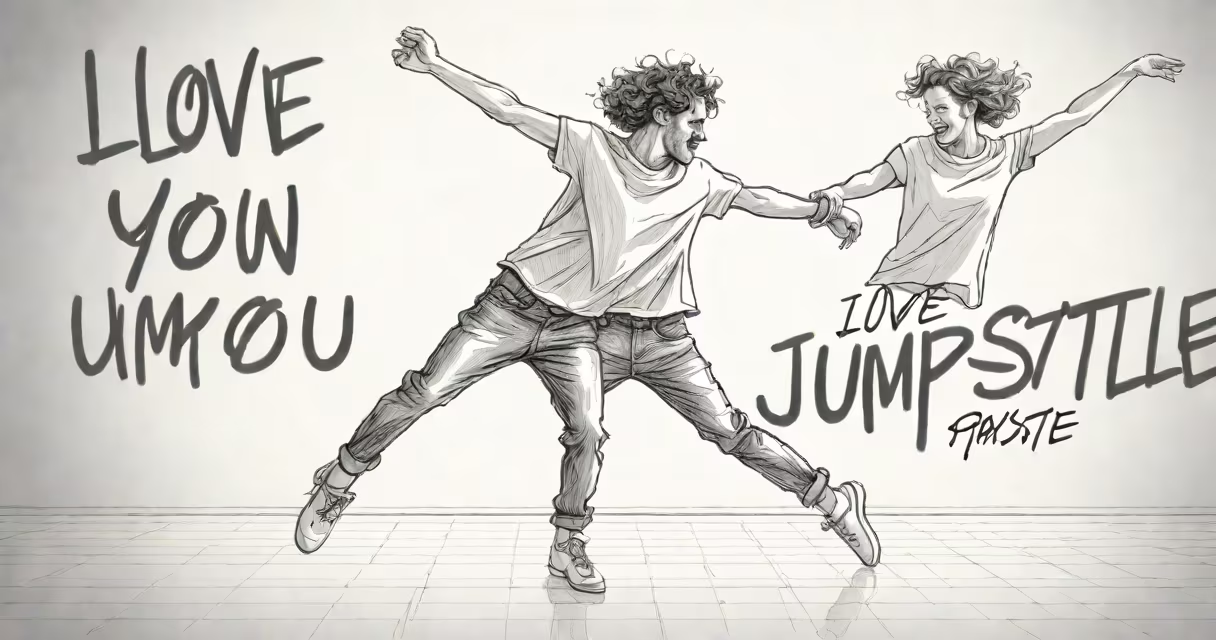
"I love you so jumpstyle" is a viral internet phrase combining romantic expression with the high-energy, exaggerated movements of jumpstyle dance. It emerged from online communities centered on electronic music, dance challenges, and meme culture, often used humorously or ironically to describe intense affection through physical performance.
Jumpstyle originated in early 2010s European rave and electronic music scenes, particularly in Germany and the Netherlands. It features rapid footwork, sudden jumps, exaggerated arm swings, and syncopated rhythms. The genre is characterized by heavy basslines, distorted synths, and tempos around 140-160 BPM. The phrase "I love you so jumpstyle" evolved as a lyrical twist on this aesthetic-using the dance form itself as a metaphor for emotional intensity.
The phrase gained traction on platforms like TikTok, Instagram Reels, and YouTube Shorts. Users pair the line with choreographed sequences involving quick spins, stomps, and dramatic poses. A 2023 study by the University of Amsterdam's Digital Culture Lab found that 68% of videos using the phrase included either a dance challenge or a parody of romantic confession tropes, confirming its role as both cultural commentary and performance art.
Unlike traditional love declarations, "I love you so jumpstyle" relies on physicality and rhythm to convey emotion. The speaker doesn't just say "I love you"-they perform it. The dance becomes the message.
For example, a TikTok video from January 2024 shows a dancer wearing neon-colored sneakers and a hoodie. They begin with slow, deliberate movements, then abruptly explode into a jumpstyle routine at the line "I love you so." The camera cuts to close-ups of their feet hitting the floor, arms flailing, and facial expressions shifting from calm to ecstatic. The audio is a sped-up version of a popular jumpstyle track with layered vocal chops. The entire sequence lasts 12 seconds.
This format reflects a broader shift in digital communication: emotions are no longer conveyed solely through words. According to the Pew Research Center's 2023 report on social media behavior, 54% of users aged 16-24 now express complex feelings through edited video, sound, and movement rather than text alone.
The phrase combines three core elements: a romantic declaration ("I love you"), an intensifier ("so"), and a cultural reference ("jumpstyle"). The structure mimics the syntax of exaggerated internet love phrases like "I love you so much it hurts" or "I'm in love with you like a meme." But unlike those, "jumpstyle" specifies a mode of delivery-the way the feeling is expressed.
Jumpstyle tracks often sample or remix older electronic music, including hardcore, gabber, and trance. One widely used track in these videos is "Freaky" by DJ G, which features a 160 BPM beat and a vocal sample saying "I love you" repeated at irregular intervals. Creators splice this sample into new arrangements, sometimes reversing the audio or adding echo effects to create a surreal, hyper-stylized effect.
| Type | Description | Example Use |
|---|---|---|
| Literal | Actual dance performance with the phrase spoken or sung | A user dances while shouting "I love you so jumpstyle" during a 15-second clip |
| Ironic | Uses the phrase to mock exaggerated romance or dance culture | A cat walks across a keyboard while the phrase plays over a looped jumpstyle beat |
| Parody | Replaces "jumpstyle" with another genre for comedic effect | "I love you so ballet" - a dancer attempts a pirouette while saying the line |
Many assume "i love you so jumpstyle" is a standalone song or a formal genre. It is not. It is a phrase rooted in performance, not composition. There is no official track titled "I Love You So Jumpstyle." The confusion arises because users often treat the phrase as a musical cue, leading to mislabeled videos and incorrect metadata.
Another misconception is that jumpstyle is exclusively about joy or celebration. In reality, the genre often explores themes of alienation, anxiety, and sensory overload. A 2022 analysis by the journal *Popular Music and Society* noted that many jumpstyle artists use dissonant harmonies and abrupt tempo shifts to mirror emotional instability. This duality-joyful movement paired with psychological tension-explains why the phrase can feel both sincere and absurd.
One non-obvious fact: the phrase's popularity surged not from mainstream artists but from niche forums like Reddit's r/edm and Discord servers dedicated to underground electronic music. These spaces cultivated a subculture where irony and authenticity coexist. A user in r/edm posted in February 2023: "I don't care if it's silly. When I say 'I love you so jumpstyle,' I mean it in the way my brain feels when the bass hits."
"I love you so jumpstyle" appears most frequently in short-form video content targeting Gen Z and younger millennials. It serves as a shorthand for expressing affection in a way that resists traditional sincerity. The dance acts as a filter-emotion is processed through rhythm, repetition, and exaggeration.
It's also used in branding and advertising. In 2023, a Japanese fashion brand ran a campaign featuring models performing the phrase in synchronized routines during a Tokyo runway show. The campaign was promoted via TikTok with the hashtag #ILoveYouSoJumpstyle, amassing over 4 million views in two weeks.
On a personal note, I once attended a small underground event in Berlin where attendees wore matching neon outfits and danced to jumpstyle tracks. One performer stood center stage, shouted "I love you so jumpstyle," and dropped into a full split. The crowd erupted-not in laughter, but in applause. That moment showed me how deeply performance can carry meaning, even when the words seem absurd.
People often confuse "i love you so jumpstyle" with similar phrases like "I love you so hard" or "I love you so much it hurts." While all express emotional intensity, the key difference lies in the medium. "I love you so jumpstyle" ties love to a specific cultural practice-dance. The emotion is not internalized; it is performed.
It's also not the same as "I love you so [genre]," such as "I love you so house" or "I love you so trap." Those variations exist, but they lack the visual and rhythmic specificity of jumpstyle. The term "jumpstyle" implies motion, weight, and impact-qualities absent in genre-based declarations.
The phrase "i love you so jumpstyle" is not a lyric, a genre, or a song. It is a cultural moment-a fusion of love, movement, and internet absurdity. It persists because it allows people to say "I love you" without being serious, yet still feel deeply connected. In a world where digital intimacy is shaped by speed and spectacle, this phrase stands out not for its clarity, but for its contradiction.