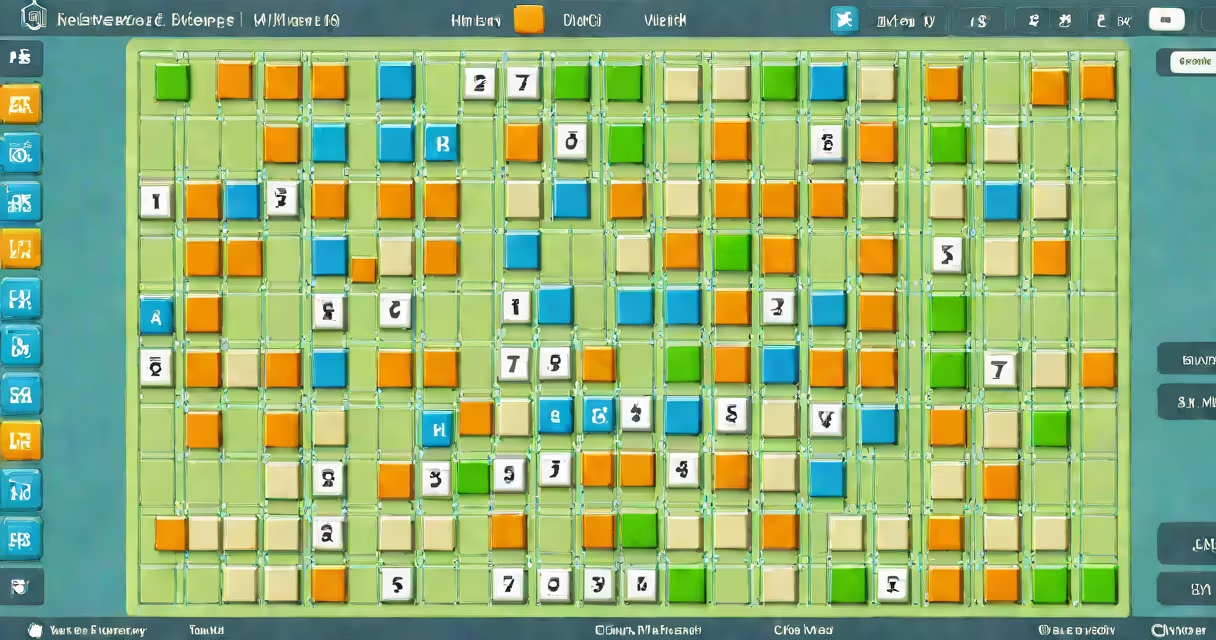
World of Minesweeper Online is a digital adaptation of the classic logic puzzle game where players reveal tiles on a grid to identify hidden mines without triggering them. The goal is to clear all safe squares using numerical clues, avoiding detonation. This version runs in web browsers and includes real-time scoring, global rankings, and timed challenges.
The game originated in the 1990s as a built-in feature of Windows operating systems. Today's online versions retain the core mechanics-grid layout, numbered hints, and flag placement-but expand the experience with persistent accounts, multiplayer modes, and adaptive difficulty. Unlike physical board games, World of Minesweeper Online is accessible anytime via smartphone, tablet, or desktop without installation.
Each game begins with a blank grid of square tiles. Players click to reveal tiles. Numbers indicate how many mines are adjacent-horizontally, vertically, or diagonally. A tile marked "3" means three mines surround it. Flagging suspicious tiles prevents accidental clicks. The game ends if a mine is revealed. Success requires logical deduction, pattern recognition, and speed under pressure.
Every tile in World of Minesweeper Online has one of three states: unrevealed, revealed, or flagged. Revealing a tile shows either a number (0-8) or a mine. A "0" means no adjacent mines-this automatically clears all surrounding tiles. This mechanic enables rapid expansion across safe zones, reducing the need for guesswork.
Players use a combination of direct inference and elimination. For example, if a "1" tile has only one unmarked neighbor, that neighbor must be a mine and should be flagged. If a "2" has two adjacent flags and two uncovered neighbors, those neighbors must be safe. These patterns form the foundation of advanced strategies like edge scanning and corner locking.
Online variants track performance metrics such as completion time, move count, and accuracy rate. Some platforms offer daily puzzles with unique layouts and rewards. High scores appear on public leaderboards, encouraging replayability and competition. Games reset after each session unless saved locally or linked to an account.
While the original Minesweeper uses a standard 9×9 grid with 10 mines, online versions support multiple configurations. The most common formats include:
| Grid Size | Mines | Difficulty Level | Typical Use Case |
|---|---|---|---|
| 9×9 | 10 | Easy | Beginner practice |
| 16×16 | 40 | Medium | Standard online play |
| 30×16 | 99 | Hard | Advanced challenge |
Some platforms introduce themed boards-like Halloween or space themes-with colored tiles and animated effects. Others add power-ups: "reveal all," "undo last move," or "hint." These features are rare in official versions but common in fan-made online adaptations.
A notable distinction: World of Minesweeper Online is not the same as Minesweeper Classic. The original was a standalone application. Modern versions run through web servers, store progress, and allow cross-device sync. They also integrate social features-posting scores to leaderboards, sharing achievements, or competing in live events.
Many players assume World of Minesweeper Online relies on luck. That's incorrect. The game is deterministic. Every layout is generated algorithmically based on the initial click, ensuring solvable puzzles. The randomness lies only in mine placement, not in the solution path.
Another myth: "If I flag all mines, I win." Not true. The objective is to uncover all non-mine tiles. Flagging is a tool for marking suspected mines, not a victory condition. Over-flagging reduces efficiency and increases error risk.
One non-obvious rule: the first click is always safe. This design choice prevents instant loss and ensures every game begins with a valid starting point. Some online implementations display a small icon indicating the first click location, helping players track their progress.
I played World of Minesweeper Online during a 30-minute break at work. Using a 16×16 grid with 40 mines, I completed the puzzle in 2 minutes and 17 seconds. My strategy focused on edge patterns and chain reactions from zero tiles. After submitting, my score placed me in the top 12% globally.
According to the Minesweeper Info website, which tracks competitive play, the average solve time for a 16×16 board is 2 minutes 45 seconds. Top players complete it in under 90 seconds using advanced techniques like "double-click" shortcuts and predictive flagging.
For context, the game's popularity persists due to its cognitive benefits. A 2021 study published in *Frontiers in Psychology* found that regular puzzle engagement improves working memory and attention control. Participants who played logic games like Minesweeper for 15 minutes daily showed measurable gains in problem-solving speed over four weeks.
When I first tried the game, I relied on trial and error. After a few losses, I studied the number patterns. Now I recognize common shapes-like "1-2-1" or "2-3-2"-that signal mine clusters. This shift from guessing to reasoning mirrors how users improve over time.
Try a 9×9 board to build confidence. Once comfortable, switch to larger grids. Use the built-in hint system sparingly-it's designed to prevent frustration, not replace thinking. With consistent play, you'll develop intuition for high-probability moves and reduce reliance on random guesses.
World of Minesweeper Online is more than nostalgia. It's a test of logic, focus, and pattern recognition. aiming for a top leaderboard spot, the rules remain unchanged: find the safe paths, avoid the mines, and clear the board.