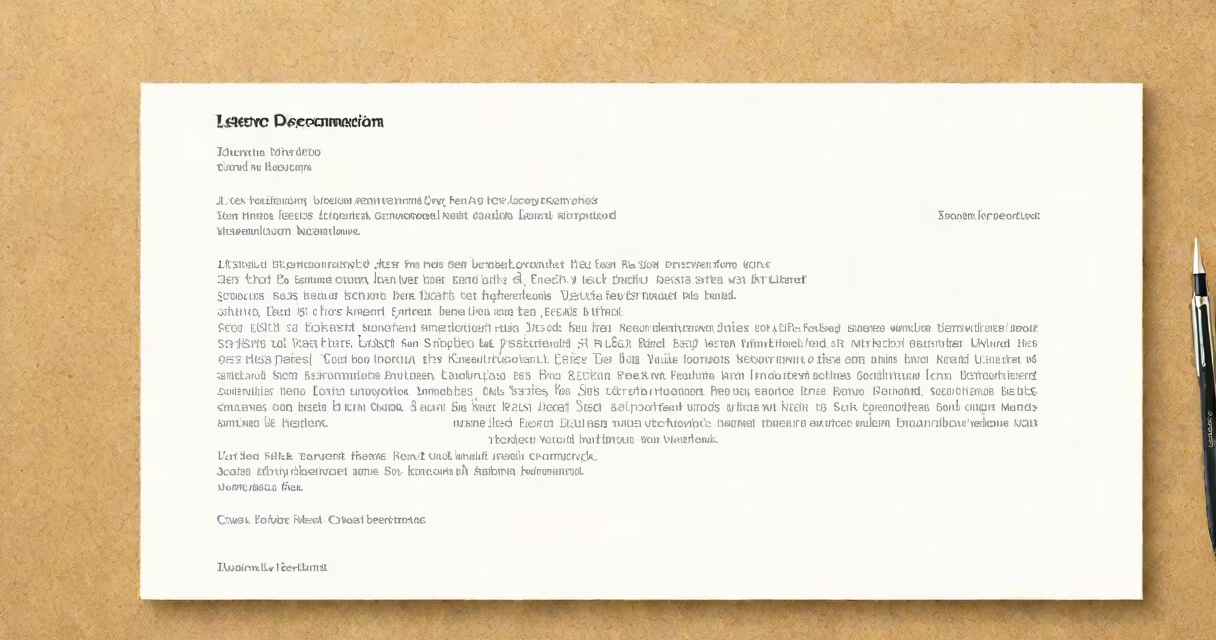
A letter of recommendation template Word is a preformatted document in Microsoft Word designed to help users write consistent, professional letters endorsing someone's qualifications for academic programs, jobs, or awards. It includes placeholder text, structured sections, and formatting that aligns with formal standards.
These templates are built using Word's built-in styles and layout tools. They typically include fields for the recommender's contact details, date, recipient information, body paragraphs with space for specific examples, and a formal closing. Users replace placeholders with personal details and tailor content to the individual being recommended.
For example, a professor writing for a student applying to medical school might use a template with sections labeled "Academic Performance," "Research Experience," and "Personal Qualities." The template ensures all required elements appear in a logical order and maintain consistent font size, spacing, and margins-critical for credibility.
When you open a letter of recommendation template Word file, you see a structured layout with instructions in gray text or brackets. These cues guide you through filling in blanks such as [Your Name], [Institution], or [Student's Name]. You replace each placeholder with actual information and rewrite the narrative content to reflect the person's achievements.
Templates often include predefined formatting-like 12-point Times New Roman, double spacing, and 1-inch margins-to meet submission guidelines. Many schools and employers require these specifications. Using a template reduces errors and saves time compared to building a letter from scratch.
Word's "Track Changes" feature lets you review edits before finalizing. You can also save versions under different names, such as "Recommendation - Sarah Chen - Medical School Final," to track revisions.
There are several standard types of recommendation letters, each suited to a different context. The most common are academic, employment, and scholarship recommendations.
| Type | Best For | Typical Length | Key Sections |
|---|---|---|---|
| Academic | College, grad school, fellowship applications | 1-2 pages | Coursework performance, research involvement, intellectual curiosity |
| Employment | Job offers, promotions, internships | 1 page | Work ethic, project outcomes, leadership examples |
| Scholarship | Funding for students based on merit or need | 1 page | Financial situation, community service, long-term goals |
For instance, a biology professor writing for a student applying to a PhD program might show lab skills, independent thinking, and publication contributions. A template tailored for graduate admissions would prompt the writer to include metrics like GPA, class rank, or hours spent in research.
Some templates include optional sections for rating scales (e.g., "On a scale of 1-5, how would you rate their problem-solving ability?"). These are useful for institutions that collect standardized data across submissions.
People often mistake a letter of recommendation template Word for a generic cover letter or a personal statement. While all three are formal documents, they serve distinct purposes. A cover letter introduces the applicant to an employer. A personal statement explains the applicant's motivations. A recommendation letter speaks on behalf of the applicant from a third-party perspective.
Another confusion arises around whether templates are acceptable. Some applicants worry that using a template makes the letter seem impersonal. But according to the National Association of Colleges and Employers (NACE), 89% of hiring managers prefer letters that follow a clear structure-so long as the content remains authentic and customized.
A template is not a substitute for personal insight. A strong letter must include specific anecdotes, such as "During the 2023 summer research project, she identified a flaw in the data model that improved accuracy by 17%." Generic praise like "She is hardworking" lacks impact and weakens the letter's credibility.
Many users assume that downloading a template is the same as creating a document from scratch. But templates preserve formatting, default fonts, and layout settings. A blank Word document resets to default settings, which may not match institutional requirements.
For example, a university application portal may require PDFs with 11-point Calibri, 1-inch margins, and no headers. A template designed for that institution ensures compliance. A blank document risks misalignment, especially if the user forgets to adjust settings.
I once reviewed a graduate school application where the recommendation letter was sent as a PNG image because the writer had used a custom font and embedded graphics. The admissions committee rejected it due to formatting issues. A properly configured template avoids such problems.
Suppose you're a high school teacher recommending a student for a national science competition. You download a "letter of recommendation template Word" from a trusted education site. The file opens with:
You replace the bracketed fields with real data. Then, in the body, you expand on the student's work:
Maria Lopez demonstrated strong analytical skill during her senior project on solar panel efficiency. She conducted 14 experiments over six weeks, documented results in a detailed lab notebook, and presented findings at our regional STEM symposium. Her final design increased energy conversion by 22% compared to baseline models.
After adding a closing paragraph affirming her readiness for advanced study, you save the file as "Recommendation_Maria_Lopez_NSF_2024.docx" and send it as a PDF.
This process takes less than 15 minutes and produces a polished, compliant letter.
Reputable sources include the American Psychological Association (APA) website, university career centers, and official government portals. Avoid third-party sites offering free templates with hidden ads or malware. Always scan downloads with antivirus software.
For example, the University of Michigan's Career Center provides downloadable templates in .docx format, including options for academic, internship, and faculty references. These are vetted for clarity and professionalism.
Using a letter of recommendation template Word doesn't lower quality-it raises consistency and professionalism. When done correctly, it ensures every letter meets standards while allowing room for personal voice and evidence-based claims.
Always proofread before sending. Check spelling, grammar, and alignment with the recipient's guidelines. A well-crafted letter of recommendation template Word is a tool, not a shortcut. Its value lies in how thoughtfully it's adapted to the individual and purpose.